
If you're searching for a Water Softener System Near Me in Los Angeles, you're probably already dealing with the signs. White spots on glasses. Soap that won't rinse clean. Dry skin after a shower. A water heater that seems to work harder than it should. In LA, those aren't minor annoyances. They're usually clues that hard water is subtly affecting fixtures, appliances, and daily comfort.
This isn't a niche home upgrade anymore. The U.S. water softening systems market was valued at USD 716.3 million in 2024 and is projected to reach USD 1,190.5 million by 2032, according to Fortune Business Insights on the U.S. water softening systems market. That matters because it shows softening is a mainstream infrastructure decision for homes and businesses, especially in hard-water regions.
In Los Angeles, the right answer usually isn't “buy the cheapest box online and hope it works.” The right answer is to match the system to the water, the building, and the way people use water inside that property. That's where many local searches go off track.
Your Guide to Solving Los Angeles Hard Water Problems
Los Angeles water users usually notice hard water before they know what to call it. Faucets develop crusty buildup. Shower glass clouds over fast. Coffee equipment, dishwashers, and water heaters start showing the wear that scale causes over time. Homeowners feel it as inconvenience. Restaurants and property managers feel it in maintenance calls.
Why local context matters
A search for a Water Softener System Near Me is really a search for a local solution. LA properties vary widely. A condo in Burbank, a single-family home in the Valley, and a restaurant in West LA don't have the same plumbing layout, fixture count, or daily demand pattern.
That's why generic advice often fails. A system that works fine in one home can be undersized, oversized, or the wrong technology in another.
For a practical primer on common symptoms and causes, Praz offers a useful guide on how to get rid of hard water.
What smart buyers focus on first
The strongest buying decisions usually start with four questions:
What problem are you solving
Are you trying to stop scale, improve soap performance, protect equipment, or address drinking-water concerns too?How much water does the property use
A small household and a busy food-service operation need very different equipment.Where should treatment happen
Some buildings need whole-home treatment. Others benefit more from targeted treatment at hot water lines, kitchen equipment, or drinking-water points.Who will maintain the system
A softener that looks affordable at installation can become frustrating if upkeep is ignored.
Hard water problems look simple from the outside. The fix usually isn't simple until someone measures the water and maps the usage.
A practical Los Angeles example
A homeowner may call because towels feel stiff and the water heater has started making noise. A restaurant owner may call because glassware doesn't come out clean and dish equipment needs frequent descaling. Both cases point to hard water, but the system recommendation won't be the same.
That's the difference between shopping by symptom and solving by diagnosis.
What a Water Softener Does and What It Does Not Do
A water softener is a specific tool for a specific job. It handles hardness minerals. It does not solve every water-quality issue in the building.
What it does
The EPA explains that water softeners use cation-exchange resins to swap hardness ions like calcium and magnesium for sodium or potassium ions, which prevents the scale that damages pipes and appliances. You can review that mechanism in the EPA's water softeners technical sheet.
In plain terms, the softener removes the minerals that leave deposits behind.
That matters most in places where hard water hits equipment every day:
Water heaters
Scale collects where water is heated first.Dishwashers and glasswashers
Mineral spotting and film become a constant complaint.Shower valves and fixtures
Buildup shortens service life and affects appearance.Boilers and hot-water systems
Commercial equipment pays the price faster when scale is ignored.
A simple way to think about it
Think of a softener as a gatekeeper. It's built to catch the minerals that create scale problems before that water moves through the building. If the issue is calcium and magnesium, a properly selected softener is directly relevant.
If the issue is chlorine taste, lead concerns, PFAS, nitrates, or microbiological contamination, a softener is not the device that addresses those problems.
What it does not do
Many buyers find themselves misled. A softener does not function like an all-purpose filter. It doesn't remove many contaminants people worry about when they notice bad taste, odor, or safety concerns.
That's why local searches often stall after installation. The scale problem improves, but the customer still doesn't like the drinking water.
For households wondering why softened water may taste different, this article on water taste salty with a water softener helps explain one common concern.
Practical rule: If your complaint includes “my water tastes bad” or “I'm worried about contaminants,” don't assume a softener alone is the answer.
A real-world example
A family in LA may hate soap scum, rough laundry, and white buildup around faucets. A softener directly addresses that type of hardness problem.
A different property may have those same symptoms plus concern about drinking water at the kitchen sink. In that case, the practical solution is often a softener for scale control and a separate filtration or reverse osmosis solution for drinking water.
That distinction saves people money. It also prevents the common mistake of buying one system and expecting it to do two different jobs.
Decoding Your Options Types of Water Softener Systems
Most buyers don't need more brand names. They need clarity on how each system type behaves in a real property.
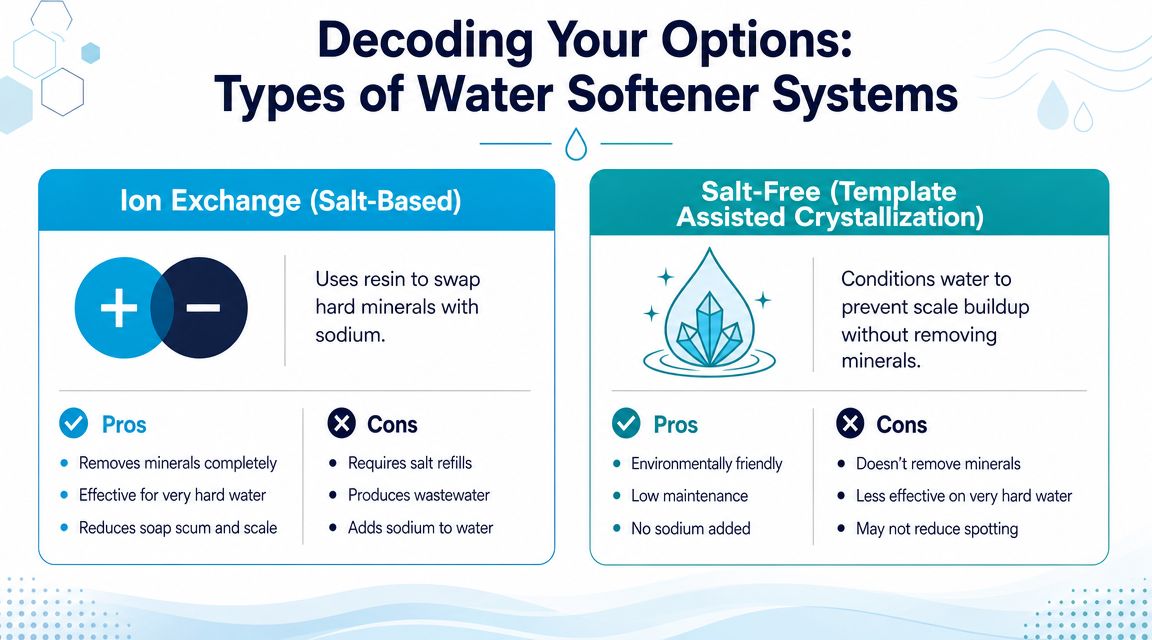
A useful starting point is this comparison visual.
Salt-based ion exchange systems
This is the standard solution when the goal is to remove hardness minerals and stop scale at the source. These systems use resin and regeneration cycles to exchange calcium and magnesium for sodium or potassium.
For many LA homes, this is the most direct answer when the complaint is heavy scale, stiff laundry, or frequent appliance buildup.
A typical use case is a family home where residents want softer water across showers, laundry, and hot-water equipment. If the sizing is correct and maintenance stays on schedule, these systems are usually the most effective at true softening.
Trade-offs to expect
Strong scale control
This is the main advantage.Regular upkeep
Salt or potassium replenishment and periodic service are part of ownership.Drain and installation planning
Placement matters, especially in tighter mechanical spaces.
Salt-free conditioning systems
Salt-free units are often marketed as softeners, but that creates confusion. They don't remove hardness minerals in the same way a salt-based softener does. They condition water to reduce scale formation behavior.
For some properties, that difference matters a lot. If a homeowner expects silky shower feel and full mineral removal, a salt-free unit may not match the expectation. If the goal is reducing scale potential with lower maintenance and without salt handling, it may be a reasonable fit.
This is often attractive to owners who want less maintenance and who understand they are choosing conditioning, not full softening.
Dual-tank systems
Dual-tank systems are built for higher and more continuous demand. When one tank is regenerating, the other remains in service.
That setup makes practical sense for:
Restaurants
Soft water demand doesn't pause during service.Multi-family properties
Water use is spread across more people and longer time windows.Large homes
High fixture counts can push a single-tank system hard.
Here's a useful walkthrough for buyers comparing complete treatment setups, especially when softening may need to work alongside filtration: best water filtration system for whole house.
A short video can also help clarify how system types differ in day-to-day use.
Rent or buy
Renting appeals to people who want predictable service and less maintenance responsibility. Buying appeals to owners who want long-term control over the equipment and are comfortable managing upkeep.
A practical example: a homeowner planning to stay in the property long term may prefer ownership. A property manager who wants service bundled into one arrangement may lean toward rental.
Why testing still comes first
Many searches for a Water Softener System Near Me start with hard-water symptoms, but softeners only remove hardness minerals. They don't address chlorine, PFAS, lead, or other contaminants, which is why testing first and combining softening with filtration can be the more complete solution, as noted in this discussion of water softener installation and water treatment matching.
Water Softener System Comparison for LA Homes & Businesses
| System Type | How It Works | Best For | Maintenance Level |
|---|---|---|---|
| Salt-Based Ion Exchange | Removes hardness minerals through ion exchange | Homes and businesses with clear hard-water scale problems | Moderate to high |
| Salt-Free Conditioner | Conditions water to reduce scale formation behavior | Owners who want lower upkeep and understand it does not fully soften | Low to moderate |
| Dual-Tank Softener | Alternates between two tanks for continuous service | Restaurants, multi-family sites, large homes | Moderate to high |
| Rental Softener Program | Equipment and service are bundled through a provider | People who want less service responsibility | Varies by agreement |
| Purchased Softener System | Owner buys and maintains the equipment | Long-term owners who want control over system selection | Varies by system |
Testing Your Water and Sizing Your System Correctly
A homeowner in Los Angeles sees white scale on shower glass, soap that will not lather well, and a water heater that seems to struggle earlier than it should. The next mistake is common. They buy a unit based on a neighbor's setup or a quick online deal, without checking the actual hardness at their address or the amount of water the property uses.
That approach leads to oversized equipment, undersized equipment, unnecessary salt use, or a system that never really fixes the problem.
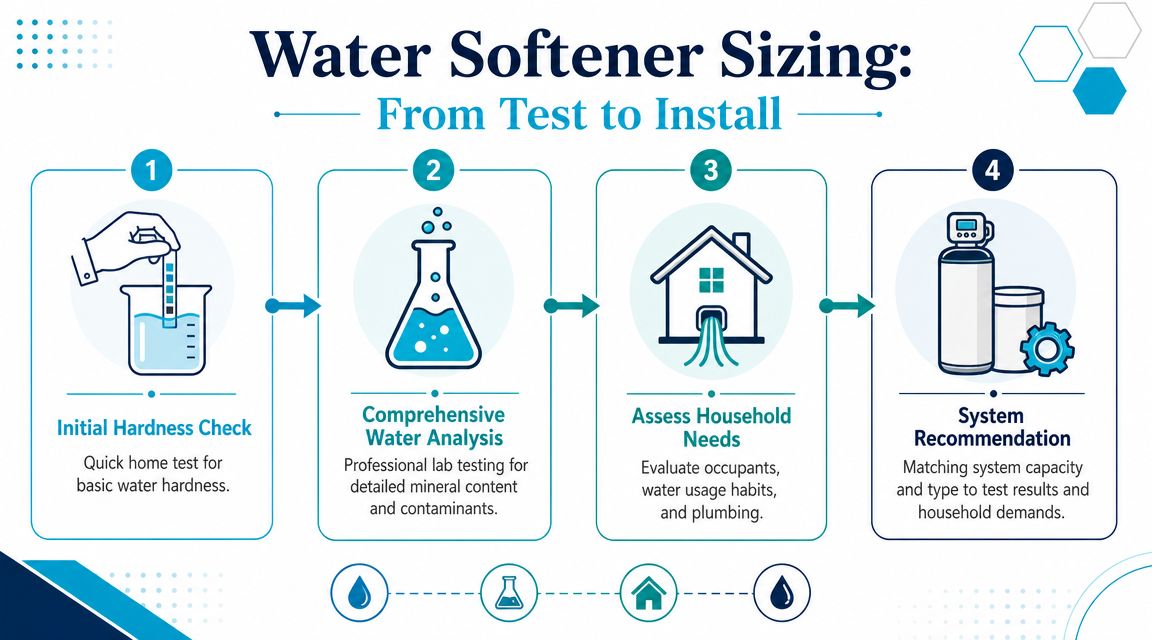
What to test for first
Start with hardness. For softener sizing, hardness is usually measured in grains per gallon, or gpg.
The U.S. Department of Energy states that water above 7.5 gpg is considered hard enough to justify softening in many cases, and it gives a simple sizing example: a home using 225 gallons per day with 10 gpg water needs 2,250 grains of capacity per day. That guidance is outlined in the Department of Energy's page on purchasing and maintaining a water softener.
In Los Angeles, hardness can vary by neighborhood, water source, and even building conditions. A reading from another part of town is not a substitute for a test at your property. That is why we use a test-first process at Praz Pure Water. It keeps the recommendation tied to the water you have, not to assumptions.
DIY test versus professional analysis
A test strip from a hardware store can confirm whether hardness is present. That is a useful first screen for a homeowner deciding whether to investigate further.
A professional water analysis gives you more decision-grade information:
Actual hardness at the tap
This matters more than citywide averages.Water use pattern
A small condo, a five-person household, a restaurant, and a mixed-use building do not need the same regeneration schedule or reserve capacity.Other treatment needs
Hardness is only one part of the picture. Many LA owners also want better taste, chlorine reduction, or point-of-use drinking water treatment. If you are weighing those broader questions, this article on is a home water filter worth it is a useful companion read.Installation constraints
Available drain access, electrical access, pipe routing, and equipment footprint affect what will work cleanly in the field.
How sizing should be done
Softener sizing comes down to two numbers first. Measured hardness and realistic daily water use.
If either number is wrong, the system performance suffers. Undersizing can cause frequent regeneration, more salt use, more water waste, and breakthrough hardness before the next cycle. Oversizing has its own downside. The resin can sit too long between regenerations, which is not ideal for efficiency or long-term operation.
A sound recommendation also accounts for the way the property uses water. Two homes with the same square footage may need different systems if one has two occupants and the other has five, or if one has a large soaking tub, heavy laundry use, or irrigation tied into the wrong line.
A practical LA example
Take a four-person household in Los Angeles with visible scale on fixtures and steady daily water use. The right installer should not size that job from square footage alone. They should confirm hardness, estimate real usage, and check whether the plumbing layout supports the proposed equipment.
The Department of Energy notes that an average four-person home is often sized around 33,000 GPG. That is a reasonable reference point, not a rule for every house. A property with higher hardness, heavier use, or peak demand from multiple bathrooms may need a different setup. A smaller household may not.
Local experience is vital. In older LA homes, I often see limited side-yard space, aging shutoffs, awkward drain locations, or a water heater and softener competing for the same utility area. Those field conditions affect tank size, valve choice, and installation labor just as much as the lab result does.
Be cautious if an installer recommends a specific capacity before asking for a hardness reading, occupancy count, and water-use pattern.
Where LA properties get sizing wrong
Los Angeles properties usually run into the same practical issues:
Tight installation areas
A technically correct unit still has to fit and remain serviceable.Older plumbing
Repipes, galvanized remnants, or limited bypass options can change the install plan.Split treatment goals
Some owners want soft water for the whole house and separate drinking water filtration at the kitchen sink.Commercial demand swings
Offices, salons, restaurants, and multi-tenant properties often have short periods of very high demand that a basic residential sizing method can miss.
Good sizing is part math and part field judgment. Test first, calculate from actual use, then match the system to the building you have in Los Angeles.
How to Choose the Right Local Installer in Los Angeles
Once you know what type of system you need, the installer becomes the next critical decision. A good system installed poorly will still create callbacks, leaks, regeneration problems, or maintenance headaches.
This checklist helps separate real water-treatment contractors from companies that mainly sell fast installs.
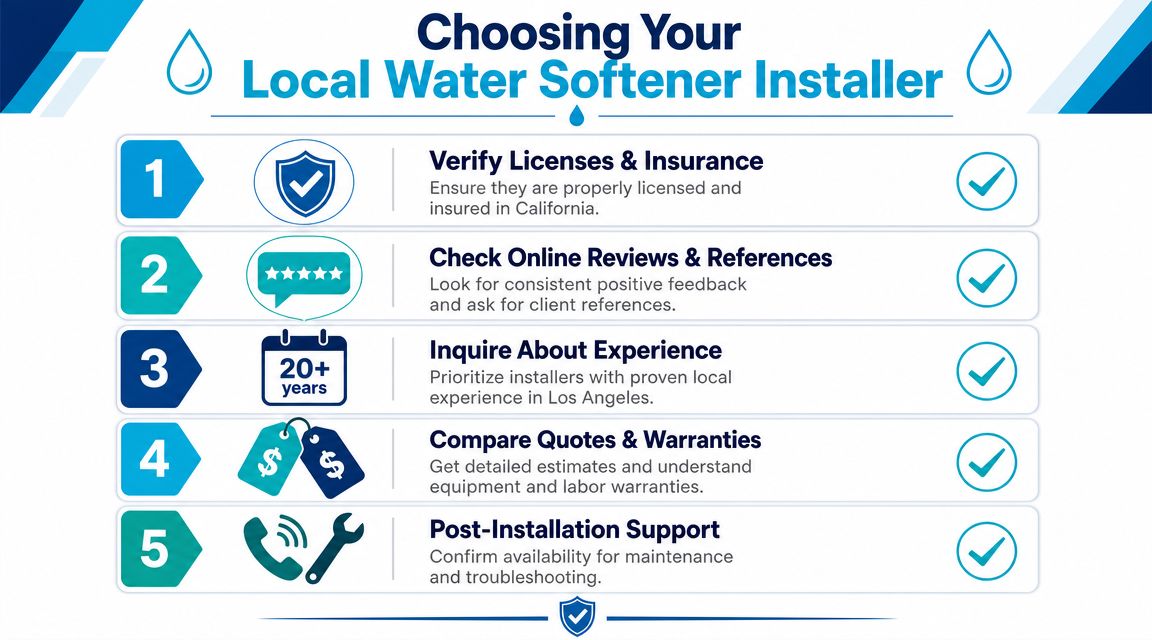
Questions worth asking every installer
Ask direct questions and listen for direct answers.
Are you properly licensed and insured in California
If the answer is vague, move on.Will you test the water before recommending equipment
A company that skips testing is selling inventory, not solving a problem.How do you size the system
They should talk about hardness, water use, and building layout.What maintenance does this specific system require
Salt, cleaning, service intervals, and what the owner handles versus the provider.What happens after installation
Warranty support and follow-up service matter more than many buyers realize.
What strong local installers understand
An installer working in Los Angeles should understand the practical issues that show up on local jobs:
- Older homes with limited install space
- Business sites that can't tolerate water shutdowns during peak hours
- The difference between a whole-home softener and a targeted treatment plan
- Situations where softening alone won't solve taste or drinking-water concerns
One option in the local market is Praz Pure Water, Inc., which provides residential and commercial softening, filtration, reverse osmosis, and rental options from its Los Angeles base. What matters in any provider is the same thing: water assessment first, equipment matched to the site, and ongoing support that fits the customer's maintenance needs.
Red flags that usually cost people later
Some warning signs show up early if you know what to watch for.
A softener quote without a water test is like a shoe fitting done without asking your size.
Watch for these problems:
Pressure-only sales
The installer pushes for same-day signatures before discussing water conditions.No talk about maintenance
Buyers hear about install day but not ownership.No site-specific questions
Nobody asks where the unit will drain, where the main line enters, or whether the property has space constraints.Promises that one system solves everything
That usually means the seller is blurring the line between softening and filtration.
A practical LA example
A restaurant owner searching Water Softener System Near Me may get multiple bids quickly. The low bid may focus only on putting a unit near the service line. The better bid usually includes operational questions: when can water be shut off, what equipment needs protection first, and whether a continuous soft water setup is needed.
That difference often determines whether the install holds up under real daily use.
Understanding the True Cost of a Water Softener System
The purchase price is only part of the cost. Ownership is where many people get surprised.
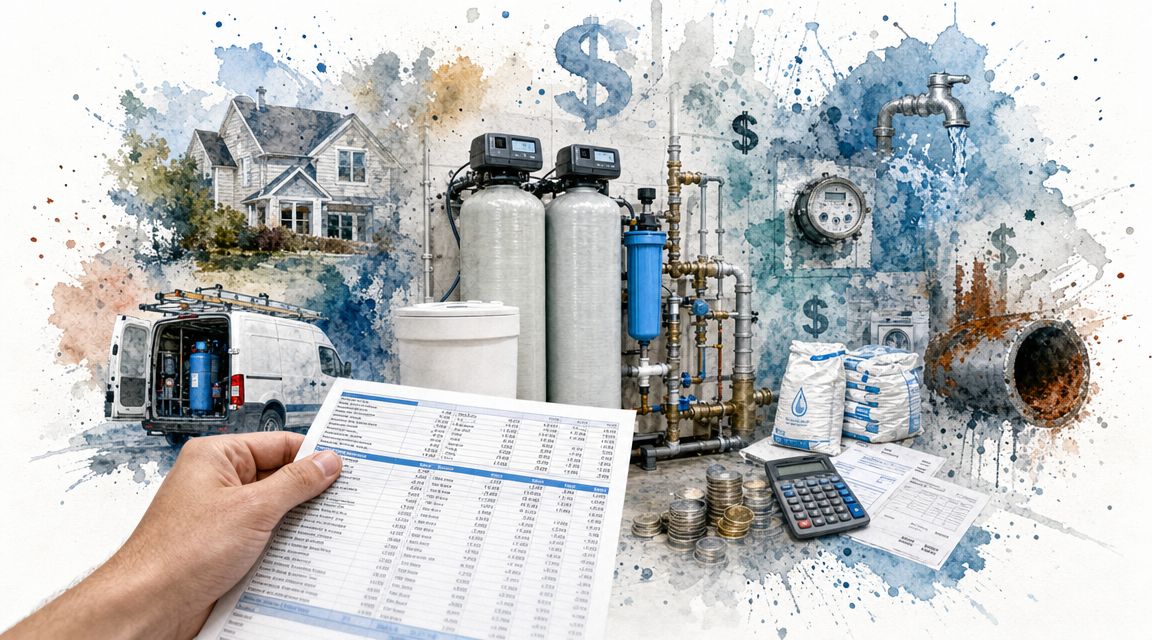
The costs people often miss
Beyond installation, softener ownership includes ongoing costs for salt, resin replacement, and brine tank cleaning. Softened water can also add sodium, which is a concern for some households, so the maintenance burden and lifecycle cost matter more than just the upfront price, as discussed in this overview of water softener and water filtration services.
A low upfront quote can still become the expensive option if the unit is inefficient, undersized, or poorly matched to the property.
What to compare instead of just sticker price
When evaluating proposals, compare them across these categories:
Equipment fit
Is the unit sized for the property?Expected upkeep
Who adds salt, cleans the brine tank, and monitors performance?Service support
Is service included, optional, or left entirely to the owner?Drinking-water needs
Will you still need separate filtration at the kitchen or breakroom sink?Long-term operating practicality
Can the owner realistically keep up with what the system needs?
A practical buying example
Consider two hypothetical homeowners in LA. One chooses the cheapest installed system available online. The other chooses a properly sized unit with clearer service expectations. The cheaper system may still work, but if it regenerates poorly, needs more attention, or doesn't align with the household's actual usage, the owner pays for that decision in inconvenience and service calls.
That's why I tell buyers to think in terms of ownership experience, not just day-one price.
When filtration should be part of the conversation
Some buyers start with hardness but then realize they also care about taste, odor, or drinking-water quality. At that point, it helps to think beyond softening alone. A broader homeowner perspective on is a home water filter worth it can be useful when you're deciding whether your property needs filtration in addition to softening.
The cheapest quote is only cheap if the system keeps working the way you need it to.
Rental versus ownership from a cost standpoint
For some properties, rental makes financial sense because maintenance and service are easier to predict. For others, ownership is the better fit because the building will use the system long term and the owner wants full control.
This is especially true in Los Angeles, where building type, install complexity, and maintenance access can change the practical cost picture more than buyers expect. A house with easy access and a consistent routine is different from a small commercial site where downtime has a business cost.
Your Path to Pure Soft Water in Los Angeles
If you're trying to choose a Water Softener System Near Me in Los Angeles, the decision gets much easier when you strip away the marketing and focus on four things.
First, test the water before buying anything. Hardness may be the main issue, but it may not be the only one.
Second, choose the right system type for the job. True softening, salt-free conditioning, dual-tank setups, and point-of-use filtration all solve different problems.
Third, size the system around actual use. A properly sized unit protects equipment and performs more consistently.
Fourth, pick an installer who treats this as a water-matching job, not a fast sales job. The right local contractor should ask better questions than the average online listing ever will.
For readers comparing hard-water realities in other California mountain and regional conditions, this article on the benefits of a Big Bear water softener adds useful context on why local water conditions change the right answer.
The goal isn't to buy the most equipment. It's to solve the actual problem with the least waste, the right maintenance plan, and a setup that fits the property.
If you want a clear recommendation for your Los Angeles home, restaurant, office, or multi-unit property, contact Praz Pure Water, Inc. for a no-obligation water assessment. The smartest first step is to test the water, review your usage, and match the system to the building before you spend money on the wrong fix.