
Choosing an under-sink water filter is one of the smartest investments you can make for your home. It's a significant upgrade from a simple pitcher, offering superior contaminant removal and substantial long-term cost savings compared to bottled water. The greatest value? You get a continuous supply of clean, great-tasting water directly from your kitchen tap.
Why an Under Sink Water Filter Is a Smart Home Upgrade
Before starting any home project, it's wise to weigh the benefits. Just as homeowners are often evaluating the impact of various home maintenance and improvement projects, understanding the practical value an under-sink water filter brings to your daily life is key.
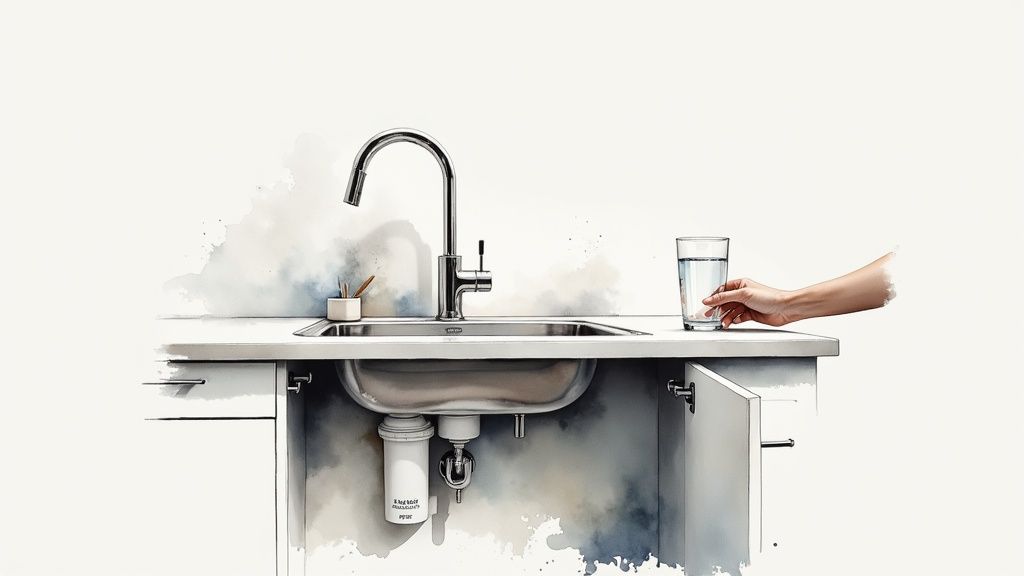
Unlike a pitcher filter that you must constantly refill, an under-sink system connects directly to your cold water line. This means you get freshly filtered water on demand—no more waiting, no more hassle.
The Clear Advantages of Under Sink Systems
The benefits extend far beyond convenience. Consider how these systems improve your day-to-day life:
- Better Contaminant Reduction: Many under-sink models use advanced multi-stage filtration or reverse osmosis. They are engineered to tackle a much wider range of contaminants than simple pitchers, effectively reducing substances like lead, chlorine, pesticides, and other impurities that affect taste and safety.
- Real Cost Savings: While there's an upfront investment, the savings accumulate quickly. By eliminating the need for bottled water, an average family can save hundreds of dollars each year.
- A Greener Choice: Making this switch means your household will rely less on single-use plastics. You'll be actively reducing plastic waste and minimizing your environmental footprint.
- Convenience on Tap: Imagine an endless supply of purified water for drinking, cooking, or rinsing produce. No more carrying heavy water bottles from the store or forgetting to refill the pitcher.
This move toward better home filtration is a significant trend. The market for under-sink water filter systems was valued at around $5 billion in 2025 and is projected to reach $9 billion by 2033. This growth shows that more people are moving away from bottled water—saving families an average of $300 yearly—and embracing more practical, efficient solutions.
Actionable Insight: Start by calculating your family's weekly spending on bottled water. This number will quickly show you the long-term financial value of installing an under-sink system, making the initial investment feel more manageable.
Getting to Know Your Under-Sink Filtration Options
Selecting the right under-sink water filter is like choosing the right tool for a job. The best filtration technology for you depends on what's in your water and what you want to remove. Each system has a specific purpose, targeting different impurities to deliver the clean, crisp taste you desire.
The core concept is removing unwanted substances, but the method these systems use is what differentiates them. Some are excellent for basic taste improvements, while others are powerful purifiers that remove nearly everything. It all comes down to your local water quality and your family's health priorities. For a deeper dive into the science, check out our guide on how water filtration works.
Single-Stage Carbon Filters: The Taste and Odor Fixers
A single-stage activated carbon filter is the most direct solution for better-tasting water. It acts like a highly porous sponge, excelling at one primary task: improving the taste and smell of your water.
Its main target is chlorine, the chemical often responsible for a "pool-like" scent in city water. It also effectively removes certain volatile organic compounds (VOCs). It's a simple, effective, and straightforward solution.
Practical Example: You live in a downtown apartment where the city water is safe, but you dislike the strong chlorine taste in your morning coffee. A single-stage carbon filter is the perfect solution. It’s an affordable, no-fuss way to get great-tasting water without committing to a complex system. For more on how these simple but effective systems work, guides on products like BRITA integrated water filter taps are a great resource.
Multi-Stage Filters: The All-Around Defenders
Multi-stage filters represent the next level of filtration. They combine several different techniques into one integrated system. They typically start with a sediment filter, which acts as a gatekeeper, catching larger particles like rust, dirt, and sand. This is crucial because it protects the more delicate filters downstream from clogging. After the sediment stage, you'll usually find one or more carbon blocks and other specialized media.
By layering these technologies, multi-stage systems can address a much broader spectrum of contaminants, including lead, pesticides, and other chemicals that a basic carbon filter might miss.
Expert Take: A multi-stage system offers an ideal balance for most families. It provides more comprehensive filtration than a simple carbon filter but avoids the water waste and installation complexity of a full reverse osmosis setup. It's a fantastic, well-rounded choice.
Reverse Osmosis: The Ultimate Purification Powerhouse
When you need the absolute highest level of water purity, Reverse Osmosis (RO) is the undisputed champion. This technology is highly sophisticated, using pressure to force water through a semipermeable membrane so fine that only water molecules can pass, leaving virtually all contaminants behind.
An RO system is the top choice for removing the most challenging substances. Its list of targets is long and impressive:
- Heavy metals like lead, arsenic, and mercury
- Fluoride and nitrates
- Microscopic contaminants like bacteria and viruses
- Dissolved salts and other total dissolved solids (TDS)
Practical Example: You own an older home with original plumbing, and the risk of lead leaching into your water is a genuine concern. An RO system provides complete peace of mind. It’s also the go-to solution if your local water report indicates high levels of specific contaminants that other filters cannot handle.
Alkaline Filters: The pH and Flavor Enhancers
Alkaline filters are typically an upgrade, often paired with a reverse osmosis unit, rather than a standalone system. After an RO system purifies the water (which also removes minerals), an alkaline filter adds beneficial minerals like calcium and magnesium back in. This remineralization process naturally raises the water's pH, usually to a healthier range of 8 to 9.5.
The immediate difference is taste. The added minerals give the water a smoother, more refreshing flavor. Beyond taste, some people choose alkaline water for potential health benefits and its less acidic profile, making it more pleasant to drink throughout the day.
Comparing the Top Under Sink Water Filter Systems
Choosing the best under-sink water filter involves understanding the technology and how it fits your lifestyle and water quality. A system that's perfect for one home could be overkill—or insufficient—for another. Let's break down the practical differences between the leading options: Carbon, Multi-Stage, Reverse Osmosis, and Alkaline filters.
This simple decision tree can help you visualize the path. Are you just trying to eliminate a chlorine taste, or are you concerned about something more specific in your water?
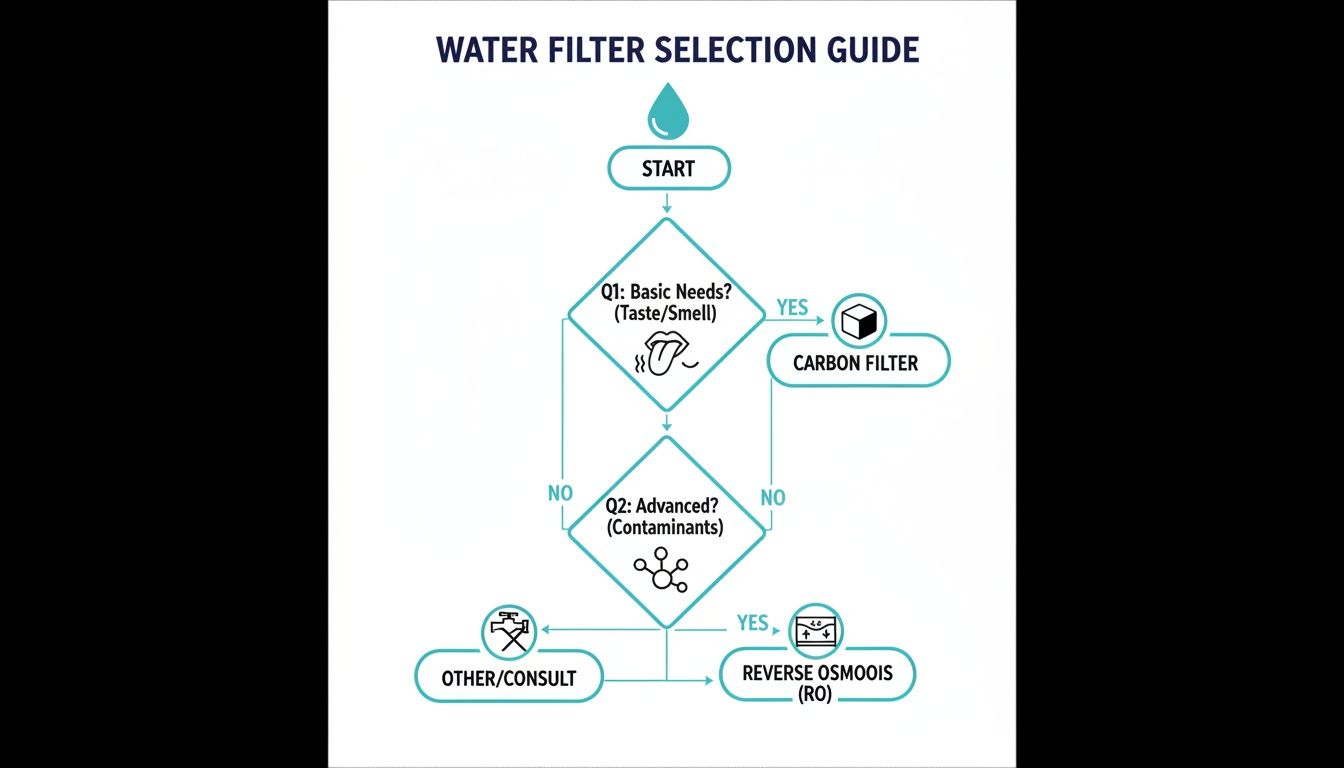
As the flowchart shows, identifying your primary goal—great taste versus serious purification—is the first step toward finding the right fit.
Contaminant Removal: What Do They Actually Take Out?
This is the most critical factor. What each filter is designed to remove from your water is fundamentally different.
A single-stage carbon filter is your first line of defense for better-tasting water. It excels at reducing chlorine, the primary cause of that "tap water" smell and taste. It also captures some organic compounds, making your water instantly more enjoyable.
A multi-stage system goes a step further. By layering different media, like a sediment filter and carbon blocks, it can trap contaminants a simple carbon filter misses, including lead, some pesticides, and cysts. This makes it an excellent middle-ground solution for general health concerns.
Then there is Reverse Osmosis (RO), the heavyweight champion of water purification. RO systems are the gold standard, dominating a massive $2.3 billion market expected to grow 5.7% annually through 2034. These units are engineered to remove up to 99.9% of total dissolved solids (TDS), including tough contaminants like arsenic, fluoride, nitrates, and even bacteria. For context, since 2002, NSF International tests have shown RO systems outperform basic carbon filters by 70% in TDS reduction. The most popular 50-100 gallon capacity systems, holding 40.4% of the market share, are ideal for families using 100-150 gallons a day. You can find more details on these powerful filtration systems on gminsights.com.
Key Differentiator: A carbon filter makes water taste better. An RO system makes it fundamentally purer. It removes dissolved solids and microscopic threats that other systems cannot, a critical distinction for anyone with specific health concerns.
Under Sink Filter System Comparison
| Feature | Carbon Filter | Multi-Stage Filter | Reverse Osmosis (RO) | Alkaline Filter |
|---|---|---|---|---|
| Primary Goal | Improves taste & smell | Broader contaminant reduction | Maximum purity, TDS removal | pH balancing, adds minerals |
| Removes Chlorine | Excellent | Excellent | Excellent | N/A (usually post-RO) |
| Removes Lead | Limited | Good to Excellent | Excellent | N/A |
| Removes TDS | No | No | Up to 99.9% | Adds minerals (increases TDS) |
| Removes Fluoride | No | No | Excellent | No |
| Impact on Water Flow | Minimal | Minimal | Requires tank for good pressure | Minimal (part of RO system) |
| Under-Sink Space | Minimal | Small to Medium | Large (system + tank) | Minimal (add-on cartridge) |
| Installation | DIY-Friendly | Mostly DIY-Friendly | Professional Recommended | Part of RO install |
This table highlights the trade-offs: as purification power increases, so do the system's complexity and space requirements.
Water Flow Rate And Pressure
No one wants to wait for a glass of water to fill. The impact a filter has on your water flow is a daily quality-of-life issue you can't overlook.
Standard carbon and multi-stage filters are designed for speed. Water passes through them with minimal resistance, so you’ll barely notice a change in flow rate from your main faucet.
Reverse osmosis is different. The RO process forces water through an extremely fine membrane, which is naturally slow. That’s why every RO system includes a small storage tank. The system purifies water slowly and stores it, so when you open the dedicated RO faucet, you get a strong, steady stream. Without the tank, the flow would be a frustrating trickle.
Installation And Space Requirements
Performance is irrelevant if the system doesn't fit under your sink. Practicality matters.
- Carbon & Simple Multi-Stage Filters: These are the most compact and easiest to install. Often just a single canister that connects to your cold water line, they take up very little cabinet space. If you're comfortable with basic plumbing, you can likely install one yourself in under an hour.
- Reverse Osmosis Systems: These are a larger commitment. An RO system requires a separate storage tank, a dedicated faucet (which means drilling a hole in your countertop or sink), and a connection to your drain line to flush away rejected contaminants. For these reasons, professional installation is almost always recommended.
- Alkaline Filters: These are typically an extra cartridge added to an RO system. They don't significantly complicate the installation but do add to the overall footprint.
Actionable Insight: Before you buy anything, grab a tape measure. Check the exact height, width, and depth available under your sink to ensure your chosen system—especially a bulky RO unit—will fit comfortably.
Filter Lifespan And Maintenance Costs
The upfront price is just the beginning. The true cost of a water filter includes the ongoing expense and effort of replacing cartridges.
Simple carbon filters are the most affordable to maintain. A single filter might cost $30 – $70 and last 6 to 12 months, with a simple twist-off replacement.
Multi-stage systems are a step up in cost, typically running $60 – $150 annually, since you have two or more filters to replace on a similar 6- to 12-month schedule.
RO systems have the highest long-term costs, from $100 to over $200 per year. You have multiple pre-filters and a post-filter to change every 6-12 months, plus the expensive RO membrane, which needs replacing every 2-4 years. While the cost is higher, the peace of mind that comes with exceptionally pure water is an investment well worth making for many families.
What to Know Before You Buy an Under-Sink Filter
Choosing the right type of filter is a great start, but real-world details determine whether a system is a perfect fit or a daily headache. Before purchasing an under-sink water filter, take a close look at your home's unique setup. Factors like under-sink space, water pressure, and official certifications are crucial for ensuring a smooth upgrade.
Spending a few minutes checking these factors will ensure the system you choose works flawlessly from day one.
Measure Twice, Install Once: Your Under-Sink Space
The cabinet under your kitchen sink can be deceptively crowded. Between plumbing, a garbage disposal, and cleaning supplies, space disappears quickly. Don't just guess if a filter will fit—use a tape measure.
- Get the real numbers: Measure the actual height, width, and depth you have to work with. Account for existing pipes and hoses that cannot be moved.
- Plan for RO systems: Reverse osmosis systems are the largest. They need room for the filter unit plus a separate storage tank, which is often the size of a small propane tank.
- Remember filter changes: You'll need access to swap out filters. Leave enough room to comfortably twist off the filter housings without difficulty.
Practical Example: A homeowner wants a full RO system but has a deep sink basin and a bulky garbage disposal. After measuring, they realize a standard upright tank won't fit. The solution? They find a system with a slim, horizontal tank that can be tucked neatly at the back of the cabinet, solving the space issue without sacrificing performance.
Your Home’s Water Pressure Matters
Water pressure, measured in pounds per square inch (PSI), is the force that moves water through your pipes. It's a critical factor for filter performance, especially for reverse osmosis systems.
Most homes have water pressure between 40 and 80 PSI. While a simple carbon or multi-stage filter works well in this range, RO systems are more demanding. They need adequate pressure to force water molecules through the ultra-fine membrane.
If your home’s pressure is below 40 PSI, an RO system will be inefficient, producing water slowly and wasting a significant amount. In this case, you would need to add a booster pump to the system or choose a different type of filter.
Actionable Insight: Check your water pressure before buying an RO system. You can get an inexpensive water pressure gauge at any hardware store. Screw it onto an outside hose bib and turn on the water for an instant reading. This five-minute test can prevent a major installation headache.
Understanding NSF and ANSI Certifications
How can you be sure a filter actually removes what it claims to? Look for certifications from the National Sanitation Foundation (NSF) and the American National Standards Institute (ANSI). These independent organizations rigorously test products against public health and safety standards.
- NSF/ANSI 42 (Aesthetic Effects): Certifies that a system reduces substances affecting taste and smell, like chlorine.
- NSF/ANSI 53 (Health Effects): A stricter standard verifying the reduction of specific harmful contaminants like lead, mercury, and certain parasites.
- NSF/ANSI 58 (Reverse Osmosis): Exclusive to RO systems, this confirms the reduction of dissolved solids like fluoride, arsenic, and nitrates.
When comparing systems, look for the official NSF seal and standard numbers. It's the only way to know you're getting a product that delivers the safety and purity your family deserves.
Understanding the True Cost of Ownership
When shopping for the best under-sink water filter systems, the initial price is just the beginning. The total cost of ownership includes everything you'll spend over the years to keep the system running perfectly. Thinking long-term helps you avoid surprise expenses.
The largest ongoing cost is replacing filters. Each system has a different maintenance schedule and cartridge price point, which significantly affects your annual spending.
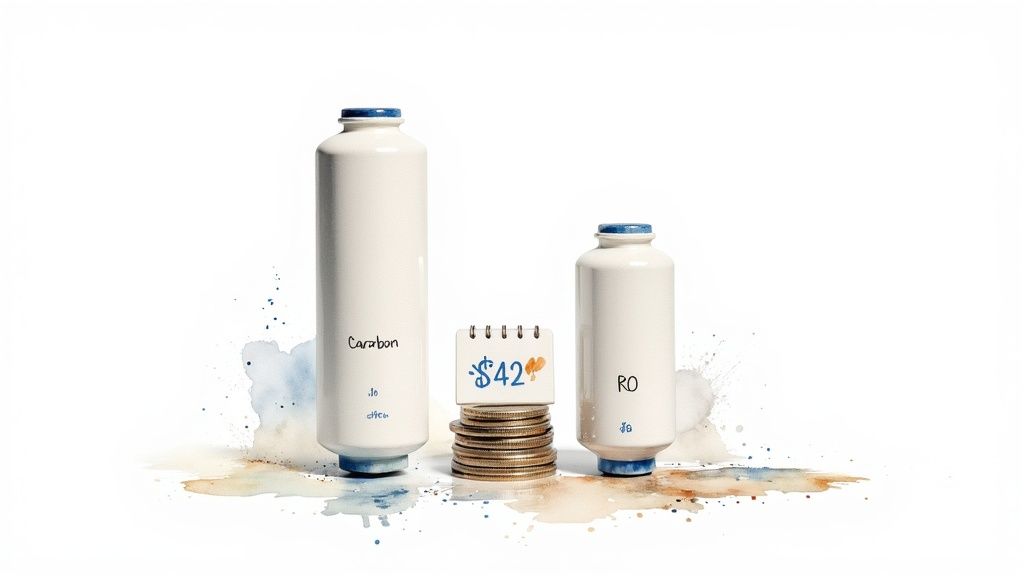
Breaking Down Annual Filter Costs
Here’s what you can expect to spend each year on maintenance:
- Single-Stage Carbon Filters: The most budget-friendly option. A single cartridge change every 6 to 12 months will cost between $30 and $70 for the year.
- Multi-Stage Filters: With two or more filters to swap, the annual cost increases to the $60 to $150 range, with a similar 6- to 12-month replacement cycle.
- Reverse Osmosis (RO) Systems: These require the largest maintenance investment. Annual pre- and post-filter changes cost $100 to $200+. Additionally, the RO membrane itself needs replacement every 2 to 4 years, which is a separate, more substantial expense.
Actionable Takeaway: The initial purchase price is a one-time cost, but filter replacements are a recurring commitment. Factor these ongoing expenses into your budget to understand the true lifetime cost of any under-sink water filter.
A Five-Year Cost Comparison Scenario
Let's compare the potential five-year cost of a basic carbon filter versus a full RO system to illustrate how these costs add up.
Scenario A: Basic Carbon Filter System
- Initial System Cost: $120
- Annual Filter Cost: $50
- Five-Year Filter Total: $250 ($50 x 5)
- Total Five-Year Cost: $370
Scenario B: Reverse Osmosis System
- Initial System Cost: $350
- Annual Pre/Post-Filter Cost: $150
- RO Membrane Replacement (Year 3): $100
- Five-Year Filter Total: $850 (($150 x 5) + $100)
- Total Five-Year Cost: $1,200
While the carbon filter is the clear winner on price, the RO system's higher cost provides far more powerful purification. The decision isn't just about which is cheaper; it's about balancing your budget with your water quality goals. For a closer look at professional installation, you can explore the details of the reverse osmosis system installation cost. This comparison helps you determine which option provides the right value for your home over the long term.
Getting It Right: Why Professional Installation and Support Matter
Choosing the right under-sink water filter is a crucial step, but proper installation and reliable support are what turn that equipment into a source of pure water you can depend on. While the DIY route may seem like a way to save money, it often leads to problems that can be more costly in the long run.
The demand for these systems has grown significantly, with homeowners now accounting for 65% of global sales. The kitchen filter market is expected to grow from $780 million to $1.65 billion by 2032. As awareness of contaminants increases, ensuring a correct installation from the start is more critical than ever. You can explore these market trends at dataintelo.com.
The Hidden Dangers of a DIY Install
A small misstep during a DIY installation can lead to significant issues, negating the benefits of your new filter.
- Leaks and Water Damage: An improperly tightened fitting can cause a slow leak, leading to warped cabinets, ruined flooring, and mold growth—all resulting in expensive repairs.
- Poor Filter Performance: Incorrect hose connections or failure to flush the system properly can allow unfiltered water to bypass the filter, meaning contaminants you thought were being removed are still in your water.
- Voiding Your Warranty: Many manufacturers require professional installation to keep the warranty valid. A DIY job could leave you without coverage if a critical part fails.
The Praz Pure Water Advantage
When you choose a professional installation from a local expert like Praz Pure Water, you avoid these risks and gain peace of mind. Our approach is built on expertise and reliable support.
Choosing a professional isn’t just about getting the system installed—it's about building a partnership. A local expert ensures your system is perfectly matched to your home's needs and provides accessible support for years to come.
Here’s what our service provides:
- A Tailored Assessment: We begin by evaluating your home's water quality and plumbing to ensure the system you've chosen is the best fit.
- A Guaranteed, Flawless Installation: Our certified technicians handle everything, from drilling a precise hole for the new faucet to triple-checking every connection to ensure it’s secure and leak-free.
- Ongoing Local Support: We are here for you in the community. Whether you need a filter change, have a question, or require routine maintenance, we are your go-to resource for keeping your water pure.
Frequently Asked
Questions
As you get closer to a decision, a few final questions often come to mind. Here are answers to some of the most common ones we hear from homeowners.
How Often Should I Change My Under Sink Water Filters?
The replacement schedule depends on your specific system and water usage. A simple carbon filter usually needs a new cartridge every 6 to 12 months. For a more advanced Reverse Osmosis system, the initial sediment and carbon pre-filters typically need replacement every 6-12 months, while the core RO membrane can last 2 to 3 years. Always follow the manufacturer's recommendations for optimal performance.
Will an Under Sink Filter Affect My Water Pressure?
For standard carbon and multi-stage filters, you'll likely notice little to no change in water pressure. Reverse Osmosis (RO) systems are different. The intensive filtration process naturally slows water flow. To compensate, every RO system includes a storage tank that keeps purified water pressurized and ready, ensuring a strong, consistent stream from the dedicated faucet.
Can I Install an Under Sink Filter System Myself?
While you can install some basic, single-filter systems yourself, we always recommend professional installation for multi-stage or Reverse Osmosis systems.
An incorrect installation can cause leaks, plumbing damage, or poor filtration, rendering the system ineffective. Professional installation ensures it works correctly from day one and keeps your warranty intact.
Does Reverse Osmosis Remove Healthy Minerals from Water?
Yes, the fine RO membrane removes nearly all dissolved solids, including beneficial minerals like calcium and magnesium. However, we get the vast majority of our essential minerals from food, not water. For those concerned about contaminants like fluoride, RO is one of the most effective solutions available. You can read more about how reverse osmosis removes fluoride in our detailed guide. If you want to add minerals back, many RO systems can be fitted with a remineralization cartridge that restores a healthy balance of minerals and improves taste.
Ready to enjoy pure, great-tasting water right from your tap? The experts at Praz Pure Water, Inc. can help you find the perfect under-sink water filter system for your Los Angeles home. Contact us today for a personalized water assessment and professional installation!