
A commercial water purification system is an investment that pays for itself over and over. At its core, it’s a setup that removes contaminants, minerals, and other impurities from your business's water supply. This protects your expensive equipment, keeps your products consistent, and gives your staff and customers safe, great-tasting water.
Think of it as essential quality control for your entire operation. The value it delivers is clear: it shields your assets, improves your product, and elevates your customer experience.
Why Smart Businesses Invest In Water Purification
Are you constantly battling hard water spots on your glassware? Is the taste of your coffee or soda inconsistent? Do your equipment repair bills seem to creep up every year? If that sounds familiar, you're not alone. Many business owners assume their city water is good enough, only to find it's quietly causing problems behind the scenes.
Installing a commercial water purification system isn't just another expense—it’s a strategic move to protect your business’s long-term health and profitability. Using untreated water is a hidden liability that can lead to costly breakdowns and unhappy customers.
Protecting Assets and Boosting Efficiency
Much of the water in Los Angeles is "hard," meaning it's full of minerals like calcium and magnesium. Over time, these minerals build up as scale, clogging your pipes, damaging water heaters, and making your ice machines, dishwashers, and coffee makers work harder than they should.
Actionable Insight: A properly specified water purification system acts as a shield for your capital equipment. By removing damaging minerals at the source, you can extend the lifespan of your appliances, significantly reduce maintenance calls, and lower energy consumption.
This is all about being proactive instead of reactive. You're preventing expensive repair bills before they happen. This strategy is gaining traction everywhere; the market for commercial water purifiers is expected to hit $13.12 billion by 2030, driven by a huge demand for quality and safety in hospitality, healthcare, and beyond. You can get a closer look at this trend in this detailed report.
Funding Your Water Quality Upgrade
A top-tier purification system is a major asset, and it's important to plan for the investment. As you work through your buyer checklist, look into your funding options. Many businesses secure a dedicated equipment financing loan to manage the upfront cost. This guide will walk you through the entire process, from figuring out your needs to calculating your return on investment, giving you a clear path forward.
Getting to Know the Different Water Purification Technologies
Choosing the right commercial water purification system can feel overwhelming, but it gets a lot easier once you understand what each type of technology is designed to do. Think of it like assembling a team of specialists for a specific mission—each one has a unique skill. Your goal is to build a system that perfectly targets your water's specific problems, whether that’s removing dissolved solids or zapping harmful bacteria.
When you get the combination right, the value ripples across your entire business, from protecting your expensive equipment to elevating your customer experience.
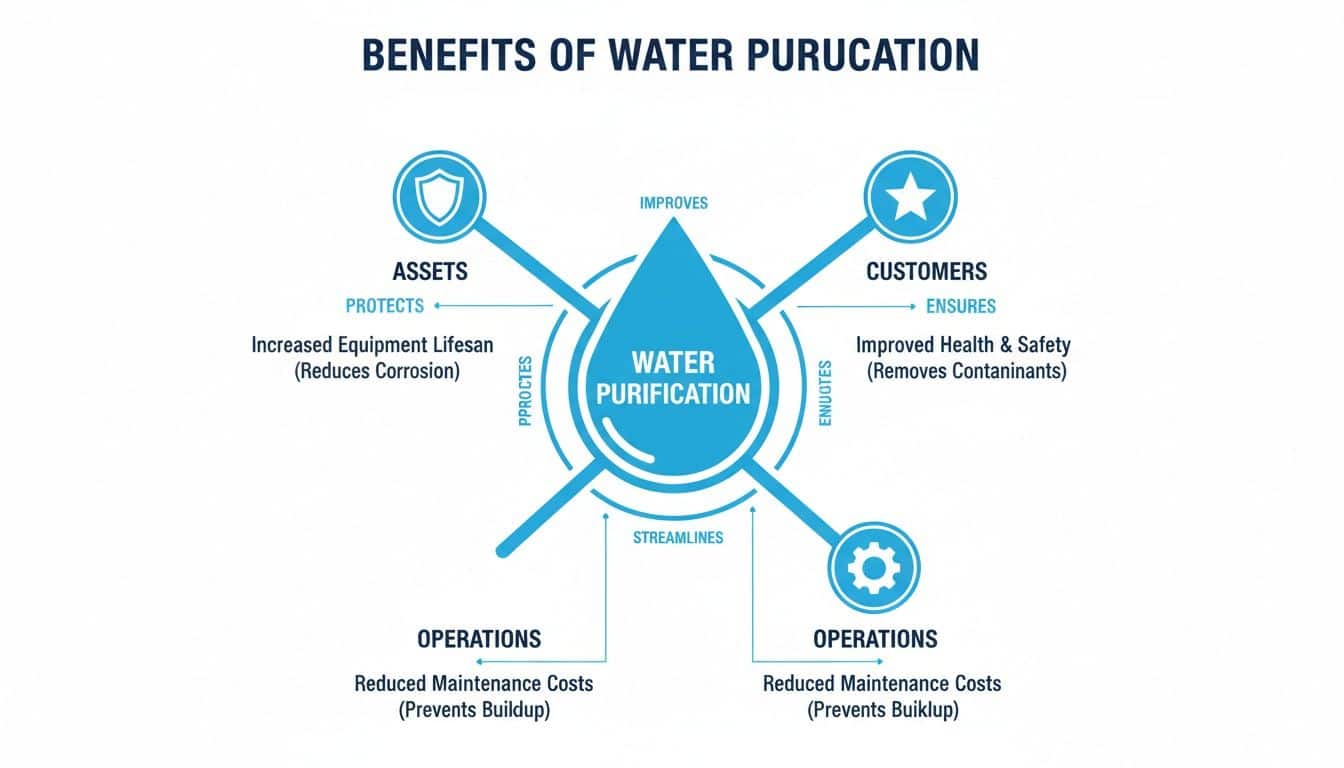
As you can see, good water isn't just a utility; it's a foundational asset that protects your investments, smooths out your operations, and leaves a lasting positive impression on everyone you serve.
Now, let's look at the different specialists you can add to your team. We've put together a quick-reference table to help you see at a glance how these technologies stack up.
Comparing Commercial Water Purification Technologies
This table provides a simple breakdown of the primary purification technologies, helping you quickly identify which solution might be the best fit for your business's unique challenges.
| Technology | Primary Function | Removes | Best For (Business Type) |
|---|---|---|---|
| Reverse Osmosis (RO) | Ultimate Purification | 95-99% of dissolved solids, metals, chemicals, salts | Restaurants, Cafes, Medical/Dental Offices, Laboratories |
| Water Softener | Scale Prevention | Hardness minerals (calcium & magnesium) | Hotels, Laundromats, Car Washes, Multi-Family Housing |
| UV Sterilization | Microbial Disinfection | Bacteria, viruses, protozoa (Giardia, etc.) | Businesses on well water, Food Production, Healthcare, Gyms |
| Media Filtration | Targeted Removal | Chlorine, sediment, iron, specific contaminants | Offices, Restaurants (pre-treatment), Manufacturing |
Each technology solves a different piece of the water quality puzzle. In many commercial settings, the most effective solution is a combination of two or more of these systems working together.
Reverse Osmosis: The Ultimate Purifier
When you need the purest water, Reverse Osmosis (RO) is the champion. It uses high pressure to force water through a semi-permeable membrane—a filter so fine that it stops nearly everything except pure H₂O molecules from passing through.
This process is incredibly thorough, removing a huge range of contaminants:
- Dissolved solids like salts and minerals
- Heavy metals like lead and arsenic
- Nitrates, sulfates, and other chemical compounds
- Fluoride and chlorine
Because it's so powerful, RO is the go-to for any business where water quality is non-negotiable. It's used everywhere, from restaurants that want perfectly clear ice and premium-tasting beverages to medical offices needing sterile water for equipment. Market data backs this up, showing that RO systems are projected to make up 38.7% of the water purifier market by 2026. Over 35% of commercial installations are already in hospitality and healthcare, and you can discover why RO systems are so popular across these industries.
Water Softeners: The Scale Busters
If RO is the ultimate purifier, a water softener is the specialist that stops one very specific and costly troublemaker: hardness. Hard water is loaded with minerals like calcium and magnesium. While not harmful to drink, these minerals create limescale, which clogs pipes, destroys heating elements, and leaves ugly spots on everything.
A water softener tackles this head-on with a process called ion exchange. It swaps the "hard" calcium and magnesium ions for "soft" sodium ions. This doesn't purify the water in the way RO does, but it completely solves the expensive problem of scale buildup.
Practical Example: A busy Los Angeles restaurant was spending thousands each year to descale its commercial dishwasher and replace burnt-out heating elements. After installing a water softener, their emergency repair calls dropped to zero, glassware came out spotless, and they even started using less detergent, saving money all around.
For any business that relies on water-fed appliances—from laundromats and hotels to car washes and coffee shops—a water softener is an essential first line of defense for your equipment. Our guide on how water filtration works dives deeper into the science behind this and other processes.
UV Sterilization: The Bacteria Blocker
Meet your microbiological security guard: UV (Ultraviolet) Sterilization. This technology is your ultimate defense against invisible threats. It works by passing water through a chamber with a special lamp that emits a specific wavelength of UV light. This light instantly scrambles the DNA of microorganisms like bacteria, viruses, and protozoa (such as Giardia and Cryptosporidium), making it impossible for them to reproduce and cause illness.
UV is a physical process, not a chemical one. It adds nothing to the water and doesn't remove other contaminants like sediment or chlorine. For this reason, it's almost always paired with other filters, like a sediment or carbon filter, which remove particles that microbes could hide behind.
UV is an absolute must-have for:
- Businesses on well water, which is more susceptible to biological contamination.
- Food and beverage producers where preventing microbial growth is a critical safety step.
- Healthcare clinics, childcare centers, and gyms that need microbiologically safe water to protect vulnerable people.
How To Accurately Assess Your Business's Water Needs
Let's get practical. Knowing the types of systems is one thing, but figuring out exactly what your business needs is the most important step. Choosing the right system comes down to two simple things: what’s in your water, and how much of it you use.
A professional assessment is the only way to get a clear, data-driven picture of your situation. It’s the step that prevents you from spending thousands on the wrong solution.
Start With A Professional Water Quality Test
You're flying blind without real data. A professional water quality test is non-negotiable, especially for businesses in places like Los Angeles where hard water is common. While your city’s water report is a good starting point, it doesn't tell you what’s happening inside your building after that water has traveled through miles of pipes.
A comprehensive, on-site test will check for the specifics:
- Total Dissolved Solids (TDS): This is the measure of all the "stuff" in your water—minerals, salts, and metals.
- Hardness: This number tells us exactly how much calcium and magnesium is present, which causes scale buildup.
- Chlorine and Chloramine: We need to know the levels of these city disinfectants, as they are the primary cause of bad taste and odor.
- Other Contaminants: A good test also screens for less common but problematic things like iron, lead, or sediment.
Once you have these results, the path forward becomes much clearer. If your hardness levels are high, a water softener is a must. If TDS is the main issue, then you know you need to be looking at a reverse osmosis system.
Calculate Your Daily Water Usage
Next up is quantity. You need a solid estimate of how much water your business consumes, measured in Gallons Per Day (GPD). Sizing your system correctly is absolutely critical.
Actionable Insight: A system that’s too small will be overwhelmed on your busiest days, leading to equipment failure and poor water quality. A system that’s too large is a waste of money, space, and energy.
To get a reliable starting number, use these simple industry benchmarks:
- Restaurants: 1.5 – 2.5 gallons per seat, per day. A 100-seat restaurant needs a system that can handle at least 150-250 GPD.
- Offices: 0.5 – 1 gallon per employee, per day. An office with 50 employees should plan for 25-50 GPD just for drinking water and kitchen use.
- Hotels & Multi-Family: 40 – 60 gallons per room, per day. This higher number accounts for laundry, kitchens, and all guest/resident usage.
These figures give you a strong baseline. A water treatment expert can help you zero in on a more precise number by factoring in your specific hours, peak demand times, and any water-hungry appliances like high-volume ice machines or dishwashers.
Find The Perfect Fit For Your Business
This is where it all comes together. The right solution balances your water quality report, your daily usage, and the practical realities of your space and budget.
For instance, a cozy coffee shop with hard water and a high-end espresso machine might only need a compact water softener and a small, under-counter RO system. It's targeted and efficient.
A large apartment building, on the other hand, will need a much bigger, centralized softening system in a main mechanical room to protect the plumbing for the entire property. The goal is always to engineer a system that is both effective and efficient—giving you exactly the water you need without wasting money on capacity you won't use.
Real-World Examples Of Purification Systems In Action
Theory is one thing, but seeing how a commercial water purification system can solve real, everyday problems is where it all clicks. Let’s look at a few Los Angeles businesses that completely turned things around by getting their water quality under control.
These stories aren't just about fancy equipment; they're about turning hidden costs into real, measurable wins.
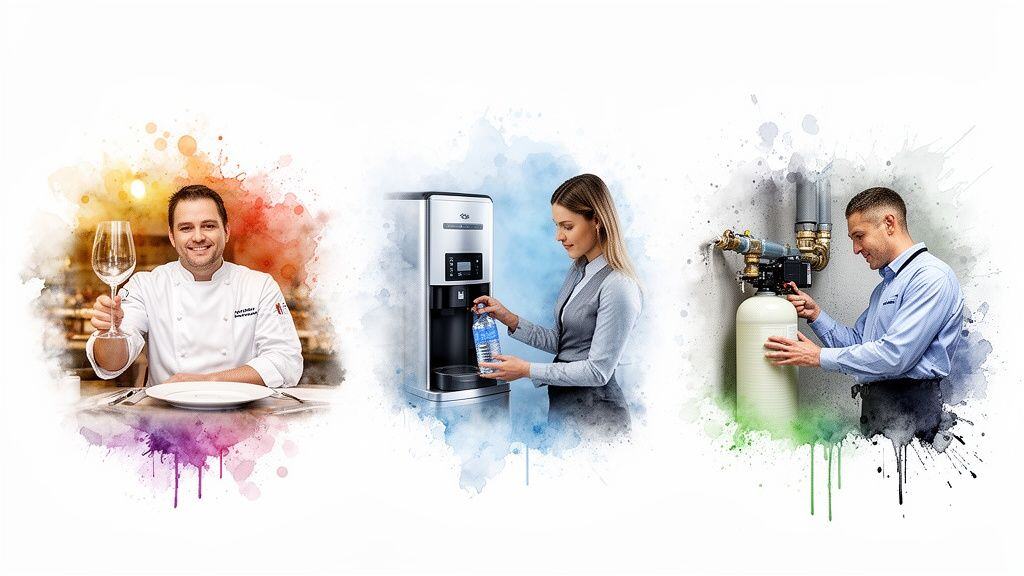
You'll notice that each case involved a different challenge and received a specific, targeted solution. This shows that the right water treatment is an investment that pays you back, often sooner than you’d think.
Case Study 1: The Busy Restaurant
We worked with a popular downtown LA restaurant fighting a losing battle with its water. Their glassware came out of their high-end dishwasher covered in a cloudy, white film. Worse, their expensive espresso machine and combi oven were constantly breaking down.
- The Problem: Extreme hard water was causing scale to build up everywhere, damaging valuable equipment and creating extra work. It even soured the taste of their coffee and fountain drinks.
- The Solution: We designed a two-part system. First, a commercial-grade water softener was installed to treat all the water for the kitchen. Then, we added a point-of-use Reverse Osmosis (RO) system to feed pure water directly to the espresso machine, ice maker, and beverage station.
- The Measurable Outcome: The restaurant saw a 90% reduction in spotted glassware, freeing up staff to focus on serving guests. Emergency repair calls for their machines dropped to zero, saving them an estimated $4,000 a year on maintenance.
Case Study 2: The Growing Corporate Office
A mid-sized tech firm in Burbank was spending over $800 a month on bottled water delivery for its 100 employees. Besides the high cost, it was a logistical nightmare—finding space for bulky jugs and dealing with the plastic waste went against their green initiatives.
Key Insight: Many offices overspend on bottled water, not realizing a modern bottleless cooler can provide higher quality water at a fraction of the cost, while also eliminating plastic waste and storage issues.
Management knew there had to be a better way. They wanted a solution that was more sustainable, affordable, and provided better-tasting water for their team.
- The Problem: Their bottled water service was expensive, inefficient, and created a ton of environmental waste.
- The Solution: We installed a bottleless RO water cooler in their main breakroom. The unit taps right into the building’s water line and uses a multi-stage filtration process to produce incredibly pure water. If you want to see how this technology can handle high-demand environments, you can learn more about a powerful commercial RO water filter system that is perfect for these kinds of applications.
- The Measurable Outcome: The company completely cut its $9,600 annual bottled water bill. The switch resulted in immediate savings of over 70%. Employees loved the "crisp and clean" taste, and the company got to highlight its smaller carbon footprint.
Case Study 3: The Multi-Family Property Manager
A property management company was drowning in maintenance calls at their 50-unit apartment complex. Tenants were constantly complaining about poor water pressure, leaky faucets, and broken water heaters. The maintenance team was burning through its budget on endless plumbing repairs.
- The Problem: Severe hard water was wrecking the entire building's plumbing. Scale was clogging pipes and destroying appliances from the inside out, leading to unhappy tenants and high maintenance costs.
- The Solution: A single, centralized commercial water softener was installed in the building's main mechanical room. This one powerful system was sized to treat all the water entering the property, protecting every pipe, fixture, and appliance in all 50 apartments.
- The Measurable Outcome: Within six months, plumbing-related maintenance calls fell by a staggering 80%. The property manager could finally use the maintenance budget for actual property improvements instead of just putting out fires, boosting the building's value and helping with tenant retention.
Understanding The Full Cost And Return On Investment
When you're looking at a new commercial water purification system, it's easy to focus on the sticker price. But the real story is the Return on Investment (ROI). The right system isn’t a business expense. It's an investment that saves money, protects your equipment, and elevates your brand.
To make the right call, you need to see the whole financial picture. This means looking at the tangible savings you’ll see on your profit and loss statement, as well as the intangible benefits that are just as crucial to your success.
Calculating Your Tangible ROI
Tangible returns are the clear, measurable savings you can track. These are the direct financial benefits that come from installing a commercial water purification system designed for your specific needs. The impact often hits the bottom line almost immediately.
Here’s where the savings really start to add up:
- Reduced Appliance Repairs: Hard water scale is notorious for destroying expensive equipment. A simple water softener can slash maintenance calls and replacement costs for dishwashers, ice machines, and water heaters.
- Lower Utility Bills: Scale buildup forces appliances to work harder and use more energy. With clean, soft water, heating elements run efficiently, and you’ll notice the difference on your gas and electric bills.
- Decreased Supply Costs: When water is soft, you need less soap, detergent, and cleaning chemicals. Many businesses find they can cut their usage of these supplies by as much as 50%.
- Elimination of Bottled Water: For offices, the cost of bottled water is a constant drain. A bottleless cooler with a reverse osmosis system delivers better-tasting water for a fraction of the price, often saving businesses over 70% a year.
To get a more detailed look at what to expect, our guide on reverse osmosis system installation costs breaks down all the variables that go into the final price.
The Value Of Intangible Benefits
You can't always put a number on these, but intangible benefits have a massive impact on your reputation. These are the "soft" returns that build customer loyalty and make your business a better place to be.
A restaurant serving drinks in spotted glasses sends a message of carelessness. An office with cloudy, bad-tasting tap water tells employees their well-being isn't a top concern. Pure water elevates your brand from the inside out.
Think about the real-world value of these improvements:
- Superior Product Quality: For a coffee shop, pure water is the foundation for a perfect cup, every single time. For a brewery, it’s about a consistent flavor profile. That's the quality that keeps people coming back.
- Enhanced Customer Experience: Spotless glassware, crystal-clear ice cubes, and a refreshing glass of water in your waiting room all signal quality and attention to detail.
- Improved Employee Morale: Providing clean, great-tasting drinking water is a simple but powerful perk. It’s a daily reminder that you care about your team's health.
- Stronger Brand Reputation: When you show a commitment to quality and sustainability—like ditching plastic bottles—you build a brand that today's consumers and employees want to support.
Installation, Maintenance, and Long-Term Service
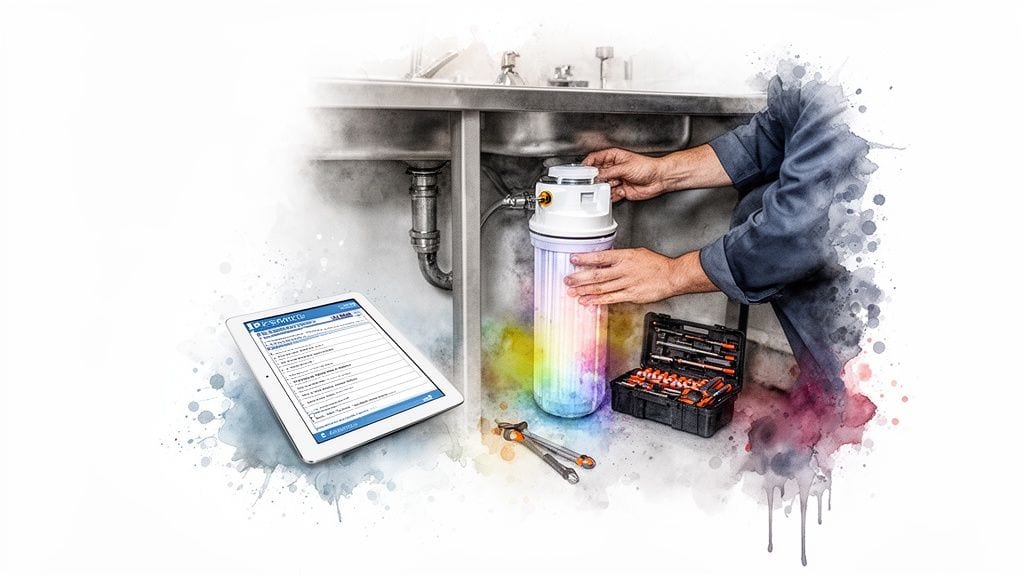
You've decided on the right commercial water purification system. That’s a huge win for your business. But what about the installation? Will it shut down my operations? And who is going to take care of it long-term?
A professional partner turns what could be a headache into a background process you never have to worry about. The goal is to make your system a reliable asset, not another problem to solve.
Keeping Your Business Running During Installation
A professional installation is built around one simple goal: minimal operational downtime. Your business can't just stop.
That's why installers work around your schedule. For a busy restaurant, that might mean an overnight install of a new RO system and water softener. The kitchen closes, the team gets to work, and by the time the morning prep crew arrives, everything is ready. For a corporate office, we can set up and plumb new bottleless coolers before the first employee arrives.
The process is designed to be quick, clean, and out of your way.
The Value of Proactive Maintenance
Once your system is running, the secret to its longevity is proactive maintenance. It’s just like getting the oil changed in your car—you follow a schedule to prevent problems.
Actionable Insight: Scheduled service isn't just an expense—it's insurance against failure. It guarantees your water quality stays consistent, protects your equipment, and helps you avoid emergency service calls that disrupt your budget and your business.
This forward-thinking approach is becoming the norm. The demand for reliable, high-quality water is pushing the commercial water treatment market to new heights—it's projected to expand at a 9.4% CAGR from 2026 to 2033 after crossing $45 billion globally in 2025. This isn't just a trend; it's a response to critical needs in offices, hotels, and hospitals where good water is non-negotiable. You can read more about the market's rapid growth.
What to Look For in a Service Plan
A solid service agreement removes all the guesswork and gives you a predictable, fixed cost for upkeep. For example, our bi-monthly service plans at Praz Pure Water are designed to keep your system humming along perfectly.
Here’s what any good plan should cover:
- Regular Filter Changes: This is the most critical task. Filters get clogged and lose their effectiveness, so they need to be replaced on a strict schedule.
- System Sanitization: A technician should sanitize RO tanks and water lines to prevent any microbial growth.
- Performance Audits: We test your water and inspect every component to spot small issues before they become expensive breakdowns.
- Salt Delivery for Softeners: If you have a water softener, a great service plan can include managing your salt supply and delivering it when you need it.
When these services are backed by a strong warranty, you get complete peace of mind. Handing off your system’s care to experts means you can get back to focusing on what you do best—running your business.
Your Essential Buyer Checklist Before You Purchase
Let's get down to brass tacks. Making a big investment like a commercial water purification system feels a lot better when you're confident you're making the right call. We've covered a lot of ground, and now it's time to put it all together into a practical checklist.
Use this as your guide for vetting any provider or proposal. A truly experienced partner will welcome these questions.
Water Quality and System Specifications
A great system starts with understanding your water. Without that, you're just guessing. Demand a solution that’s built for your building's specific water problems.
- Have you performed a professional, on-site water test? Ask to see the actual report. You'll want to know the hard numbers for Total Dissolved Solids (TDS), hardness (measured in Grains Per Gallon), and chlorine.
- Does the proposed system solve your main issues? If your water test flagged high hardness, you should see a water softener in the quote. If TDS is off the charts, a Reverse Osmosis system should be the star.
- Is the equipment certified by a third party? Look for the NSF (National Sanitation Foundation) seal. This is your assurance that the system does what it claims and is built with food-safe materials.
Your water quality report is your road map. Without it, any recommendation is just a guess. Insist on a solution built on real data, not assumptions.
Sizing and Future Needs
Once you know what contaminants to target, the next question is how much water you need. An undersized system will fail during your busiest hours, and an oversized one is a drain on your budget.
- Is the system sized for your peak daily water usage (GPD)? The provider should be able to walk you through their math, whether it's based on the number of seats in your restaurant, employees in your office, or units in your building.
- Did they ask about your future plans? If you're planning an expansion, a good system should be able to scale with you. A great partner will help you plan for that now so you don't have to start over later.
Service, Support, and Long-Term Value
The relationship doesn't end once the pipes are connected. The real value of a partnership shows up in the months and years after installation.
- What's actually included in the maintenance plan? Ask for a detailed list. Does it cover scheduled filter changes, system sanitization, and regular performance checks?
- What are the full warranty terms for the equipment and labor? Get clarity on what’s covered, for how long, and who to call when something goes wrong.
- Do they offer flexible agreements, like rentals or service bundles? These can be smart ways to get top-tier equipment and proactive service without a massive upfront capital expense.
Ready to invest in pure, reliable water that protects your business? The team at Praz Pure Water, Inc. has been designing and supporting custom solutions for Los Angeles businesses for over 20 years. We always start with a detailed water assessment to build a system that truly works for you. Start your journey to better water today.