
If you live anywhere in the Los Angeles area, you're almost certainly dealing with hard water. It’s a quiet problem that creates daily frustrations and slowly drains your wallet. Those chalky spots on your shower doors and the scratchy feel of your towels? Those are the classic calling cards of mineral-rich water—the very problem a house water softener is built to solve.
The Hidden Costs of Hard Water in Your LA Home
Have you ever pulled your glassware out of the dishwasher, only to find it's still cloudy? Or noticed your bright, new clothes feel stiff and look faded after just a few washes? These aren't random issues; they’re tell-tale signs of hard water, a problem plaguing homes all across Los Angeles.
Put simply, hard water is water that’s loaded with dissolved minerals, mainly calcium and magnesium. While it’s safe to drink, these minerals cause a whole host of problems that cost you real time and money. For example, in the Los Angeles area, it's not uncommon for water hardness to top 12 grains per gallon (GPG). That's well into the "very hard" classification and more than enough to cause serious issues around the house.
Practical Examples of Hard Water Damage
The impact of these minerals goes way beyond just being a nuisance. The buildup they leave behind, known as limescale, slowly but surely damages just about everything that comes into contact with your water.
- Appliance Inefficiency: Think of your water heater. Limescale forms a rock-hard coating on its heating element, forcing it to use up to 24% more energy just to get the water hot. The same buildup slowly chokes the life out of your washing machine, dishwasher, and coffee maker, leading to premature breakdowns.
- Plumbing Problems: Over the years, that same scale accumulates inside your pipes. It restricts water flow, causes a drop in water pressure, and can eventually lead to expensive plumbing repairs or even a complete repiping job. A real-world example is seeing your shower pressure weaken over time, not because of the city's supply, but because your pipes are slowly closing up.
- Increased Cleaning Product Usage: Here's a frustrating one. The minerals in hard water react poorly with soap and detergent, which keeps them from creating a good lather. You end up using way more soap, shampoo, and laundry detergent just to feel clean.
Actionable Insight: Look at your showerhead. If it's clogged with a white, crusty buildup, that's a direct visual of what's happening inside your pipes and appliances. This isn't a sign you're bad at cleaning—it's the direct result of hard water mineral deposits.
The Financial Drain of Doing Nothing
It all adds up faster than you’d think. You're spending more on energy because your water heater is working overtime. You're replacing expensive appliances years before you should have to. You’re constantly buying more cleaning supplies, detergents, and even skin lotions to combat the drying effects on your skin and hair.
A house water softener gets to the root of the problem by removing these minerals before they can enter your home's plumbing. It doesn’t just eliminate the daily headaches of spots and soap scum—it actively protects your investments and lowers your monthly bills, delivering real, tangible value from day one.
How a Water Softener Actually Works
It’s one thing to see the frustrating signs of hard water around your home, but it’s another to understand how a house water softener gets rid of the problem. Thankfully, the science behind it is surprisingly straightforward. It all boils down to a process called ion exchange.
Think of a water softener's main tank as being filled with thousands of tiny resin beads that act like powerful mineral magnets. These beads are loaded up with "soft" sodium ions.
When hard water from your main supply line flows into the tank, the "hard" minerals—mostly calcium and magnesium—come into contact with these beads. Since the hard minerals have a stronger magnetic pull, the resin beads eagerly grab onto them, swapping out a sodium ion in the process.
Simple Science: The resin beads prefer the hard minerals. They physically pull the calcium and magnesium out of your water and, in exchange, release a harmless sodium ion. This simple trade is the core of how water softening works, providing a clear benefit for your home.
This swap happens constantly as water moves through the system, so every drop that reaches your faucets, showerheads, and appliances has been softened.
The Science of Ion Exchange
So, what does that mineral-swapping process look like in action? It's a simple, continuous cycle.
- Hard Water In: Water from your main line is routed into the mineral tank, where it flows down through the bed of resin beads.
- Minerals Get Trapped: As the water passes through, the calcium and magnesium ions stick firmly to the resin beads.
- Sodium Gets Released: For every hard mineral ion the resin captures, a sodium ion is released into the water.
- Soft Water Out: The water, now free of hard minerals, flows out from the bottom of the tank and is distributed to the rest of your home.
As this diagram shows, letting hard water run unchecked doesn't just cause annoyances; it actively damages your home's plumbing and appliances, leading to costly repairs and replacements.
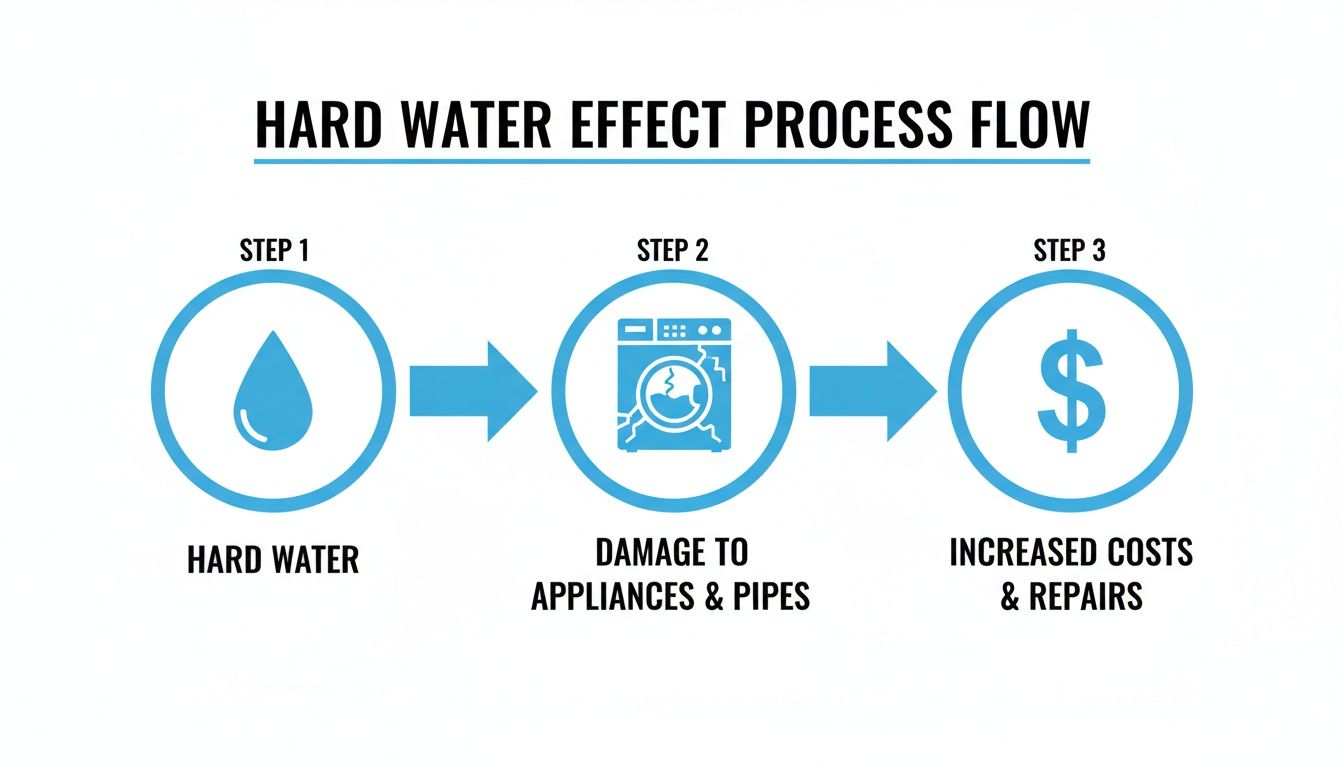
Hard water is more than an inconvenience—it's a direct threat to your home's infrastructure and your wallet.
Keeping the System Running with Regeneration
Eventually, those little resin beads become completely saturated with hard minerals and can't grab any more. That’s where the system’s automatic regeneration cycle kicks in to clean them off. Think of it as a reset button for your softener.
Your system is programmed to run this cycle when you're not using water, typically in the middle of the night. It draws a saltwater solution (brine) from a second, smaller tank and uses it to flush the main mineral tank.
This concentrated brine wash is strong enough to break the bond between the resin beads and the captured hard minerals, forcing them off. The system then flushes all that mineral-packed saltwater down the drain. The resin beads are left clean, recharged with a fresh supply of sodium ions, and ready to start softening your water again. It's a completely hands-off process that keeps your water soft day after day.
Choosing the Right Water Softener for Your Home
Okay, you've decided it's time to do something about your home's hard water. That's the first step. Now comes the important part: picking the right system. Not all house water softeners are created equal, and the best one for you really boils down to your family’s size, your daily water habits, and frankly, how much you want to think about maintenance.
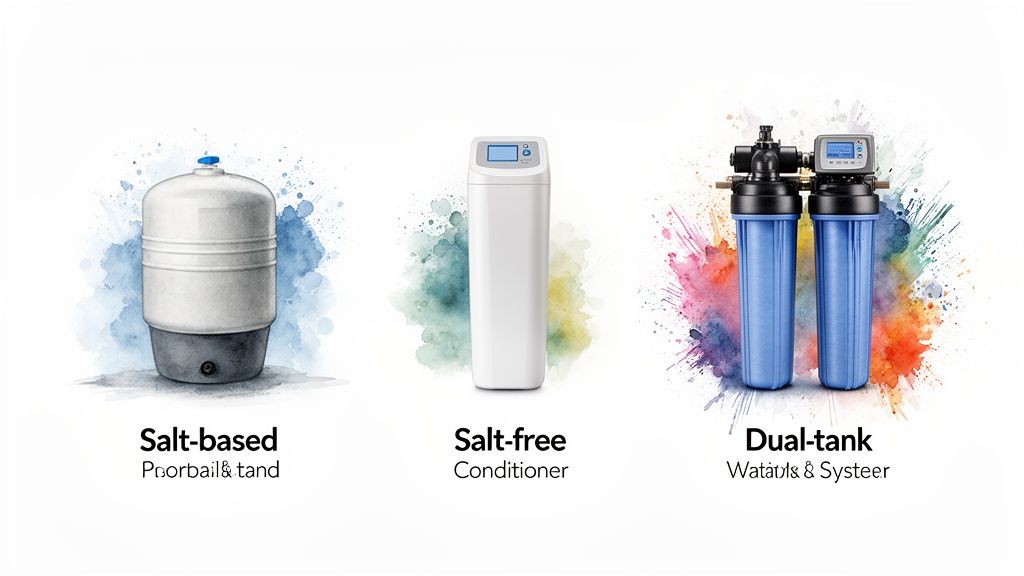
To make a smart choice, you need to understand the main players on the market. Let's walk through the three most common types you'll encounter: traditional salt-based systems, salt-free conditioners, and the heavy-duty dual-tank softeners.
Traditional Salt-Based Ion Exchange Softeners
This is the system most people picture when they think of a water softener, and for good reason. It’s the industry standard because it works. As we touched on earlier, these systems use a process called ion exchange to physically pull the hard minerals—calcium and magnesium—right out of your water, swapping them for soft sodium ions.
This is the only technology that gives you truly soft water and all the perks that come with it. We're talking no more soap scum, scale-free appliances, and that noticeably softer feel on your skin and hair.
- How It Works: Your water passes through a tank full of resin beads that grab onto the hardness minerals. Every so often, the system flushes itself with a saltwater brine solution to clean the beads and wash the captured minerals down the drain. This is called regeneration.
- Best For: Most homeowners, especially in places like Los Angeles with notoriously hard water. If you want to get rid of scale and all the other frustrations of hard water for good, this is your gold standard.
- Maintenance: You'll need to add salt to the brine tank every one to two months. The exact timing depends on how hard your water is and how much you use.
Practical Example: A family of four in the San Fernando Valley is tired of seeing a white film on their brand-new dishwasher. They choose a salt-based system because their top priority is protecting their appliances and finally stopping the endless cycle of scrubbing spots off their dishes and shower doors.
Salt-Free Water Conditioners
Here's where things can get a little confusing. The term "salt-free water softener" isn't entirely accurate. A better name is "water conditioner." Instead of removing hardness minerals, these systems use a slick process called Template Assisted Crystallization (TAC) to change their physical form.
This technology converts the minerals into tiny, stable crystals that can’t stick to surfaces. So, while it does a great job preventing scale buildup in your pipes and water heater, it doesn't actually soften the water. You won't get that silky feeling on your skin or see a big difference in how your soap lathers.
- How It Works: A special media inside the tank acts as a catalyst, transforming hardness minerals into microscopic crystals that simply flow through your plumbing without causing scale.
- Best For: Homeowners whose only goal is preventing scale damage, people on very strict sodium-free diets, or those living in communities with brine discharge regulations.
- Maintenance: This is their biggest selling point: they require virtually no maintenance. No salt bags to haul, no regeneration cycles, and no electricity needed.
High-Efficiency Dual-Tank Systems
For big families, busy households, or even small businesses, a dual-tank system is the top-tier solution. Think of it as a supercharged version of a traditional salt-based softener, built to provide an endless supply of soft water, 24/7.
A standard single-tank system has a small vulnerability: it can't soften water while it's regenerating. A dual-tank setup fixes that by using two resin tanks. When one tank is exhausted and needs to regenerate, the system automatically flips over to the fresh second tank.
This means you never have to deal with downtime or hard water "bleeding through"—a common issue with single tanks during periods of high water use, like when laundry, showers, and the dishwasher are all running.
- How It Works: Two resin tanks work as a team. One is always active while the other is on standby or regenerating, ensuring you have perfectly soft water around the clock.
- Best For: Large households (5+ people), homes with lots of bathrooms, and any situation where water demand is high or unpredictable. They're also perfect for commercial settings like restaurants or salons.
- Maintenance: It’s the same as a single-tank system—you still add salt—but these systems are smarter. They use salt and water more efficiently because they only regenerate exactly when needed.
Water Softener System Comparison
Use this table to quickly compare the most common water treatment systems and find the best fit for your home's needs.
| System Type | How It Works | Best For | Maintenance Needs | Scale Removal |
|---|---|---|---|---|
| Salt-Based Ion Exchange | Physically removes hardness minerals using resin and salt. | Most homes seeking complete hard water elimination. | Add salt every 1-2 months. | Yes, removes existing scale and prevents new buildup. |
| Salt-Free Conditioner | Crystallizes minerals to prevent them from sticking to surfaces. | Homes focused only on scale prevention; low-maintenance priority. | None, media may need replacing every 5-7 years. | No, only prevents new scale, does not remove existing. |
| Dual-Tank System | Two salt-based tanks provide a continuous flow of soft water. | Large families, high-demand homes, and commercial use. | Add salt (often less frequently than a single tank). | Yes, provides the most consistent scale protection. |
Ultimately, choosing between these options is about matching the technology to your priorities. For a deeper dive into sizing a system for your home, check out our guide on how to choose a water softener. By weighing your needs against the strengths of each system, you can find the perfect house water softener and start enjoying better water.
Understanding Water Softener Costs and Installation
When you're thinking about getting a water softener, the price tag on the unit is only one part of the story. To make a smart investment, you need to look at the whole picture—from the equipment and installation to the salt you'll need down the road.
Let's walk through what really goes into the cost of a water softener and why getting it installed correctly is the most important step.
Sizing Your System: The First Step to an Accurate Quote
Before you can even start comparing prices, you have to know what size system your home needs. This is a crucial first step. If you get a softener that’s too small, it will constantly be running to keep up and won't soften your water effectively. Go too big, and you'll just be wasting salt and water during unnecessary regeneration cycles.
Professionals figure out the right size using a straightforward calculation. It’s based on how much water your family uses and just how hard your water is.
You can do a rough estimate yourself:
(# of People in Home) x (75 Gallons Per Person Daily) x (Your Water’s Hardness in GPG) = Grains to Remove Daily
So, for a family of four living in an area like Los Angeles with water hardness around 15 GPG (Grains Per Gallon), the math would look like this: 4 people x 75 gallons x 15 GPG = 4,500 grains per day. This number tells a pro what capacity your softener needs to handle your home’s demand efficiently.
Breaking Down the Total Cost of Ownership
The "total cost" is what you'll actually spend over the life of the system, not just what you pay on day one. It's helpful to break it down into three main parts.
- The Unit Itself: The initial purchase price can vary quite a bit. You might find basic, single-tank systems starting around $800, while more advanced, high-efficiency dual-tank models can be $3,000 or more.
- Professional Installation: This is a critical expense. Depending on how complex your plumbing is, expect to pay anywhere from $400 to $1,200. Costs can go up if new pipes or a dedicated drain line have to be installed.
- Ongoing Salt: This is your only regular maintenance cost. For most families, a couple of bags of salt every few months is typical, usually adding up to $100-$200 per year.
Purchase vs. Rental: Which Is Right for You?
That initial investment can feel steep, which is why many people are now looking at rental options. It’s a great way to get all the benefits of soft water without the large upfront expense.
Actionable Takeaway: Ownership vs. Renting
Purchasing means the system is yours. It's usually the most cost-effective choice if you plan on staying in your home for the long haul (10+ years).
Renting gets you a top-of-the-line system for a low monthly fee. It also means all maintenance, service calls, and repairs are covered, giving you total peace of mind.
Praz Pure Water’s rental program, for example, bundles the softener, professional installation, and all future servicing into one predictable monthly payment. This makes it a fantastic, worry-free option for renters or any homeowner who prefers a simple, service-focused solution.
Why Professional Installation Is Non-Negotiable
You might be tempted to watch a few videos and try installing a water softener yourself to save a few hundred dollars. But when you’re dealing with your home's main water supply, this is one area where you really shouldn't cut corners.
Hiring a qualified plumber isn't just a convenience; it's insurance for your home and your new equipment. When considering a pro, it helps to understand what influences a homeowner's hiring decision to ensure you find a reliable expert. Here’s the value a professional installer guarantees:
- Correct Sizing: They’ll test your water and assess your home's plumbing to ensure you get the perfect unit for your actual needs.
- Code Compliance: A licensed pro knows the local plumbing codes inside and out, keeping your home safe and avoiding any potential issues down the line.
- Warranty Protection: Almost every manufacturer's warranty becomes void if the system isn't installed by a licensed professional.
- Peak Performance: Proper installation ensures the softener is set up for optimal efficiency, which saves you money on salt and water from day one.
Ultimately, professional installation protects your investment, keeps your warranty valid, and gives you the confidence that your system will work perfectly for years to come.
Simple Maintenance for Long-Lasting Performance
You’ve made a great investment in your home by installing a house water softener. The best part? Keeping it running perfectly for its full 10- to 15-year lifespan is surprisingly simple. Modern systems are built to be incredibly low-maintenance, and the few tasks required are things any homeowner can easily manage.
At its core, your main job is just to keep the brine tank filled with the right kind of salt. Without it, the system can't run its "regeneration" cycle to clean the resin beads. When that happens, you’re right back where you started—with hard water flowing through your pipes.
Keeping Your System Running Smoothly
The only thing you'll need to do regularly is add salt. Just take a peek inside the brine tank about once a month. You'll know it's time for a top-up when the water level is higher than the salt level. A good habit is to always see salt crystals sticking out above the water.
When you do add more, avoid filling the tank all the way to the top. Just go about halfway or two-thirds full. This simple trick helps prevent the older salt at the bottom from clumping into a solid mass, which can cause problems down the road.
You'll find a few different types of salt at the store:
- Evaporated Salt Pellets: This is the top-tier option—over 99.9% pure sodium chloride. Because it's so clean, it dissolves well and is the least likely to cause clogs or "mushing" in your tank.
- Solar Salt Crystals: Made by evaporating seawater, this type is also very pure (around 99.6%). It's a fantastic, budget-friendly choice that works great in most softeners.
- Rock Salt: This is your cheapest option, but it comes with a trade-off. It contains more dirt and minerals that don't dissolve, which can build up as sludge in your brine tank over time, meaning you’ll have to clean it out more often.
Spotting and Fixing Common Issues
Even with the best care, you might eventually encounter a salt bridge. This is exactly what it sounds like: a hard crust of salt forms just above the water level, creating an empty air pocket underneath. The system can't pull in the salty brine it needs for regeneration, and suddenly your water feels hard again.
Actionable Tip: Fixing a salt bridge is usually easy. First, try giving the outside of the tank a few gentle taps with a rubber mallet to see if you can break it up. If that doesn't work, grab a broom handle and carefully push down on the top of the crust until it collapses.
Taking care of your water softener is just one piece of the homeownership puzzle. It's smart to add it to a comprehensive seasonal home maintenance checklist to make sure all your home's systems are getting the attention they need.
The Value of Professional Service Plans
Of course, if you'd rather not think about any of this, a professional service plan is the ultimate set-it-and-forget-it solution. With a program like the Praz Pure Water rental, you can completely offload all maintenance. A technician will handle everything—from periodic checkups to topping off your salt and making sure the system is running at peak efficiency. It’s total peace of mind and guaranteed soft water, no effort required.
Creating a Complete Home Water Solution
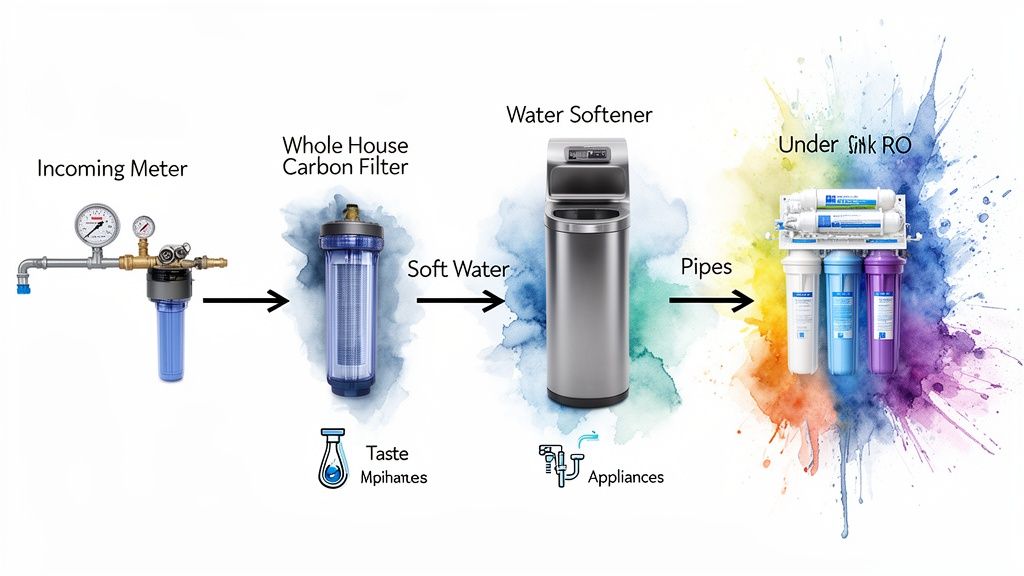
Think of a water softener as a highly specialized tool. It has one critical job—tackling the hardness minerals that cause frustrating scale buildup—and it does that job better than anything else. But what about the other things lurking in your water? A house water softener isn't built to remove contaminants like chlorine, sediment, or chemicals that give your water an unpleasant taste and smell.
A good way to look at it is that a softener protects your home’s "circulatory system"—your pipes, water heater, and appliances—from the damaging effects of hard water. It’s essential, but it isn't a silver bullet for every water quality issue you might face.
If you want water that’s not only soft but also tastes and smells fantastic, you'll need to layer in other key systems. This is how you build a complete solution that handles everything.
The Perfect Partner for Your Softener: A Whole-House Carbon Filter
Does your tap water ever smell a bit like a swimming pool? That’s almost always chlorine or its cousin, chloramine. Cities use these disinfectants to keep the water supply safe during transit, but they don't do any favors for the taste and feel of the water in your home.
This is where a whole-house carbon filter comes in. It’s the perfect companion to your softener, installed right alongside it to act like a giant sponge for chemicals. As water passes through the activated carbon media, it grabs and holds onto contaminants.
- Chlorine and Chloramines: This is the big one. A carbon filter instantly gets rid of that chemical taste and odor, making your water far more refreshing from every faucet.
- Volatile Organic Compounds (VOCs): These are various industrial chemicals and solvents that can sometimes make their way into municipal water.
- Sediment and Particulates: Carbon filters also do a great job of trapping fine dirt and rust particles, making your water visibly cleaner.
Actionable Insight: By pairing a softener with a whole-house carbon filter, you get the best of both worlds. The softener stops scale in its tracks to protect your home, while the carbon filter removes the chemicals for better-tasting water you can enjoy drinking and bathing in.
Purified Drinking Water with Reverse Osmosis
While a carbon filter makes a huge difference in your water's overall quality, some of us want an even higher level of purity for drinking and cooking. For that, a Reverse Osmosis (RO) system is the undisputed gold standard.
An RO system is a "point-of-use" filter, which means it’s typically installed right under your kitchen sink to feed a special, dedicated faucet. It delivers water that is truly bottled-water quality. It works by forcing water through an ultra-fine membrane that strips out up to 99% of all dissolved solids—we’re talking about things like salts, lead, fluoride, and many other tiny contaminants that a softener or carbon filter simply can't catch.
When you combine these systems, you create a powerful, multi-layered defense. The softener handles the hardness, the carbon filter tackles chemicals for the entire house, and the RO system delivers exceptionally pure water right where you use it most. To get a deeper dive into this layered strategy, you can explore our guide on the best water filtration system for a whole house. It’s how you go from having okay water to having truly pristine water for every single need.
Your Top Water Softener Questions, Answered
It's completely normal to have questions before bringing a new appliance into your home, and a water softener is no exception. From taste and safety to lifespan, you want to be sure you're making the right call. We've heard all the common concerns from homeowners over the years, so let's clear them up in a straightforward way.
Will My Water Taste Salty?
This is probably the number one question we get, and it's a great one. The short answer? No, it shouldn't. While a softener uses salt in its regeneration process, it’s not dumping that salt directly into your drinking water.
The ion exchange process swaps out hard minerals for a tiny, trace amount of sodium. It's so minimal you can't taste it. For a little perspective, a glass of softened water typically has less sodium than a single slice of white bread.
Is Soft Water Safe to Drink?
That naturally leads to the next big question: is it safe for my family? For almost everyone, the answer is a big yes. Soft water is perfectly safe for drinking, cooking, and everything else.
The only time for a second thought is if someone in your home is on a strict, doctor-ordered low-sodium diet. In that case, the best solution is to pair your softener with a reverse osmosis (RO) system at the kitchen sink. The RO unit will remove the added sodium and other impurities, giving you the best of both worlds. You can get a much deeper explanation on why water might taste salty with a softener and what it really means.
Key Takeaway: Softened water is completely safe and tastes great for the vast majority of households. For those with specific sodium-related health concerns, an RO system offers a perfect, purified solution for drinking water.
How Long Does a Water Softener Last?
A water softener isn't just a purchase; it's an investment in your home. So, how long will it last? With proper care, a quality house water softener can easily last 10 to 15 years, and we've seen some high-end units go even longer.
Getting the most out of your system really comes down to simple, consistent maintenance. Here’s what matters most:
- Using high-quality salt to avoid clogs and "salt bridges" in the tank.
- Keeping the brine tank filled to the right level so it can regenerate properly.
- Scheduling periodic professional service to tune up the system and catch any small issues before they become big problems.
With just a little attention, a water softener will protect your plumbing and appliances from hard water for more than a decade. It's truly one of the most durable and valuable upgrades you can make for your home.
Ready to put an end to hard water problems for good? The experts at Praz Pure Water, Inc. can help you find the perfect water softening solution for your Los Angeles home. Contact us today for a free water assessment!