
To get rid of hard water, your best bet is a whole-home solution. A water softening system uses a process called ion exchange to physically remove minerals, while a salt-free conditioner alters minerals to prevent scale buildup. For quicker, more targeted relief, showerhead filters and even boiling water can provide a temporary fix.
The Hidden Costs of Hard water in Your Home
Have you ever battled those stubborn white spots on your glass shower door or scrubbed the chalky film out of your coffee maker? That's the tell-tale sign of hard water, a widespread issue caused by high levels of dissolved minerals like calcium and magnesium. It might seem like a small annoyance at first, but over time, the impact on your home, appliances, and wallet can be significant.
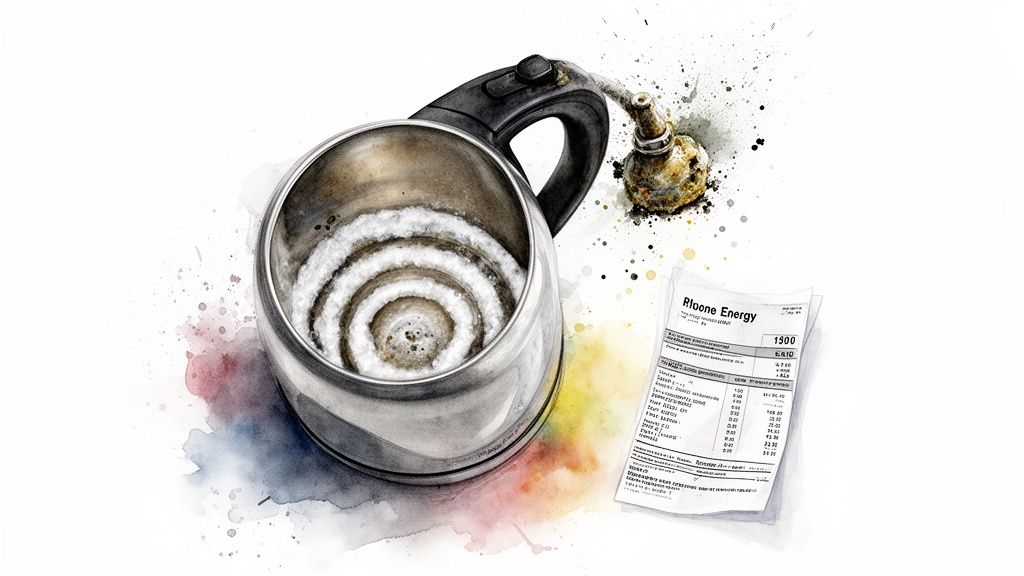
The biggest problem with hard water is limescale—that crusty, chalk-like deposit that appears anywhere water evaporates. Limescale isn't just unsightly; it's actively destructive. It clogs showerheads, coats faucets, and leaves a cloudy film on your dishes that never seems to wash away. If left unaddressed, these mineral deposits can cause serious, and often expensive, damage to your plumbing and every appliance that uses water.
Your Appliances Are Working Harder, Not Smarter
Think of limescale as a layer of insulation where you least want it. It significantly reduces the efficiency of any appliance that heats water. Your water heater is the primary victim. As scale forms a crust around the heating element, the unit must use more energy to heat the water to your desired temperature. Studies show this can reduce its efficiency by up to 30%, leading directly to a higher utility bill every month.
This inefficiency affects other essential appliances as well:
- Dishwashers: Mineral deposits clog spray arms and internal parts, which means your dishwasher not cleaning dishes effectively, leaving them spotty and dull, no matter how much detergent you use.
- Washing Machines: Hard water minerals react poorly with laundry detergent, creating soap scum that leaves clothes feeling stiff and looking faded. The scale also slowly wears down internal components, shortening the machine's lifespan.
- Coffee Makers & Kettles: These small appliances are magnets for scale due to constant heating. This not only hurts their performance but can also ruin the taste of your morning coffee or tea.
Actionable Insight: The real cost of hard water isn't a single large repair bill. It's the slow, steady drain on your finances from higher energy costs, increased use of soaps and detergents, and replacing expensive appliances years before you should.
The Impact on Your Skin and Wallet
The trouble with hard water extends beyond your pipes and appliances. The same minerals that build up in your kettle also leave a residue on your skin and hair. This invisible film can clog pores, leading to dry, itchy skin, and can make your hair feel brittle and look lifeless.
You'll likely notice you're using far more soap, shampoo, and conditioner just to get a decent lather, as the minerals prevent them from working properly. You end up buying more cleaning products for your home and more lotions for your skin. When you add it all up, learning how to reduce water hardness isn't just about convenience—it's a smart financial decision that provides immediate value.
How to Test Your Water Hardness at Home
So, you suspect you have hard water. Before you can solve the problem, you need to know exactly what you're dealing with. Determining how hard your water is is the critical first step, and the good news is you can get a solid answer right in your own kitchen.
The Quick and Easy Soap Test
The simplest way to get a basic "yes or no" answer is the classic DIY soap suds test. All you need is a clean, clear bottle with a secure lid and some pure liquid soap, like Castile soap. Avoid using detergents.
Here’s your action plan: Fill the bottle about one-third full with tap water, add a few drops of soap, and shake it vigorously for about 15 seconds.
- Lots of fluffy suds? If the top is full of bubbles and the water below is mostly clear, you likely have soft water.
- Barely any lather? If you see cloudy, milky water with a scummy film instead of rich suds, that's a classic sign of hard water. The minerals are reacting with the soap and creating soap scum.
Getting a Precise Number
The soap test confirms the problem, but it doesn't measure its severity. For that, you need a specific measurement. This is where water hardness test strips are useful. You can easily find them online or at any home improvement store.
Using them is simple: dip a strip into a glass of tap water for a few seconds, pull it out, and watch the color change. Then, match the color to the chart included in the kit. This will give you a specific reading, typically in both Grains per Gallon (GPG) and Parts per Million (PPM).
Knowing your GPG is the most valuable piece of information you can have when shopping for a water softener.
Actionable Insight: Don't just test your kitchen tap. For a more complete picture, test water from an outdoor spigot as well. This gives you a baseline reading of the water entering your home before it passes through any existing, and possibly failing, filtration systems.
To make sense of your results, you need to know what the numbers mean.
Interpreting Your Water Hardness Test Results
Here’s a clear breakdown of the standard classifications for water hardness. This will help you understand just how serious your mineral buildup problem is and what action to take.
| Classification | Grains per Gallon (GPG) | Parts per Million (PPM) |
|---|---|---|
| Soft | 0 – 3.5 | 0 – 60 |
| Moderately Hard | 3.5 – 7.0 | 61 – 120 |
| Hard | 7.0 – 10.5 | 121 – 180 |
| Very Hard | Over 10.5 | Over 180 |
Practical Example: If your test strip shows a reading of 12 GPG, you're officially in the "very hard" category. This clear data empowers you to choose the right solution instead of just guessing.
When to Call in a Professional
DIY tests are fantastic for an initial diagnosis. However, if your results come back in the "very hard" range (over 10 GPG), or if you notice other issues like a rotten-egg smell (sulfur) or rust stains (iron), it’s a smart move to get a professional water analysis.
A water treatment specialist can perform a comprehensive test that goes far beyond just hardness. They can check for chlorine, iron, sediment, and other contaminants that test strips won't catch. This detailed report ensures that the system you invest in—whether it's a salt-based softener or a multi-stage filter—is perfectly suited to your home's unique water profile, ensuring your money is well spent.
Permanent Solutions for Reducing Water Hardness
When you're tired of the endless cycle of scrubbing scale and dealing with spotty dishes, it's time to consider a permanent fix. A whole-home system treats every drop of water entering your house, representing a long-term investment in your plumbing, appliances, and daily comfort.
The two main options are ion-exchange water softeners and salt-free water conditioners. They both solve the problems caused by hard water but in completely different ways. Understanding this difference is key to choosing the right system for your home.
The Gold Standard: Ion-Exchange Water Softeners
If you've heard of a water softener, this is almost certainly what comes to mind. An ion-exchange system is the classic, time-tested solution because it physically removes the minerals—calcium and magnesium—that make water hard.
The process is straightforward: The system has a tank filled with tiny resin beads coated in sodium ions. As hard water flows over these beads, the calcium and magnesium ions are pulled out of the water and stick to the resin. In exchange, the resin releases sodium ions into the water. The result is genuinely soft water flowing to every faucet.
This method is incredibly effective. Across the United States, a staggering 85% of homes have hard water, according to the U.S. Geological Survey. For homeowners in areas with very hard water, a softener can achieve up to a 95% hardness reduction.
Practical Example: A family with notoriously hard water was replacing their kettle every year due to severe scale buildup. After installing an ion-exchange softener, they not only saved their kettle but also noticed their laundry was brighter, their skin felt less dry, and they were using 50% less dish soap and laundry detergent. This is the value a softener brings.
A Different Approach: Salt-Free Water Conditioners
For those who want a low-maintenance solution, salt-free water conditioners are a great alternative. It’s important to know that these systems don't soften water in the traditional sense; they condition it. This means they don't actually remove the hard minerals.
Instead, they use a process called Template Assisted Crystallization (TAC). As water passes through the system, the hardness minerals are transformed into microscopic crystals that cannot stick to pipes, fixtures, or heating elements. They simply flow through your plumbing and down the drain without causing limescale.
Here’s why this is a popular choice:
- No Salt or Regeneration: You never have to buy or carry heavy bags of salt, and the system doesn't need a regeneration cycle that flushes brine into the sewer, making it more eco-friendly.
- Retains Healthy Minerals: Since calcium and magnesium remain in the water (just in a different form), you still get their potential health benefits.
- Protects Plumbing and Appliances: It achieves the main goal of preventing scale, which extends the life and efficiency of your water heater, dishwasher, and other appliances.
This flowchart can help you visualize the decision-making process, from testing your water to choosing a path forward.
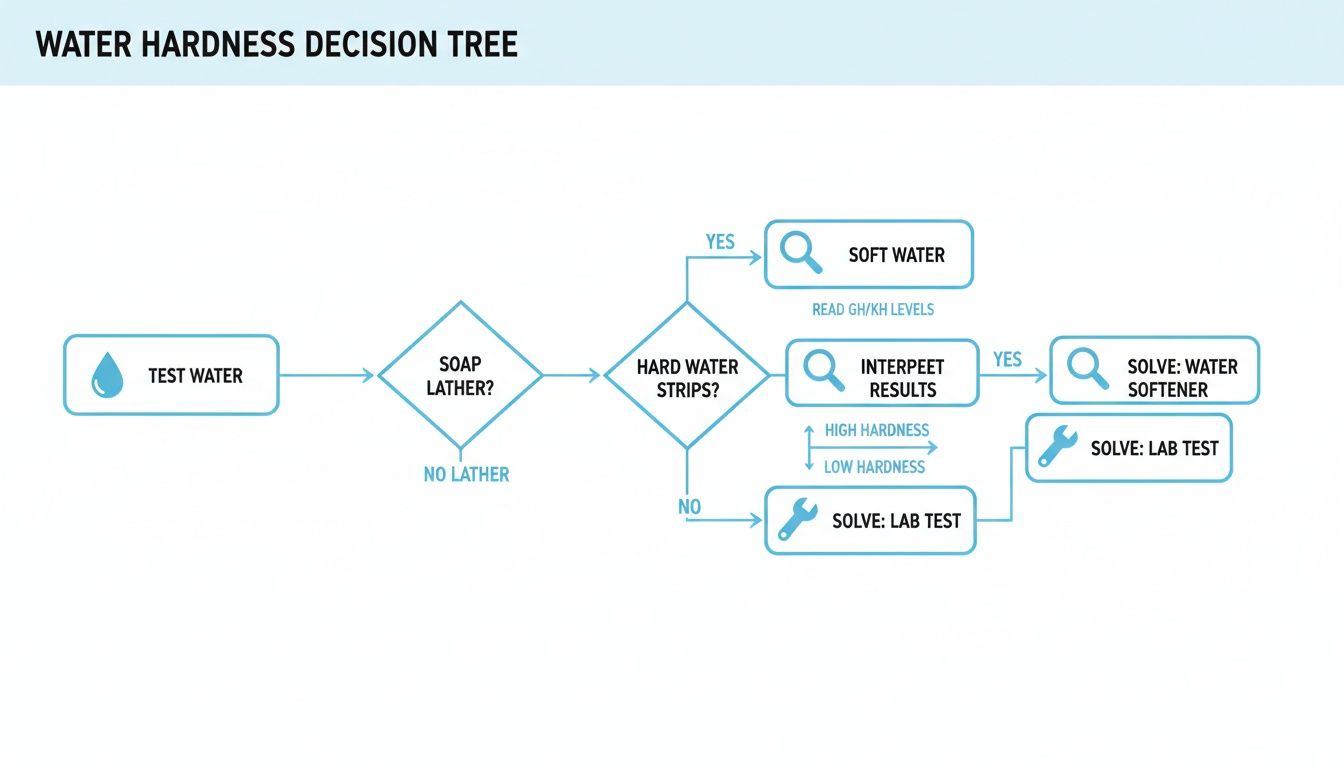
As you can see, once you've confirmed you have a hard water problem, the next actionable step is choosing a solution that fits your home's unique needs.
Making the Right Choice for Your Home
So, which one is right for you? It boils down to your priorities. Are you focused on preventing scale with zero maintenance? Or do you want all the benefits that come with truly soft water, like silky skin and better soap lather?
To make it easier, here is a head-to-head comparison to help you decide.
Ion-Exchange Softeners vs Salt-Free Conditioners
| Feature | Ion-Exchange Water Softener | Salt-Free Water Conditioner |
|---|---|---|
| Primary Function | Removes hardness minerals (calcium & magnesium) | Prevents scale buildup by crystallizing minerals |
| Maintenance | Requires you to regularly add salt | Virtually maintenance-free |
| "Soft Water" Feel | Yes—you'll notice the classic slippery feel & better lather | No—the water will feel the same as before |
| Environmental Impact | Uses salt and discharges a brine solution during regeneration | No salt or wastewater discharge |
| Best For | Homes with very hard water seeking all the benefits of soft water | Homeowners who want effective scale prevention with minimal upkeep |
For those in areas with severely hard water, a comprehensive whole house water softener system is often the most complete and effective long-term investment.
Ultimately, both systems provide a powerful, permanent solution to the headaches of hard water. By looking at your water test results, your budget, and what you hope to achieve, you can confidently pick the technology that will serve your home well for years to come.
Need a Quick Fix? Point-of-Use and Temporary Solutions
While a whole-home system is the ultimate solution, it's a significant step. If you're renting, on a tight budget, or just need relief from hard water now, there are plenty of effective and affordable options that can make an immediate difference by tackling the problem right where it bothers you most.
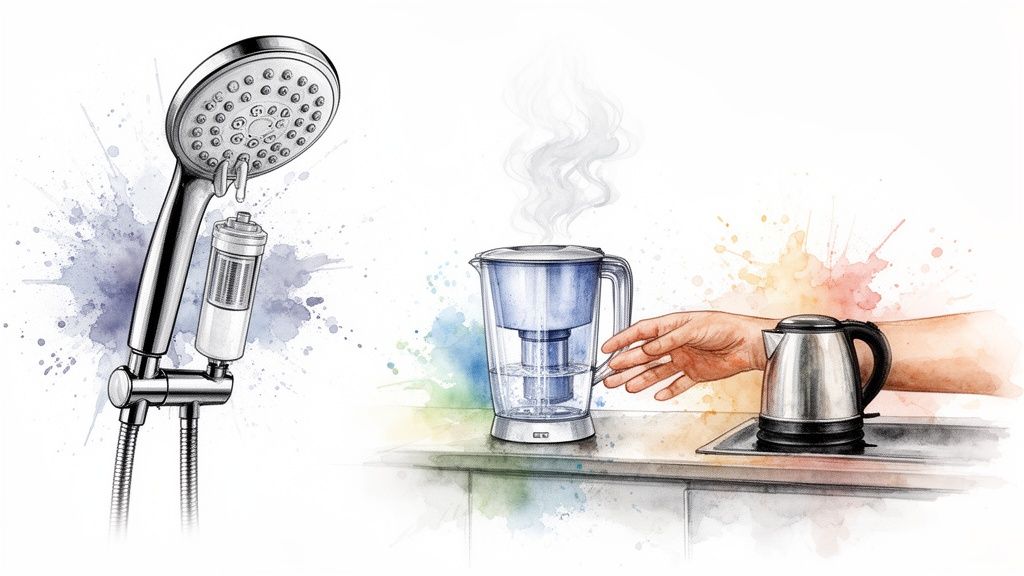
These point-of-use fixes are all about strategic intervention. Instead of treating every drop of water, you focus on the specific faucets and fixtures you use daily for showering, cooking, and drinking.
Upgrade Your Shower for Softer Skin and Hair
For many people, the daily frustration with hard water is personal—that dry, tight feeling on your skin and the brittle, dull look of your hair. A simple showerhead filter can be a game-changer, especially for renters. These filters are incredibly easy to install; they just screw on between the shower arm and your current showerhead, a task you can do yourself in under ten minutes.
Most of these filters use a blend of filtration media, like KDF and activated carbon, to target not just hardness minerals but also chlorine.
- Practical Example: Imagine a renter who installs a showerhead filter. Within a week, they notice their skin is no longer itchy after showering, and their hair feels softer and is easier to style. It's a small, actionable investment for a huge improvement in daily comfort and well-being.
A showerhead filter directly addresses the most common personal complaints about hard water. It's a low-cost, high-impact solution you can implement this afternoon.
Simple Kitchen Fixes for Better-Tasting Water
In the kitchen, hard water can affect the taste of your coffee, leave spots on your dishes, and slowly damage your small appliances with scale buildup. Thankfully, a few simple tools can make a significant difference.
A water filter pitcher is a common starting point. While basic models primarily handle chlorine and taste, you can find advanced versions designed specifically to reduce hardness minerals like calcium and magnesium. They provide great-tasting, softer water for drinking and cooking. If you're curious about the technology, our guide on how water filtration works explains it clearly.
Boiling water is another surprisingly effective method. It works best on what's known as "temporary hardness." When you boil water, some bicarbonate minerals precipitate out and stick to the bottom of your kettle as limescale. While not practical for your whole house, it’s a free and easy way to soften small batches of water for tea or coffee.
Choosing the Right Point-of-Use Method
Which quick fix is right for you? It depends on the problem you're trying to solve. Here’s a quick guide to help you take action.
| Solution | Best For | How It Works | Key Benefit |
|---|---|---|---|
| Showerhead Filter | Improving skin and hair health | Filters minerals and chlorine at the shower | Immediate relief from dryness and irritation |
| Water Filter Pitcher | Better drinking and cooking water | Uses activated carbon and ion-exchange resin | Removes hardness, chlorine, and improves taste |
| Boiling Water | Cooking, coffee, and tea | Precipitates temporary hardness minerals | Simple, no-cost method for small batches |
These targeted fixes are empowering. They offer affordable, actionable ways to combat the daily annoyances of hard water while you consider a more permanent, whole-home solution. They prove you don’t have to just put up with it.
Maintaining Your System for Lasting Performance
Installing a water treatment system is a major victory against hard water. To ensure that investment pays off for years, consistent maintenance is key. Think of it not as a chore, but as a simple routine to keep a vital piece of home equipment running at its best, providing lasting value.
Modern systems are designed to be low-maintenance. Whether you have a salt-based softener or a salt-free conditioner, a little care will keep it working efficiently and help you avoid expensive repairs.
Salt-Based Softener Care
If you have an ion-exchange softener, your main responsibility is straightforward: keep the brine tank filled with salt. Salt is what recharges the resin beads so they can continue to remove hardness minerals. A good habit is to check the salt level once a month.
As a general rule, keep the tank at least one-third full. If it runs empty, your system will stop softening the water, and you'll quickly see spots reappear on your glassware.
When it’s time to refill, you'll find a few types of salt:
- Evaporated Salt Pellets: This is the highest quality option—up to 99.9% pure. It’s what most manufacturers recommend because its purity leaves very little residue in your tank.
- Solar Salt Crystals: Made from evaporated seawater, this is a solid, more affordable alternative. It's slightly less pure, so you may need to clean your tank more often.
- Rock Salt: This is the cheapest option but contains more insoluble minerals that can build up as sludge in your tank, potentially causing clogs.
Actionable Insight: Avoid filling the brine tank to the very top. Leaving a few inches of space helps prevent "salt bridging," where a hard crust forms over the water. This crust stops the salt from dissolving, preventing the softener from regenerating until you break it up.
Upkeep for Salt-Free Conditioners
A major benefit of a salt-free water conditioner is its minimal upkeep. There’s no salt to add and no regeneration cycle, making it a "set it and forget it" solution for scale prevention.
However, low-maintenance isn't no-maintenance. Most salt-free conditioners are installed with a sediment pre-filter. This filter acts as a bodyguard for your system, catching dirt, sand, and rust before they can damage the conditioning media.
You’ll need to replace this pre-filter cartridge periodically—usually every 6 to 12 months, depending on your water quality. A clogged filter can't protect your system and can even lower your home’s water pressure. Fortunately, changing it is a quick job, typically taking less than 15 minutes.
The Value of a Professional Checkup
Regardless of your system type, having a professional inspect it every year or two is a smart move. A technician can spot small issues before they become major problems. While knowing how to descale a coffee machine is useful, a professional tune-up for your water system helps prevent that scale from forming in the first place.
During a service call, a technician will typically:
- Test Your Water: They'll confirm the system is working correctly by testing the treated water.
- Inspect the System: This includes checking for leaks, cleaning injectors, and ensuring all mechanical parts are in good condition.
- Optimize Settings: For softeners, they can adjust the regeneration schedule to match your water usage, which can save you money on salt and water.
This preventative care ensures your system’s longevity and guarantees you continue to receive the full benefits of your investment every day.
Common Questions About Water Softening
Deciding to tackle your home’s hard water often brings up many questions. This is completely normal. It’s a significant investment in your home, so you want to feel confident in your choice. Let's walk through the most common concerns to provide clear, straightforward answers.
My goal is to cut through the jargon so you can understand how these systems work and what to expect.
Will a Water Softener Make My Drinking Water Salty?
This is the number one question we hear, and it stems from a common misunderstanding. While traditional softeners use salt (sodium chloride) to clean their resin beads, they are designed to add only a very small amount of sodium to your water—not the chloride that creates a "salty" taste.
To put it in perspective, the amount of sodium in an 8-ounce glass of softened water is often less than what’s in a single slice of white bread. Most people never notice a difference.
However, if you are on a strict low-sodium diet or prefer the purest taste for drinking, there is an excellent solution. We often pair a whole-house softener with an under-sink Reverse Osmosis (RO) system. This setup gives you the best of both worlds: the RO unit filters out the added sodium and other impurities, delivering exceptionally pure water right at your kitchen tap. Learning more about why softened water might taste different can offer additional peace of mind.
A common myth is that softened water tastes salty. In reality, the sodium level is incredibly low. For anyone with health concerns or a preference for pure taste, a Reverse Osmosis system is the perfect partner for a softener.
What Is the Difference Between a Water Softener and a Water Filter?
It's helpful to think of them as specialists with two different jobs. A water softener has one specific mission: to remove the minerals—calcium and magnesium—that cause destructive limescale. It’s the expert you hire to protect your pipes, water heater, and appliances.
A water filter, on the other hand, is a generalist. Its job is to address a wider range of contaminants to improve your water's overall taste, smell, and safety. This can include chlorine, sediment, pesticides, and lead.
For the best possible water quality, the ideal setup often involves both systems working together. The softener handles the scale, and a filter takes care of everything else.
How Much Does a Whole-Home Water Softener Cost?
The upfront cost for a quality whole-home system can range from a couple to several thousand dollars. The final price depends on key factors like the size of your home, your family's water usage, and the severity of your water hardness.
It’s crucial to view this as an investment, not just an expense. A softener provides value over time by extending the life of your appliances, cutting your spending on soaps and detergents by up to 50%, and even lowering your energy bills by making your water heater more efficient.
To make this more accessible, many companies, including us, offer rental programs. These come with a manageable monthly payment that covers installation and all future maintenance, giving you all the benefits without the large initial cost.
Are Salt-Free Water Conditioners as Effective as Softeners?
They are effective, but for a different purpose. The key takeaway is that a salt-free conditioner doesn’t create "soft" water because it doesn't remove the hardness minerals. Instead, it uses a process called Template Assisted Crystallization (TAC) to change the structure of the minerals so they cannot stick to surfaces and form scale.
So, how do you choose? Here is a clear action plan:
- Choose a salt-free conditioner if: Your primary goal is to prevent scale buildup in your pipes and appliances, and you want a zero-maintenance solution.
- Choose a salt-based softener if: You want all the classic benefits of soft water—no scale, rich soap lather, softer skin and hair, brighter laundry, and spotless dishes.
For very hard water, a traditional ion-exchange softener remains the most comprehensive and effective solution.
Ready to find the right fix for your home or business? The team at Praz Pure Water, Inc. brings over 20 years of hands-on experience helping Angelenos get the clean, soft water they deserve. Contact us today for a free water assessment and personalized recommendation.