
Before you can solve your hard water problem, you need to understand exactly what you’re dealing with. The first, most critical step is to find out how hard your water is. This isn't about guesswork; it's about getting a specific measurement to guide your solution.
Your First Step: Pinpoint the Problem
So, what exactly is hard water? It’s simply water that has collected a high amount of minerals, mainly calcium and magnesium, on its way to your home. When this water evaporates, it leaves those minerals behind as a chalky, white residue called limescale. This is the crusty buildup you see on your showerheads, the spots on your dishes, and the scale that slowly damages your appliances.
This is more than a small inconvenience. The global market for water hardness removal was valued at USD 1.94 billion and is projected to reach USD 3.28 billion by 2033. This large number shows one clear thing: many homeowners are tired of the damage and are actively seeking effective, long-term solutions.
How to Test Your Water Hardness at Home
Fortunately, testing your water is a simple DIY task. There are a few easy ways to get a reliable reading on your home's water hardness, giving you the clear data you need to take action.
-
Practical Example: The Soap Test: This is a classic for a reason. Grab a clean, clear bottle, fill it one-third full with tap water, and add a few drops of pure liquid soap (like Castile soap). Shake it vigorously. If you get a bottle full of rich, fluffy suds, your water is likely soft. If you see a cloudy, scummy film with very few bubbles, you have hard water. This simple test gives you an immediate, visual clue.
-
Actionable Insight: Use Water Hardness Test Strips: For a more precise number, these strips are your best bet. They’re inexpensive and easy to find online or at a home improvement store. Just dip a strip into a water sample, and the color will change. Match that color to the included chart to find out your water’s hardness, usually measured in Grains Per Gallon (GPG). This gives you a specific number to work with.
-
Professional-Grade Testing: For the most accurate data, you can use a digital water tester or a mail-in lab test. These will provide a detailed report on your water's mineral content, removing all guesswork.
Using a test strip is incredibly straightforward—just dip it in a glass of water, and you'll get a quick visual on your mineral levels.
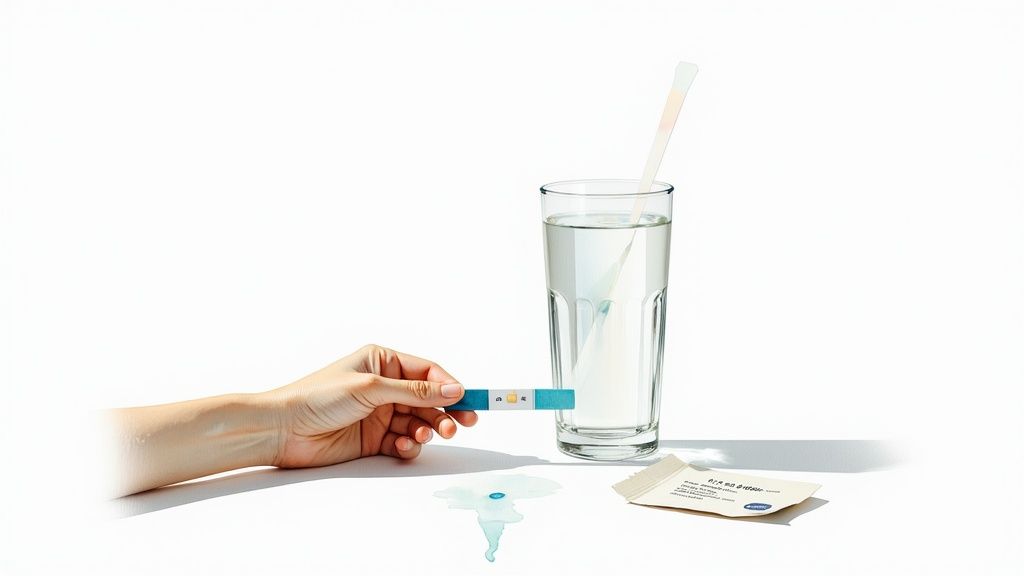
From there, it's all about understanding what that result means for your home.
Making Sense of Your GPG Number
Once you have your GPG number, what does it actually mean? The higher the GPG, the more dissolved minerals are in your water, and the more aggressively limescale will build up on your pipes and appliances.
Knowing your exact GPG is a game-changer. It transforms a vague complaint about "hard water" into a specific, measurable problem you can solve with the right equipment.
Here’s a simple breakdown of what those numbers mean in the real world.
Interpreting Your Water Hardness Results
| Grains Per Gallon (GPG) | Hardness Level | What This Means for Your Home |
|---|---|---|
| 0 – 1 | Soft | Ideal. No scale buildup; soap lathers easily. |
| 1.1 – 3.5 | Slightly Hard | Minor spotting on dishes and fixtures may be noticeable. |
| 3.6 – 7.0 | Moderately Hard | Visible scale buildup will start to appear on faucets and in appliances. |
| 7.1 – 10.5 | Hard | Limescale becomes a problem. Appliances lose efficiency and require frequent cleaning. |
| Over 10.5 | Very Hard | Significant scale buildup that can damage pipes, water heaters, and other appliances. A water softener is highly recommended. |
Having this specific data is crucial when you start looking into the best water treatment systems for your home. A system designed for slightly hard water simply won’t be effective if you’re dealing with very hard water. Testing first ensures you invest in a solution that will actually work for your situation.
Tackling the Limescale You Already Have
Before installing a new water treatment system, it’s a good idea to clean up the existing mess hard water has made. This means removing the chalky, crusty buildup on your faucets, showerheads, and glass doors. This residue isn't just unsightly—it harms your home by clogging pipes, reducing water pressure, and forcing your appliances to work harder.
The secret to removing it is acidity. Limescale is mostly calcium and magnesium, which are alkaline minerals. A mild acid easily breaks them down and dissolves the deposits. You likely already have everything you need in your kitchen.
Your Go-To DIY Cleaning Toolkit
For most everyday limescale issues, you can skip the harsh chemical cleaners. Some basic household items and a little effort will restore the shine to your fixtures and improve your appliance performance. These methods are not only effective but also safer for your home and family.
Here are a few proven, actionable tips for common hard water problems.
-
Actionable Insight for Weak Shower Pressure: If your shower feels weak, limescale is the likely culprit. To fix this, fill a plastic sandwich bag with white vinegar and tie it around the showerhead so the fixture is fully submerged. Let it soak for an hour, or overnight for severe clogs. The vinegar will dissolve the mineral buildup. In the morning, wipe it clean and enjoy your restored water pressure.
-
Practical Example for Foggy Shower Doors: That cloudy film on your glass shower doors is a clear sign of hard water. To remove it, create a paste of baking soda and a small amount of water. Apply the paste to the glass, let it sit for about 15 minutes, and then scrub with a non-abrasive sponge. The baking soda acts as a gentle abrasive, lifting the mineral stains without scratching the glass.
-
Actionable Insight for Spotted Faucets: To make your chrome faucets shine again, soak paper towels in white vinegar and wrap them tightly around the stained areas. Leave them for at least an hour. This keeps the vinegar in constant contact with the limescale, allowing it to dissolve the deposits. When you remove the towels, the spots should wipe away easily.
These simple tricks are perfect for maintenance and clearing up the visible signs of hard water, giving you a clean slate while you plan a long-term, whole-home solution.
Descaling Your Coffee Maker and Kettle
Limescale doesn't just build up where you can see it. It also forms inside your small appliances, like coffee makers and electric kettles. This internal buildup harms their performance and can make your morning coffee taste chalky or "off."
Here’s a practical, step-by-step guide to descale a coffee maker:
- Fill the water reservoir with a 50/50 solution of water and white vinegar.
- Start a brew cycle, but turn it off halfway through.
- Let the hot vinegar solution sit inside the machine for about an hour to dissolve scale from the internal parts.
- Finish the brew cycle to flush the solution out.
- Run two or three more cycles with plain water to rinse away any lingering vinegar taste.
This quick maintenance routine not only improves the taste of your coffee but also helps your machine last longer by preventing clogs and protecting the heating element.
When to Use Commercial Descalers
Sometimes, vinegar and baking soda aren't enough. For years of thick, rock-hard buildup, you might need a stronger solution. This is when you should use a commercial descaling product.
Think of it this way: vinegar is for routine cleaning, but a dedicated descaler is for a deep-cleaning restoration. When you face a serious limescale problem, you need a specialized tool.
Look for products that use mild acids like citric acid, sulfamic acid, or phosphoric acid. They are designed to dissolve heavy mineral deposits quickly without damaging your fixtures. Always follow the product's directions, wear gloves, and ensure proper ventilation. They are the perfect solution for getting a tough limescale situation under control.
Choosing the Right Long-Term Hard Water Solution
Cleaning limescale is just a temporary fix for a permanent problem. Without a system to treat water as it enters your home, you're stuck in a never-ending cycle of scrubbing and soaking. The only way to truly solve the hard water issue is to stop the minerals at the source.
With various technologies available, how do you know which one is right for you? Let's break down the most common options so you can make an informed decision for your home.
Traditional Salt-Based Water Softeners: The Gold Standard
When most people think about removing hard water, they picture a traditional salt-based water softener. There's a good reason for this—this technology remains the most effective method for physically removing the calcium and magnesium that cause the problems.
The process, known as ion exchange, is quite clever. Inside the softener tank are thousands of tiny resin beads coated in sodium ions. As hard water flows past these beads, the hard minerals are attracted to the resin, swapping places with the sodium ions. What emerges is genuinely soft water, free of the minerals that clog your pipes and damage your appliances.
This effectiveness is why salt-based systems dominate the market. The global demand for water softeners was valued at USD 3.3 billion and is expected to nearly double by 2034. It's a proven, reliable solution. You can dig deeper into the numbers behind this trend in the full research on water softener trends.
Salt-Free Water Conditioners: A Different Approach
Next are salt-free water conditioners, which can be a source of confusion. It’s crucial to understand that these systems do not soften water. They do not remove the hardness minerals.
Instead, they use a process called Template Assisted Crystallization (TAC) to change the physical form of the minerals. Essentially, it alters the minerals' structure so they can't stick to pipes, fixtures, or heating elements. The minerals remain in your water but flow through without causing scale. This makes conditioners a great low-maintenance option if your only goal is to prevent scale buildup.
Just remember, you won't get the other benefits of soft water. Your soap won't lather as well, you won't feel that silky sensation on your skin, and you might still see water spots on your dishes. Think of it as a scale prevention tool, not a true water softener.
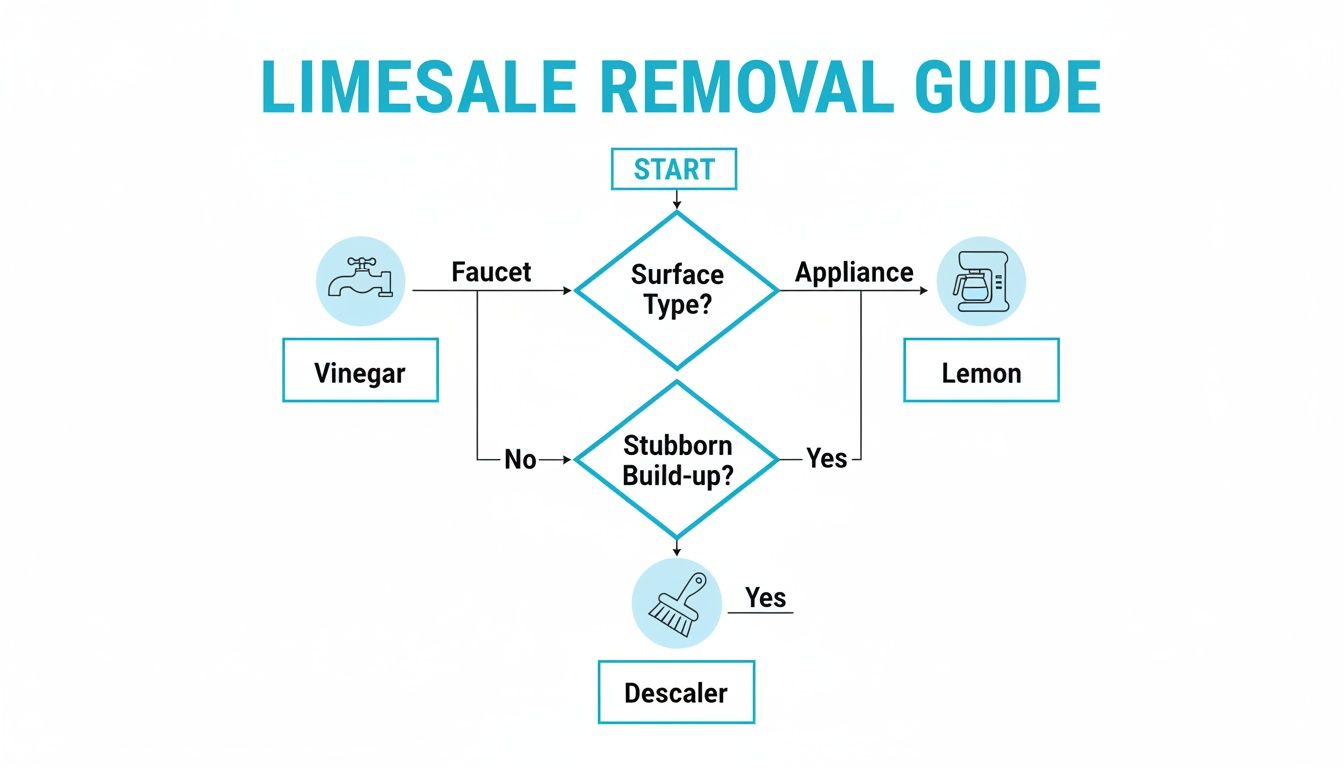
This flowchart provides a good visual for tackling existing scale—while simple cleaners like vinegar work for light spots, heavy buildup often requires a dedicated descaler.
Whole-House Filtration and Reverse Osmosis
It's a common mistake to assume a standard water filter will solve a hardness problem. Most whole-house filters, particularly carbon-based ones, are designed to remove things like chlorine, sediment, and pesticides to improve your water's taste and smell. They do not affect the dissolved minerals that cause hardness.
Reverse Osmosis (RO), however, is a different technology. An RO system pushes water through a very fine membrane that removes nearly everything—including calcium and magnesium. While RO is incredibly effective, installing a system for your entire house is often unnecessary and can be expensive. That’s why you typically see them installed under a kitchen sink to provide ultra-purified drinking water.
Ultimately, your choice depends on your goal. Do you want to eliminate scale completely and enjoy all the benefits of soft water? Or is your main priority to protect your plumbing with zero maintenance?
Let's compare them side-by-side to make the decision easier.
Comparing Hard Water Treatment Systems
Making the right investment for your home means understanding what each system does and who it's best for. This table offers a clear, side-by-side comparison of the top water treatment methods to help you decide.
| Treatment Method | Primary Function | Ideal For Homeowners Who… | Typical Upfront Cost |
|---|---|---|---|
| Salt-Based Water Softener | Physically removes hardness minerals (calcium & magnesium). | Want to eliminate scale, improve soap efficiency, get softer skin and hair, and protect all appliances. | $1,000 – $4,000 |
| Salt-Free Water Conditioner | Prevents scale by crystallizing minerals so they can't stick to surfaces. | Want a low-maintenance way to protect pipes and water heaters from scale, but don't mind not having "soft" water. | $800 – $2,500 |
| Whole-House Carbon Filter | Removes chlorine, sediment, and chemicals to improve taste and odor. | Are happy with their water hardness but want to remove contaminants for better-tasting water. | $600 – $2,000 |
| Reverse Osmosis (RO) | Filters out nearly all dissolved solids, including minerals and contaminants. | Want the purest possible drinking water at a specific tap (e.g., the kitchen sink). | $300 – $1,000 (P.O.U.) |
At the end of the day, if you’re looking for a complete solution to all the problems caused by hard water, a traditional salt-based system is the most effective choice. If you're considering this option, you can find a helpful breakdown of what a whole house water softener system entails and how it can benefit every part of your home.
Getting It Installed and Keeping It Running
You’ve done your research and selected the right system for your home—that's a huge step. Now comes the practical part: installing it correctly and ensuring it continues to work perfectly for years. A little planning here will save you a lot of future trouble.
First, you need to decide whether to install the system yourself or hire a professional. It’s tempting to save money with a DIY approach, but this decision requires careful consideration.
DIY vs. Professional Installation
If you’re considering installing a water softener or whole-house filter yourself, be realistic about your plumbing skills. You will be cutting into your home's main water line, which is not a task for beginners. It involves soldering copper pipes or using push-to-connect fittings and ensuring there are absolutely no leaks. For an experienced DIYer, this can be a rewarding project that saves a few hundred dollars.
For most homeowners, however, hiring a licensed plumber is the smarter, safer choice. A professional ensures the system is installed correctly and complies with local building codes. A failed installation can lead to slow leaks, a drop in water pressure, or even a major flood, eliminating any money you thought you saved.
A professional plumber does more than just connect pipes. They find the best location for efficiency, set up the bypass valve correctly for future maintenance, and program the unit based on your specific water hardness. That expertise is almost always worth the investment.
Think of it as starting your system off on the right foot—it’s the best thing you can do for its long-term performance and health.
Understanding Routine Upkeep for Your System
Once your system is installed, a little routine maintenance is all it takes to keep it running smoothly. The specific tasks depend on the type of system you chose. If you neglect this upkeep, you'll end up back where you started, dealing with scale and hard water spots.
Here’s a quick guide on what to expect:
-
Salt-Based Water Softeners: These require the most hands-on attention, but it's minimal. You’ll need to check the salt level in the brine tank once a month and add more as needed. A typical family usually uses a 40-pound bag of salt every 6 to 12 weeks. It's also wise to ensure the system's regeneration cycle is running correctly.
-
Salt-Free Conditioners: A major benefit of these systems is that they are virtually maintenance-free. There's no salt to buy and no regeneration cycles to monitor. You just set it and forget it, making it perfect for a zero-fuss solution to scale.
-
Reverse Osmosis (RO) Systems: To keep the pure water flowing, you'll need to change the filters regularly. The sediment and carbon pre-filters typically need to be replaced every 6 to 12 months. The RO membrane is more durable, lasting 2 to 3 years. Mark these dates on your calendar, as clogged filters will slow your water flow and reduce purification effectiveness.
Getting into the specifics is key, and if you're leaning this way, a good next step is understanding the reverse osmosis system installation cost.
Budgeting for Long-Term Costs
The initial purchase price is just the beginning. To fully understand the investment, you need to consider the total cost of ownership over the system's lifespan.
Let’s break down what you should plan on spending annually:
| System Type | Ongoing Expense | Estimated Annual Cost | Primary Task |
|---|---|---|---|
| Water Softener | Salt and Water | $100 – $250 | Refilling the brine tank with salt bags. |
| RO System | Filter Cartridges | $50 – $150 | Replacing pre-filters and the RO membrane on schedule. |
| Salt-Free Conditioner | Electricity (minimal) | < $20 | No regular maintenance tasks required. |
When you look at it this way, the ongoing costs are a small price to pay for protecting your home’s plumbing and expensive appliances. Factoring in a budget for salt or filters from the start ensures your system continues to deliver the value you paid for.
The Real Value of Investing in Soft Water
It’s easy to view a water treatment system as just another household expense, but that misses the bigger picture. This is a direct investment in the health of your home, your finances, and your daily comfort. When you solve a hard water problem, you're not just fixing an annoyance—you're unlocking tangible savings and quality-of-life improvements that start paying you back immediately.
The first place you’ll notice the difference is in your shopping cart. Soft water is incredibly efficient with soaps and detergents. You'll find you can reduce your usage by up to 50%.
Practical Example: If you currently use a full cap of laundry detergent, you'll only need half a cap with soft water. The same goes for dish soap, shampoo, and hand soap. Over a year, this adds up to significant savings.
Protecting Your Most Expensive Appliances
Beyond the grocery bill, the most substantial long-term savings come from protecting the appliances that keep your home running. Hard water is a silent threat to water heaters, dishwashers, washing machines, and coffee makers. Limescale buildup forces them to work harder, consume more energy, and ultimately fail years ahead of schedule.
For instance, scale buildup inside a water heater can reduce its efficiency by up to 24%. This means you're paying nearly a quarter more on your energy bill just to heat the same amount of water, month after month.
Actionable Insight: Investing in a water softener is like buying an insurance policy for your most valuable appliances. It prevents the slow, costly damage of limescale, extending their lifespan and saving you from expensive, premature replacements.
This long-term protection is a major reason the market for water scale removal solutions is growing. It was valued at over USD 405.1 million and is expected to exceed USD 524.0 million by 2033. Why? Because homeowners are realizing the massive cost of not dealing with hard water. You can find more details on the financial impact of water scale removal in recent industry reports.
The Everyday Benefits You Can Actually Feel
While the financial benefits are compelling, it’s the daily advantages of soft water that truly enhance your life at home. These are the improvements you'll notice right away.
-
Softer Skin and Silkier Hair: Hard water minerals strip your skin and hair of their natural oils, leaving them feeling dry and brittle. Soft water allows soap and shampoo to rinse completely clean, leaving your skin feeling smooth and your hair more vibrant and manageable.
-
Brighter, Longer-Lasting Clothes: The same minerals get trapped in the fibers of your clothes, making them feel stiff and causing colors to fade. With soft water, your laundry comes out brighter, feels softer, and will last longer.
-
A Cleaner Home with Less Work: Forget constantly scrubbing chalky white spots off your shower doors, faucets, and dishes. With no mineral residue left behind, soft water does the hard work for you, saving you significant cleaning time.
When you get right down to it, tackling hard water isn't just an expense—it's a smart upgrade. It saves you real money, protects your home's most important systems, and makes your daily life more pleasant. It’s one of the few home improvements that truly pays for itself.
Got Questions About Hard Water? We've Got Answers.
When you start researching how to fix your hard water, many questions can arise. That makes sense—you want to be sure you're making the right choice for your home. Let's walk through some of the most common questions people have when they're ready to solve their hard water issues.
"Will a Water Softener Make My Water Taste Like Salt?"
This is probably the number one myth we hear. The short answer is no; a properly functioning water softener will never make your water taste salty. The salt's only purpose is to clean the resin beads that capture the hard minerals, not to enter your drinking water.
During a "regeneration" cycle, a saltwater solution washes the resin beads, and then the entire system is thoroughly rinsed and flushed. The amount of sodium that enters your softened water is extremely small. If you ever taste salt, it's a clear sign that your system needs maintenance.
"Can't I Just Use a Regular Water Filter to Fix Hardness?"
That's a common assumption, but unfortunately, it's not correct. Your standard pitcher filter or the one in your refrigerator uses activated carbon to trap things like chlorine, improving taste and smell.
However, they are completely ineffective against the dissolved minerals—calcium and magnesium—that cause hardness. To truly soften your water and stop scale, you need a dedicated system like a salt-based water softener that uses ion exchange.
"How Often Do I Need to Add Salt?"
How often you need to add salt depends on three factors: how much water your family uses, how hard your water is, and the type of softener you have.
Practical Example: For a typical family of four with moderately hard water, you might add a 40-pound bag of salt every 6 to 8 weeks. The good news is that many modern systems are "on-demand," meaning they only regenerate when necessary. This feature can save a significant amount of salt and water compared to older, timer-based models.
Actionable Insight: Just check the brine tank once a month. If you see water above the salt line, it's time to add another bag. A good rule of thumb is to keep the tank about halfway full.
"What About Those 'Salt-Free' Conditioners? Are They Effective?"
Salt-free systems, more accurately called "water conditioners," are an excellent option if your primary concern is scale buildup. They don't remove hardness minerals, but instead, they alter their molecular structure so they can't stick to pipes, fixtures, or appliances.
Just be aware of what they don't do. Because the minerals are still present, you won't get the other benefits of soft water—like richer lather, softer skin and hair, or spot-free glassware. They are a great, low-maintenance choice for scale prevention but are not a true substitute for a water softener.
At Praz Pure Water, Inc., we've spent over 20 years helping Los Angeles homeowners find the perfect fix for their hard water. If you're tired of spots, scale, and dry skin, we can help. Explore our custom water softening and filtration systems today.