
Installing a whole house water filtration system is a powerful move for your family's health and the longevity of your home. It goes far beyond what a simple faucet filter can do by creating a shield right where water enters your house. This single, actionable upgrade protects everything—from the pipes hidden in your walls to the appliances you use every day—from the damaging effects of hard water and other contaminants, delivering clear value from day one.
Is Your Home Crying Out for Better Water?
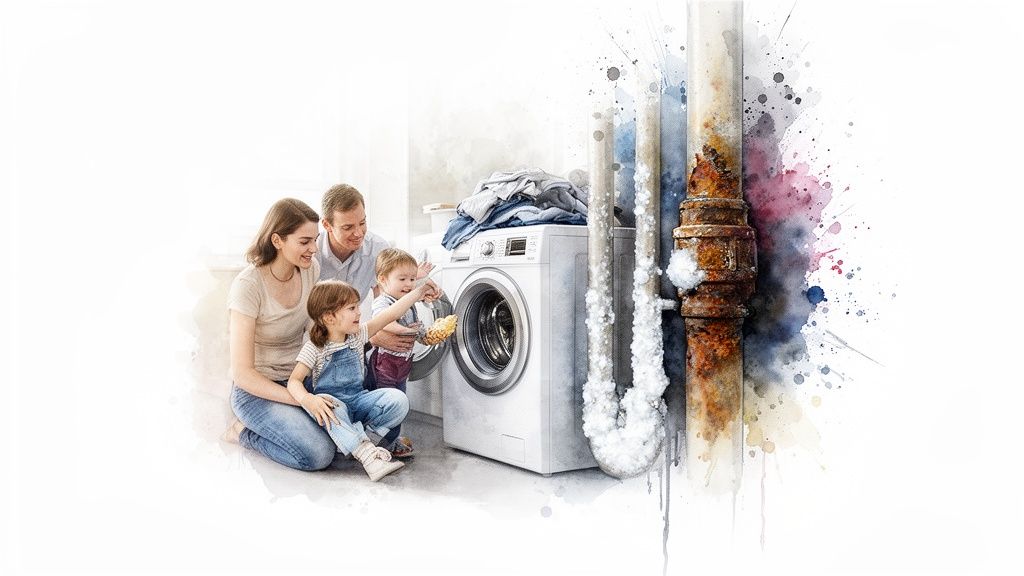
That pitcher filter in your fridge is a start, but it only addresses the water you drink. What about the water used for showering, washing clothes, or running the dishwasher? Every time you use an appliance, untreated water flows through it, often carrying minerals and chemicals that cause slow, silent damage. This isn't a luxury; it's smart, preventative home maintenance.
Consider a real-world example: A family invests in a new, high-efficiency washer. After just a year, they notice it’s struggling. Their clothes come out feeling stiff, and the machine doesn't clean like it used to. The culprit isn’t a faulty appliance—it’s the hard water, loaded with calcium and magnesium, building up a crusty layer of limescale that’s choking the internal parts. This is a common story that a whole house system prevents.
The Hidden Costs of Untreated Water
This scenario is incredibly common, particularly in areas with hard water. The damage doesn’t stop with your laundry machine, and the value of fixing it is significant.
- Plumbing Headaches: Over time, mineral deposits build up inside your pipes, restricting water flow. This leads to low pressure and can eventually cause clogs that require a costly visit from a plumber.
- Appliance Inefficiency: Your water heater is especially vulnerable. A thin layer of scale forces it to work up to 30% harder just to heat your water, which directly impacts your energy bills.
- Shorter Lifespans: Dishwashers, washing machines, and even your coffee maker will wear out much faster when they are constantly fighting against mineral buildup.
Actionable Insight: Installing a whole house water filtration system is one of the most effective ways to protect these major investments. It stops corrosive elements right at the source, ensuring every drop of water in your home is clean and gentle on your infrastructure.
It's More Than Just Minerals
Beyond the physical damage from hard water, municipal water often contains other things you’d rather avoid. While treatment plants do a solid job, some contaminants can still make it to your tap.
Chlorine, for instance, is essential for disinfection but gives your water that "pool" smell and taste. It’s also known for drying out skin and hair. A point-of-entry system removes these irritants before they ever reach your shower, making a noticeable difference in how you feel. For a closer look at the science, you can explore our straightforward guide on how water filtration works.
It’s no surprise that the demand for these systems is growing. The global market for home water filtration units was valued at USD 20.8 billion in 2025 and is on track to hit USD 35.7 billion by 2035. This isn't just a trend; it's a reflection of homeowners wanting to eliminate contaminants that municipal supplies can miss. Ultimately, a whole house system gives you something invaluable: peace of mind.
Setting Your Project Up for Success
Every successful installation starts long before a single pipe is cut. Good planning is the secret to a smooth, satisfying DIY project versus a weekend filled with frustration and extra trips to the hardware store. Taking the time to do this upfront work ensures you get the right system and have a headache-free installation day.
The first step is to figure out what's actually in your water. If you guess, you could end up with a system that does nothing for your specific problem. For example, buying a carbon filter designed for chlorine won't touch the hard water scale building up in your pipes and appliances.
Pinpoint Your Water Problems
You wouldn't take medicine without a diagnosis, and the same logic applies to your water. Start with a reliable water quality test to get a clear picture of what you’re dealing with.
Here are your best options:
- DIY Test Kits: These are inexpensive and a great starting point for homes on city water. They’ll give you a baseline reading for common culprits like chlorine, pH, and hardness.
- Lab Testing: This is the best choice for a detailed analysis. It's highly recommended for anyone on well water or with specific health concerns. A lab will identify heavy metals, bacteria, and volatile organic compounds (VOCs).
Armed with those results, you can shop with confidence, knowing you’re investing in a solution that targets your home's unique contaminants.
Practical Example: A family in a rural area was fed up with rust stains ruining their sinks and laundry. They were convinced they needed a water softener. A professional water test, however, revealed the real issue was high levels of iron and manganese, not just hardness minerals. An iron-specific filter was the right call, saving them from buying an ineffective system.
Match the System to Your Home's Needs
Once you know what to filter, the next question is how much water you need to filter. A common DIY mistake is choosing an undersized system. The result? A frustrating drop in water pressure, especially when the dishwasher is running while someone’s in the shower.
To avoid this, calculate your home's peak water demand. A straightforward way to estimate this is to count your water-using fixtures—sinks, showers, toilets, washing machine—and find a system with a flow rate that can keep up. This is measured in gallons per minute (GPM).
Actionable Insight: For a typical family of four, aim for a system with a flow rate of at least 10-15 GPM. This is usually enough to handle busy mornings without anyone noticing a pressure drop.
Don't Skip the Local Code Check
Before you buy anything, make a quick call to your local municipal building or plumbing department. Some areas have specific codes or require permits for any work on a main water line. Getting your system planned out right means you need to know your home's plumbing inside and out. Looking at an ultimate pipe size chart and reference guide can help ensure everything will be compatible.
Just recently, a homeowner in a historic district found out their city required a special type of double check valve on any whole-house system. Discovering this before he started saved him from a failed inspection and the cost of redoing the entire job. A quick phone call can save you a world of trouble.
If you want to see what goes into a full professional setup, our guide breaks down the complete reverse osmosis system installation cost and all the factors that come into play.
Choosing the Right Filtration System for Your Home
The world of water filters is massive, and it's easy to get lost in the options. But once you have your water test results, the picture becomes much clearer. Those results are your roadmap, pointing you directly to the technologies that will solve your specific water problems.
This isn't about guesswork. It's about matching the right tool to the job so you get clean, safe water without overspending on features you don't need, delivering maximum value for your investment.
Decoding the Core Filtration Technologies
Let's break down the main players. Each type of filter is designed for a specific task, and understanding what they do is the most important step in making the right choice.
-
Carbon Filters: Think of these as taste-and-odor experts. If your tap water has that chlorine smell or a chemical taste, an activated carbon filter is what you need. It works like a sponge, grabbing onto those organic compounds and chemicals to give you crisp, fresh-tasting water from every faucet.
-
Sediment Filters: If you've noticed tiny bits of grit or rust in your water, that's sediment. A sediment filter acts as a physical barrier, catching dirt, sand, and rust before it gets into your pipes and appliances. It’s often the first line of defense in a multi-stage system.
-
Water Softeners: For homes fighting hard water, a water softener is the only real answer. It uses a process called ion exchange to pull out the minerals—calcium and magnesium—that cause limescale buildup, leave spots on your dishes, and make your laundry feel stiff.
A Practical Example: The Multi-Stage Fix
Many households deal with more than one water issue at once. Imagine this common scenario: you just bought expensive, fluffy towels, but after a few washes, they feel stiff and scratchy. That's a textbook sign of hard water. On top of that, your tap water smells so strongly of chemicals that you've resorted to buying bottled water.
This is where a multi-stage system shines. A standalone carbon filter or a water softener alone would only fix half the problem.
A combined system tackles both issues head-on. The water first flows through a carbon filter to strip out the chlorine, which instantly gets rid of the bad taste and smell. From there, it moves into the water softener, which removes the hardness minerals. The result is a complete solution: pipes and appliances are protected, and your showers and laundry feel incredible.
This layered approach ensures every drop of water in your home is both soft and great-tasting. For a deeper dive into how different systems compare, check out our detailed water filtration systems comparison.
Matching Technology to Your Needs
More people are investing in home filtration. The market was valued at USD 12.12 billion in 2022 and is expected to more than double to USD 26.73 billion by 2030. This growth is fueled by a growing awareness of water quality and health.
Technologies like Reverse Osmosis (RO) and UV systems are a big part of this growth, largely because of their impressive 99% efficacy against a whole host of contaminants. You can explore the full market analysis and discover more insights about these water filtration trends.
Actionable Insight: Let your water test be your guide. When you match its findings to the right technology, you can be confident you’re installing a system that will deliver exactly what your home needs for years to come.
Getting Your Hands Dirty: A Pro's Guide to Installation
You've picked your system and have all your parts laid out. Now for the installation. Putting in a whole-house filter is a serious plumbing job, but with a bit of patience and a methodical approach, it's a project you can absolutely tackle.
We're going to walk through this the same way a pro would, focusing on the key phases of the job. It's less about a rigid "Step 1, Step 2" and more about understanding the flow of the work to get a clean, leak-free result. The goal is to properly sequence your filters—for example, a sediment filter first, then a carbon block, and finally a water softener—to get the best possible water quality.
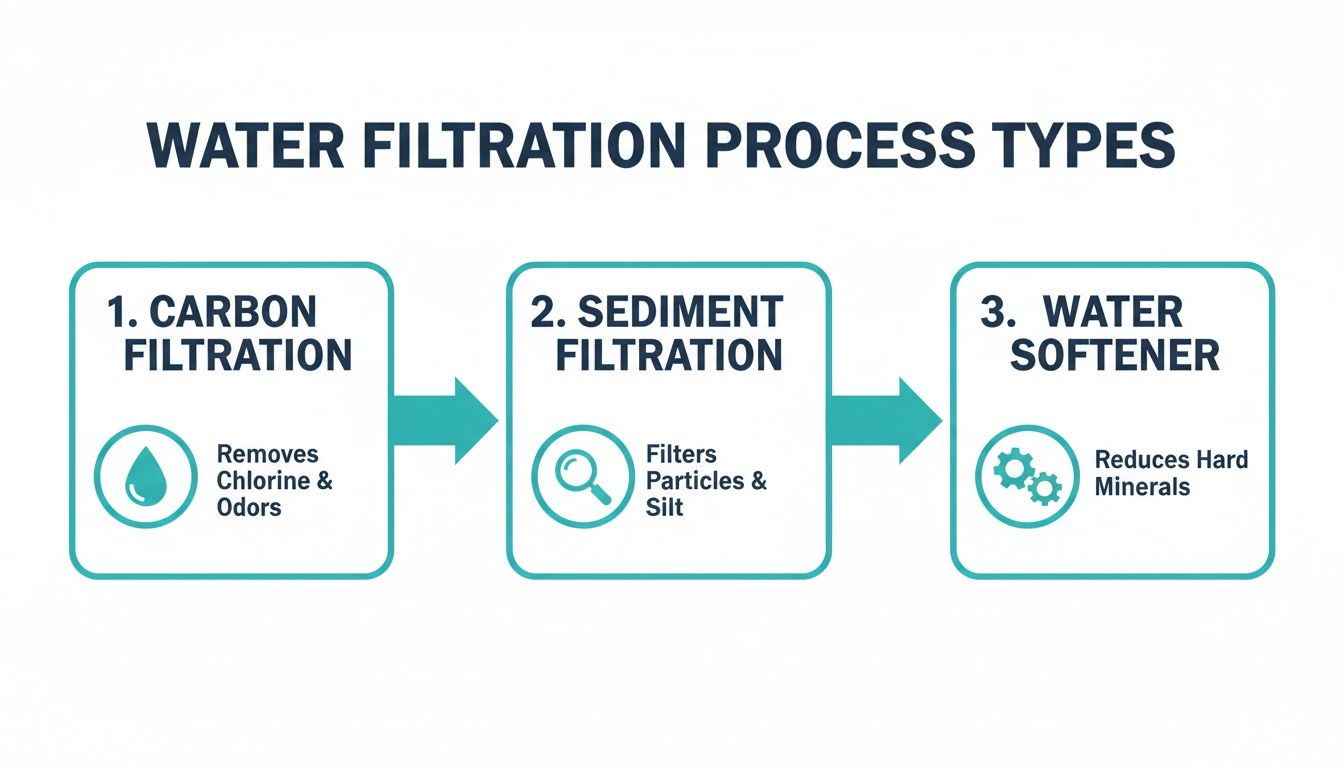
The image above gives you a good visual of how these different stages work together. You're creating a multi-stage treatment plant for your home, starting with larger particles and moving to finer contaminants.
Scouting the Perfect Installation Spot
Before you cut a pipe, you need to find the right home for your new system. This one decision can make the difference between an easy install with simple upkeep and a future full of headaches. Your target is the spot where the main water line enters your house, usually in the garage, basement, or a utility closet.
A great location has a few key things going for it:
- Elbow Room: You need space for the unit itself, plus enough room to comfortably get around it with tools for future filter changes.
- Easy Access: Avoid cramming it into a tight crawlspace. When maintenance is easy, you're more likely to do it on schedule.
- Shelter from the Elements: Your system needs protection from freezing temperatures and direct sun, both of which can damage filter housings.
- A Nearby Outlet: Many systems, especially those with UV lamps or electronic control heads, need power.
Once you’ve found the spot, clear the area and make sure you have plenty of light. A little prep work here saves a lot of frustration later.
The Shutdown and Drain: No Surprises
With your location picked out, it's time to prep the plumbing. This is where safety is key.
First, find your home’s main water shut-off valve—it's usually near the water meter or where the main pipe comes through your foundation. Turn it clockwise to shut it down completely.
Now, drain the water from the pipes. Open the faucet at the lowest point in your house (like a utility sink or outdoor spigot) and the one at the highest point (often a second-floor bathroom). Gravity will do most of the work for you. Let them run until they sputter out.
Actionable Insight: Before you make that first cut, have a bucket and a few old towels ready. No matter how well you think you've drained the lines, there's always a little water left. Being prepared is the difference between a small drip and a big mess.
Why You Need a Bypass Loop
Before you plumb in the filter, install a bypass loop. This is a parallel pipe with a few extra valves that lets you send water around the filtration system instead of through it.
This is a lifesaver for future maintenance. When it's time to change a filter or service the unit, you can shut the valves to the filter and open the bypass. The rest of your house will still have water, and you can work without pressure or a ticking clock. Every professional job includes one, and it's a detail you'll be glad you didn't skip.
Making the Connections
This is where your prep comes together. Grab your pipe cutter and make a clean, straight cut on the main water line where you plan to install the system. Always deburr the cut edges of the pipe to ensure your fittings create a perfect seal.
Now, build out the connections to and from the filter unit. Whether you're using push-to-connect fittings, compression fittings, or sweating copper pipes, the goal is the same: a rock-solid, watertight connection.
A common mistake is overtightening fittings that thread into the plastic filter head. This can easily crack the housing, leading to a disastrous leak. Use a two-wrench technique: one wrench holds the fitting on the unit still while the other tightens the incoming pipe. This isolates the stress and protects the equipment.
The Final Steps: Pressurizing and Leak-Checking
With all the plumbing connected, you're on the home stretch. Make sure the bypass valve is closed and the valves leading to the filter are open.
Head back to the main shut-off and open it slowly—just a quarter turn at first. You'll hear water rush in and fill the filter tanks. This is a critical moment. Listen for any strange hissing sounds and visually inspect every connection for drips. Going slow prevents a "water hammer" shockwave that can damage your plumbing.
Once the hissing stops, slowly open the main valve the rest of the way. Now, head back to the faucets you used for draining and let them run until all the air has sputtered out.
Finally, give all your work one last, careful inspection. Check every joint and fitting for the tiniest bead of moisture. A single slow drip can cause thousands in damage over time. It's a good practice to let the system sit under full pressure for at least an hour before calling the job done.
Keeping Your System Running Flawlessly
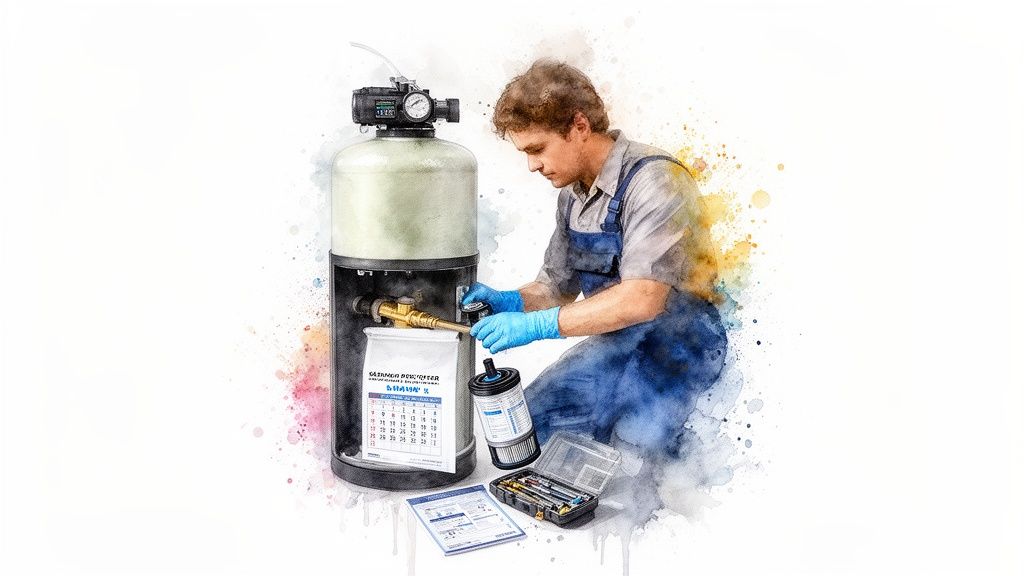
The hard part is over—your new whole house water filtration system is installed. But the job isn't quite finished. To keep that system delivering pure, clean water for years, you need to give it routine attention. Think of it like a new car; you wouldn't drive it without ever changing the oil. Neglecting your water system is the same—eventually, its performance will suffer.
Luckily, maintenance is usually simple. It just comes down to knowing which filters need attention and when. This small bit of proactive care keeps your water flowing freely and ensures the system is always working at its best.
Creating a Simple Maintenance Schedule
Different filters have different lifespans. The easiest way to stay on top of this is to mark your calendar or set reminders on your phone. For a typical multi-stage system, your schedule will look something like this:
- Sediment Pre-filter: This is the first line of defense, catching bigger stuff like rust and dirt. It's the workhorse, so swap it out every 3 to 6 months.
- Carbon Block or GAC Filter: This tackles chlorine, chemicals, and smells. Depending on water usage and quality, these filters generally last between 9 and 12 months.
- Main Carbon Tank Media: If you have a larger system with a main tank, the granulated activated carbon can last 3 to 5 years before it needs to be replaced.
- Water Softener Resin: The resin beads in a water softener can last an impressive 10 to 15 years with proper care.
To make things even easier, Praz Pure Water often suggests a bi-monthly checkup service. It takes all the guesswork out of maintenance and ensures everything is running perfectly.
Actionable Insight: A proactive maintenance plan is the single best way to protect your investment. A forgotten filter not only stops working but can also become a source of clogs and pressure loss, completely defeating the purpose of installing a whole house water filtration system in the first place.
The Real Cost of Neglect
Here is a practical example. A homeowner noticed his water pressure had dropped significantly over a few weeks. His showers felt weak, and the washing machine was taking ages to fill. He checked for leaks but found nothing. Then, he remembered the whole-house system in his garage.
When he opened the pre-filter housing, he found a sediment filter that was six months overdue for a change. It was caked in a thick, brown sludge, choking the water supply to his entire home. A simple $30 filter change brought his water pressure right back to normal. That small oversight nearly cost him an expensive plumbing call, highlighting the value of routine checks.
Sticking to a schedule is important. As public infrastructure ages, more contaminants can enter our water, and the demand for reliable point-of-entry (POE) systems is rising. The home water filtration market, which hit USD 13.98 billion in 2024, is projected to explode to USD 37.54 billion by 2034. That growth is coming from health-conscious families who want total protection. You can read the full research about these market projections to get a deeper look at this trend.
Ultimately, regular checkups and timely filter changes are what make these systems so effective, keeping your family and your home protected day in and day out.
Knowing When to Call in a Professional
There's special satisfaction in a well-done DIY project. But there's also wisdom in knowing when to hang up the tool belt. When dealing with your home's main water supply, a small mistake can quickly turn into a big, wet problem.
Sometimes, calling a professional isn't giving up—it's making the smartest, safest, and most cost-effective choice. Plumbing, especially in older houses, can be full of surprises. What looks like a simple copper pipe can conceal years of odd repairs or obsolete materials waiting to fail. Spotting these potential disasters before you make the first cut is what separates a smooth project from an emergency.
Complex Plumbing Scenarios
If your plumbing setup looks like the situations below, it is strongly recommended to pick up the phone instead of a pipe cutter.
- Old Galvanized or Polybutylene Pipes: This is a big one. These materials get incredibly brittle with age. Trying to thread them or tighten a new fitting can cause them to crack or shatter, transforming your filter installation into a full-blown re-piping crisis.
- Integrating Multiple Systems: Trying to piece together a water softener, a carbon filter, and a UV light? Getting the order, flow rate, and pressure right for a multi-stage system is a delicate balancing act. The wrong sequence can bottleneck your water pressure or make the whole system useless.
- Tight or Awkward Spaces: A cramped crawl space or utility closet makes every step exponentially harder. Professionals have the right tools—and patience—to work in those tough spots without compromising quality.
A Cautionary Tale: A homeowner planned his Saturday around installing a new filter. He watched a dozen videos and felt confident. The problem? His 1960s plumbing had a non-standard pipe size that no big-box store carried. His project came to a dead stop, but only after he'd cut the pipe, forcing a frantic and expensive emergency call to a plumber to stop the leak.
When Professional Expertise Is a Must
Beyond the pipes themselves, there are other critical reasons to bring in an expert. An experienced technician has foresight you can't get from an online guide. They anticipate problems before they happen. For example, if you run into any major issues with existing underground pipes, your best bet is always to consult a professional underground pipe repair contractor.
Here are a few more instances where going pro is the only way to go:
- Local Code Compliance: Professionals know local plumbing codes. They understand permit requirements and ensure your installation is 100% compliant, so you won't have issues with future inspections.
- Warranty Protection: Many top filtration systems state that their warranty is void without professional installation. A flawless DIY job could still leave you without coverage if the unit fails.
- Guaranteed, Leak-Free Results: This is the ultimate peace of mind. A professional installation is guaranteed. You don't have to worry about a tiny, slow drip behind the wall that you might not discover for months—after it's already caused thousands in water damage.
This is exactly where a company like Praz Pure Water makes all the difference. With years of field experience, we've navigated every tricky plumbing layout you can imagine. Our team delivers a clean, leak-free installation that not only protects your home but also ensures your new system works exactly as it should from the moment it's turned on.
Ready to ensure your whole house water filtration system is installed perfectly, without the stress and risk of a DIY project? The experts at Praz Pure Water, Inc. have over 20 years of experience providing flawless, code-compliant installations across Los Angeles. Visit us at https://prazpurewater.com to schedule your consultation and get the peace of mind that comes with a professional touch.