
If you live in Los Angeles, you know the tap water has a certain… character. The hard water leaves chalky deposits on your faucets, and that faint chlorine taste can make a simple glass of water less than refreshing. It's a common complaint, and for good reason.
That's why so many homeowners and businesses are looking beyond basic pitcher filters. They’re seeking a permanent solution, which leads them to RO water filter systems. Think of it as the ultimate upgrade for your home's water, turning your challenging city tap water into something pure, clean, and genuinely delicious. This guide will provide clear, actionable insights to help you understand and choose the best system for your needs.
Why LA Residents Are Choosing RO Water Filter Systems
In a place like Los Angeles, a reverse osmosis (RO) system isn't a luxury—it's a practical tool for better living. It directly addresses the most common issues we face with our municipal water supply, from the mineral content that causes hard water scale to the chemical aftertaste from treatment. The value you gain is immediate: better health, better-tasting food and drinks, and protection for your appliances.
This guide will walk you through everything you need to know about these systems. We'll demystify how they work and show you exactly why they’ve become the gold standard for water purification.
A Growing Demand for Purity
The move towards higher-quality water isn't just happening in our city; it's a global shift. The entire water filters market has seen explosive growth, expanding from USD 15.56 billion in 2025 to USD 16.78 billion in 2026. Projections show it reaching USD 22.8 billion by 2030. This demand is driven by a desire for a healthier lifestyle, free from the worries of tap water contaminants.
This isn't surprising. With growing concerns about water quality and a greater focus on health, people are demanding better. You can find more details in recent market research on water filters.
Here at Praz Pure Water, we've seen this trend firsthand. As local experts, we're on the front lines, helping our neighbors find the right solutions and make a choice they can feel great about.
An RO system offers more than just better-tasting water. It's an investment in your health, your home's longevity, and your peace of mind, addressing the specific water quality issues found in the greater Los Angeles area.
RO Water Filter System at a Glance
To give you a clearer picture, we've put together a quick summary of what an RO system can do for your home or business right here in LA. This table highlights the clear value and benefits you can expect.
| Benefit/Application | Why It Matters for LA Residents & Businesses |
|---|---|
| Superior Contaminant Removal | Effectively filters out heavy metals, chlorine, and salts common in LA water. |
| Ends Hard Water Scale | Protects coffee makers, ice machines, and pipes from damaging mineral buildup. |
| Better-Tasting Water & Ice | Eliminates the chemical tastes and odors, making water enjoyable to drink. |
| Cost-Effective & Eco-Friendly | Reduces reliance on single-use plastic bottles, saving money and the environment. |
As you can see, the benefits go far beyond just a glass of water. An RO system tackles the root causes of our most common water frustrations, providing a comprehensive and lasting solution.
How Reverse Osmosis Makes Your Tap Water Pure
Ever wonder how a reverse osmosis (RO) system takes your regular tap water and turns it into something so clean and refreshing? It's not a single filter, but a multi-stage journey where water is systematically purified. Think of it less like a simple filter and more like a high-tech purification plant shrunk down to fit under your sink.
The core of the whole process hinges on a concept called reverse osmosis. Using your home’s existing water pressure, the system pushes water against a very special semipermeable membrane. This membrane is the key component—it allows pure water molecules to pass through while rejecting almost everything else.
The Initial Cleanup: Pre-Filters
Before the water gets to that high-tech membrane, it must pass through one or more pre-filters. Their job is to tackle the biggest contaminants first. This is a critical step because it protects the delicate RO membrane from getting torn or clogged, extending its life significantly.
These pre-filters usually work in two parts:
- A Sediment Filter: First, a filter acts like a screen, catching physical debris like sand, rust, silt, and dirt that can flake off from old city pipes. Removing these particles right away prevents the entire system from getting clogged.
- A Carbon Filter: Next, the water moves through a carbon filter. Activated carbon is excellent at grabbing onto dissolved chemical contaminants through a process called adsorption. It's especially good at removing chlorine—the chemical responsible for that "tap water" taste and smell.
Taking care of this initial work allows the RO membrane to focus on what it does best. For a deeper dive into these fundamentals, check out our guide on how water filtration works.
The Heart of the System: The RO Membrane
With the initial cleanup done, the water is now ready for the main event. It's forced against the reverse osmosis membrane, a material with microscopic pores that are about 0.0001 microns—incredibly small. For perspective, a single human hair is about 75 microns thick.
Practical Insight: At this stage, the system separates the water into two streams. One stream is the purified water that has been forced through the membrane, and the other is a wastewater stream that carries away all the rejected contaminants like dissolved salts, heavy metals, and fluoride.
This is what sets RO apart. It’s not just filtering out particles; it’s physically separating pure H₂O from water that contains dissolved solids, from sodium and lead to arsenic and nitrates. It's a level of purification that most other filters simply can't achieve.
The Final Polish for Perfect Taste
After squeezing through the RO membrane, the water is exceptionally pure. In fact, it's so pure that it's also stripped of the naturally occurring minerals that give water its familiar, pleasant taste. Some people describe this ultra-pure water as tasting "flat."
That's why a quality RO system includes final stages to perfect the water before you drink it.
- A Post-Filter: This is usually another carbon filter, and its job is to "polish" the water. It acts as a final quality control, removing any potential off-tastes or odors the water might have picked up while sitting in the storage tank.
- An Optional Remineralization Filter: This is where great-tasting, healthy water is made. Praz Pure Water systems include this stage to reintroduce a balanced blend of beneficial minerals like calcium and magnesium back into the water. This not only dramatically improves the taste but also raises the pH, making the water more alkaline.
The final product? Water that’s not just incredibly clean and safe, but also has a crisp, refreshing taste that will make you want to drink more of it. It’s pure water, perfected.
What an RO System Actually Removes from Your Water
The first thing you’ll notice after installing a reverse osmosis water filter system is the taste—or rather, the lack of it. That crisp, clean flavor comes from what’s been taken out, and the list is longer than you might think. A quality RO system is your home’s microscopic gatekeeper, targeting an enormous range of contaminants that are often invisible, tasteless, and odorless in standard tap water.
This goes far beyond just getting rid of that swimming pool-like chlorine smell. It’s about building a comprehensive line of defense for your family or business. The system’s multi-stage process is designed to tackle impurities on a near-molecular level, providing a level of purity that simpler filters just can't touch.
The Most Common Contaminants Removed
The real power of reverse osmosis is its ability to filter out dissolved solids—the stuff you can't see. While a basic filter might catch sediment and rust, an RO membrane goes after the invisible threats hiding in your water.
Here’s a quick rundown of what a properly installed system is designed to eliminate:
- Heavy Metals: The RO membrane is incredibly effective at blocking lead, mercury, arsenic, and cadmium. These can seep into water from aging city pipes or industrial runoff and are linked to serious long-term health issues.
- Chemical Disinfectants and Byproducts: Your water is likely treated with chlorine or chloramine, which gives it that "tap water" taste and smell. RO systems remove them, along with their disinfection byproducts like trihalomethanes (THMs).
- Dissolved Salts and Minerals: This category includes sodium, chloride, and—a big one for many people—fluoride. For anyone who wants to control their family's fluoride intake, an RO system is one of the most reliable methods available. We cover this in-depth in our guide on whether reverse osmosis removes fluoride.
- Pesticides and Herbicides: Runoff from agricultural areas can carry these chemicals into the water supply. The reverse osmosis process is excellent at filtering them out long before they ever get near your glass.
This diagram shows how water travels through the different stages of an RO system to achieve such a high level of purity.
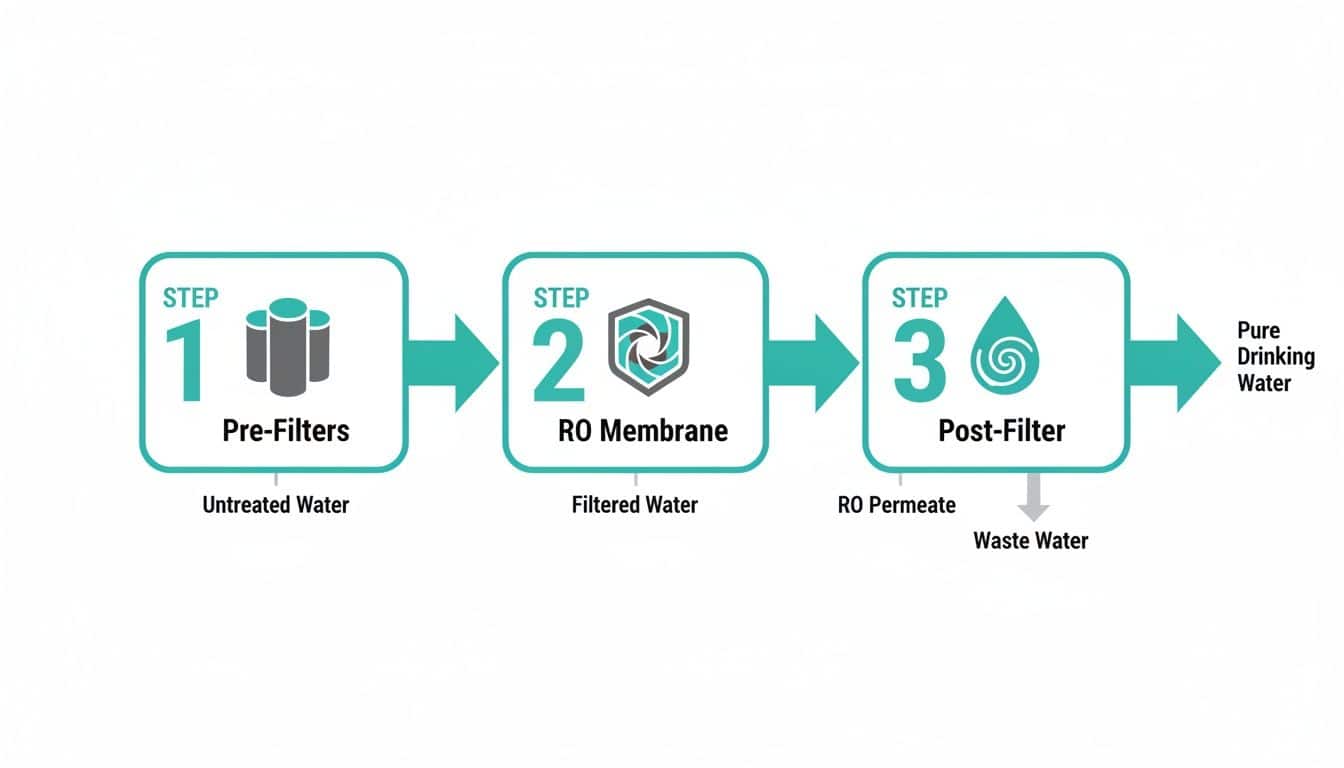
As you can see, each stage has a job. The pre-filters handle the big stuff, the RO membrane does the heavy lifting, and the post-filter gives the water a final polish. It's a systematic approach to truly clean water.
Emerging Threats and Hard Water Minerals
Beyond the usual suspects, a reverse osmosis system is also a powerful ally against modern environmental headaches. This is especially true for PFAS (per- and polyfluoroalkyl substances), which are often called "forever chemicals" because they don't break down easily and have been linked to health concerns.
The semipermeable membrane in an RO system is one of the very few residential technologies proven to effectively remove up to 99% of PFAS from drinking water, providing essential peace of mind.
And for those of us in places like Los Angeles, where the groundwater is notoriously packed with minerals, RO filters are a lifesaver. They are pros at removing the excess calcium and magnesium that create hard water. It's a problem that not only leaves spots on your dishes but can also damage your appliances over time, costing homeowners hundreds of dollars a year in repairs.
Comparing RO Systems to Other Filters
To really get a sense of an RO system's power, it helps to put it side-by-side with the common filters you see in stores. Those pitcher and faucet-mounted filters are better than nothing, but they simply don't offer the same kind of comprehensive protection. They mostly rely on activated carbon to improve taste and odor, but a lot of dissolved contaminants sail right through.
This table provides a clear comparison of what each type of filter can realistically remove.
Contaminant Removal RO vs Other Filters
| Contaminant | RO Water Filter System | Pitcher Filter | Faucet Filter |
|---|---|---|---|
| Lead & Heavy Metals | Excellent (95-99%+) | Fair to Good (Varies by model) | Fair to Good (Varies) |
| Chlorine | Excellent | Good | Good |
| Fluoride | Excellent (90-99%+) | Poor (Not typically removed) | Poor (Not typically removed) |
| Arsenic & Nitrates | Excellent | None | None |
| PFAS 'Forever Chemicals' | Excellent (Up to 99%) | Poor (Limited, model-specific) | Poor (Limited, model-specific) |
| Total Dissolved Solids | Excellent (90-99%+) | Poor | Poor |
Looking at this, the difference is stark. While basic filters make water taste a bit better, a reverse osmosis water filter system fundamentally makes it cleaner and safer. It's the clear choice for anyone serious about the quality of their drinking water.
Choosing the Right RO System for Your Home or Business
Alright, you've seen how reverse osmosis works its magic on a molecular level. Now, let’s get practical and figure out which system is the right fit for you. This isn't about picking the most expensive unit; it's about matching the technology to your actual needs, whether you're running a household or a business.
Getting this right from the start means you’ll have all the pure water you need without overspending. The decision really boils down to two key questions: how much water you need and where you need it.
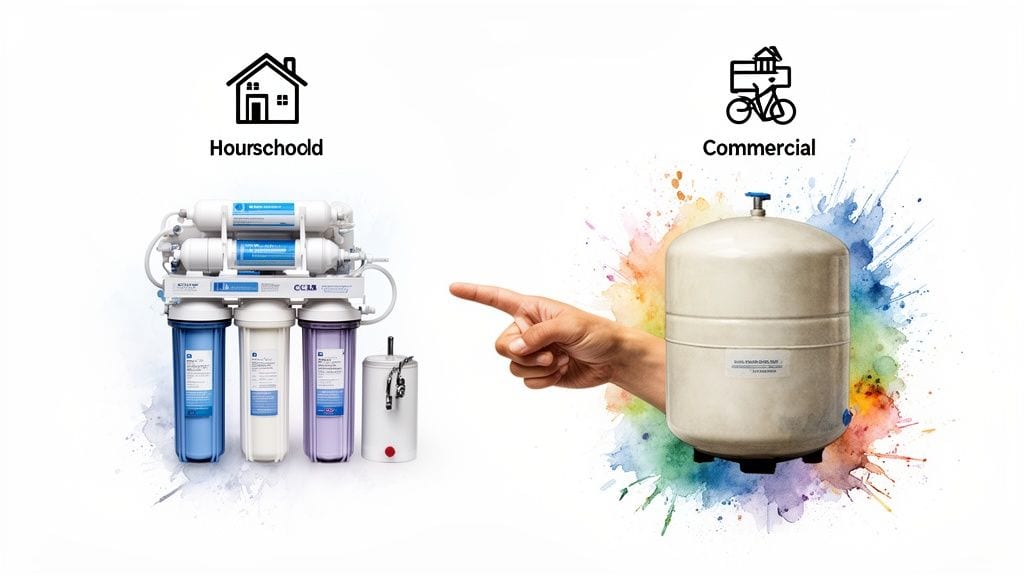
Determining the Right Capacity
An RO system’s output is measured in Gallons Per Day (GPD). This number tells you how much purified water the system can produce in a 24-hour period. Think of it as the system's top speed. Picking the right GPD is essential for keeping your tank full without constantly running the system at its limit.
Practical Example: For a family of four in a Los Angeles suburb using RO water mainly for drinking and cooking, a 50-75 GPD system is usually the sweet spot. It refills its storage tank plenty fast for daily use, so you're never waiting for water.
Now, picture a busy coffee shop in LA. Their needs are on a completely different scale.
Practical Example: A café relies on pure water for its espresso machine, ice maker, and drink station. For them, a system rated for 150 GPD or more is a must. This ensures they have a consistent supply during the morning rush, protecting their expensive equipment and the taste of their coffee.
Point-of-Use vs. Point-of-Entry Systems
The next big question is where you want the filtration to happen. This choice determines whether you get a compact unit for a single tap or a heavy-duty system that treats all the water coming into your property.
Point-of-Use (POU) Systems: These are the classic under-sink RO water filter systems most people are familiar with. They’re compact, fit neatly in a kitchen cabinet, and feed a dedicated faucet on your sink. It’s the perfect setup if your main goal is pristine water for drinking and cooking.
Point-of-Entry (POE) Systems: Often called whole-house systems, these are installed right where the main water line enters your building. A POE system purifies every drop of water you use—for showers, laundry, dishwashing, everything. While that sounds amazing, these systems are much larger, more complex, and a serious investment. They're typically reserved for businesses or homes dealing with specific water quality issues that go beyond the kitchen sink.
Making a Confident Choice with Professional Guidance
Here’s something a lot of people miss: sizing an RO system isn’t just about counting faucets or family members. Your home’s water pressure is a huge factor—RO systems work best between 50 and 65 psi. Too low, and your system’s GPD rating goes right out the window. The specific contaminants in your local water also play a part.
Getting this wrong is frustrating. You could end up with a faucet that flows at a trickle or a system that never seems to keep its tank full.
This is where calling in a specialist like Praz Pure Water makes all the difference. Instead of you having to guess, our technicians can perform a professional assessment. We'll test your water quality, check your pressure, and talk through how you use water day-to-day. From there, we can help you size an RO water filter system that’s a perfect match for your home and your budget, ensuring you get the performance you paid for from day one.
Your Simple Plan for RO System Installation and Maintenance
Think of your RO water filter system as a long-term investment in your family's health. And like any valuable piece of equipment, it needs a little bit of care to keep it running perfectly. The good news? Keeping your system in peak condition is surprisingly straightforward. Regular maintenance is not about fixing broken things; it's about ensuring your water quality never dips and you get the full value out of your investment for years to come.
A Clear Maintenance Schedule You Can Actually Follow
Forget about complicated manuals. RO system upkeep really just comes down to swapping out a few key parts on a simple schedule. It's no different than changing the oil in your car—a basic, predictable task that keeps the whole machine humming along.
Here’s a simple timeline that works for most homes:
- Pre-Filters (Sediment and Carbon): Change these every 6 to 12 months. They catch all the bigger stuff like sand, rust, and chlorine. They get dirty the fastest.
- RO Membrane: Replace this every 2 to 3 years. Its lifespan depends on how well you've kept up with changing the pre-filters.
- Post-Filter/Polishing Filter: Swap this out every 12 months. This is the final step, ensuring the water tastes crisp and clean right from the tap.
The massive shift toward these systems isn't a coincidence. As of 2025, reverse osmosis systems held a commanding 55% share of the water purifiers market, valued at a staggering USD 35.6 billion. That number is projected to climb to USD 53.2 billion by 2032, as more people turn to RO technology to remove the very impurities plaguing municipal water supplies. You can dig into the full market analysis on global water purifiers to see what's driving this trend.
Telltale Signs a Filter Needs Changing
Your system is pretty good at telling you when it needs attention. If you know what to look for, you can stay ahead of any problems.
Actionable Insight: The single most common sign that your pre-filters need changing is a big drop in water flow. If the stream from your RO faucet has slowed to a trickle, it's a near-certainty that the sediment and carbon filters are clogged. Your actionable takeaway is to order and replace these filters immediately.
A few other clues to watch for:
- The water starts tasting or smelling "off," which means the carbon filters are used up.
- Your storage tank seems to be taking forever to refill after you’ve used some water.
The Value of Professional Installation and Maintenance
While some DIY-savvy folks can manage the installation, there's a lot of peace of mind that comes with having a professional handle it. A tiny mistake, like a fitting that isn't seated just right, can cause a slow, hidden leak that leads to major water damage down the road.
This is exactly where a service like Praz Pure Water comes in. Our technicians make sure your RO water filter system is installed perfectly from day one, tuned specifically for your home's water pressure and plumbing. We cover all the factors that go into the total RO system installation cost so there are no surprises.
Even better, our maintenance plans take all the guesswork out of owning a system. We keep track of your filter schedule, show up when it's time for a change, and handle everything for you. It becomes a true "set it and forget it" solution, guaranteeing you have pure, amazing-tasting water on tap without ever having to think about it.
Why Praz Pure Water Is the Smart Choice for Los Angeles
If you live in Los Angeles, you know our water is… different. Choosing the right water purification system here isn't like anywhere else, and a generic, one-size-fits-all solution you find online often just doesn't cut it. This is where having a local specialist in your corner makes a world of difference.
We're not just a company that happens to be in LA; we live and breathe this city's water challenges. Our expertise is built on years of hands-on experience solving the specific problems LA residents face, ensuring you get the right ro water filter system that actually works for your home or business.
Expertise in Tackling LA’s Hard Water
Los Angeles is famous for its incredibly hard water. That means it’s loaded with minerals like calcium and magnesium, which are the culprits behind that stubborn, chalky scale buildup. You’ve seen it—it clogs your pipes, ruins expensive appliances like coffee makers and dishwashers, and leaves those frustrating water spots on your glasses and faucets.
A standard RO system, while amazing for purity, doesn't fix the hard water problem for your entire house. That’s why we almost always recommend a smarter, bundled approach.
Practical Example: We worked with a homeowner in the San Fernando Valley who was sick of replacing their high-end coffee machine every couple of years. The scale buildup was relentless. We set them up with a value-driven bundle: a whole-house water softener to protect all their pipes and appliances, plus an under-sink RO system for pristine drinking water. The result? No more ruined appliances and absolutely incredible-tasting water on tap.
This integrated strategy is what truly solves the problem. By pairing RO systems with water softening, we prevent that damaging mineral buildup from ever starting. You can learn more about the growing market for these advanced solutions and see why this approach is becoming the new standard.
Quality You Can Count On
A water filter is a serious investment in your family's health and your home's longevity. We get that. That's why we’re committed to installing high-quality, durable equipment that is proudly made in the USA. This isn't just a talking point; it means your system is built to withstand LA's tough water and perform reliably for years to come.
On top of that, we stand behind our work with strong warranties on every installation. You get total peace of mind knowing your investment is secure. For any professional in this field, generating plumbing leads is all about reputation, and there's no better way to build one than with quality products and guarantees you can trust.
Flexible Solutions for Homes and Businesses
We know that every home and business has a different set of needs and a different budget. A one-size-fits-all approach is lazy and ineffective, so we offer flexible solutions built around you.
For Businesses: We see it all the time with LA's amazing restaurants, cafes, and offices—they need consistently pure water. For them, we offer convenient rental options for our bottleless water coolers and commercial-grade RO systems. This lets a cafe serve incredible-tasting coffee and beverages without a huge upfront cost.
For Homeowners: Our most popular option is the value-driven bundle. By combining a top-tier RO system with a whole-house water softener, you get a comprehensive, cost-effective fix for total home water quality.
This focus on practical, tailored solutions is what sets us apart. We don't just sell you a box; we provide a complete service, from an honest initial water assessment to professional installation and ongoing support, making sure you get the perfect ro water filter system for your life in Los Angeles.
Common Questions About RO Water Filter Systems
It's smart to have a few practical questions before making a final decision. Getting the water right in your home is a big deal, and you should feel completely confident about your choice. To help you get there, we've put together some straightforward answers to the questions we hear all the time from our customers.
Does an RO Water Filter System Waste a Lot of Water?
This is probably the number one question we get, and for good reason—especially here in Los Angeles where every drop counts. The short answer is that modern systems are worlds apart from their older, inefficient cousins.
Years ago, RO systems did have a reputation for being water hogs. But technology has come a long way. Today’s high-efficiency models have drastically improved, with some offering an impressive 1:1 pure-to-waste water ratio. That means for every gallon of pure water you get, only one gallon goes to the drain. At Praz Pure Water, we exclusively recommend these water-conscious systems to ensure you get incredible purity without the guilt.
Will Reverse Osmosis Remove Healthy Minerals?
Let's be upfront: yes, the reverse osmosis process is so fine that it removes almost everything from the water, including healthy minerals like calcium and magnesium. This is what can sometimes give pure RO water a “flat” or uninteresting taste.
But here’s the easy fix: a remineralization filter. This is a standard part of the systems we recommend. After the water is thoroughly purified, it flows through this final stage, which adds a balanced blend of healthy minerals back in. You get the best of both worlds—water that's free of contaminants but also tastes crisp, refreshing, and full of healthy minerals.
Practical Example: A family switches to an RO system with remineralization and suddenly everyone, even the kids, starts drinking more water. Once you remove that faint chlorine taste and replace it with a clean, crisp flavor, it’s just naturally more appealing. That's a direct, positive impact on your family's hydration and health.
How Much Does an RO System Cost in Los Angeles?
The cost for a ro water filter system really depends on what you need—the system's capacity, extra features like remineralization, and how complex the installation is. As a general ballpark, a quality under-sink system for your home will typically land somewhere between several hundred to over a thousand dollars, including professional installation.
It's best to think of it not just as a purchase, but as a long-term investment in your family's health and your home's value. At Praz Pure Water, we believe in clear, upfront pricing and offer options for different budgets, from value-focused bundles for homeowners to convenient rental programs for businesses.
Can I Install an RO System Myself?
If you have serious plumbing skills and the right tools, a DIY installation is possible. However, for most people, we strongly recommend letting a professional handle it.
Even a tiny mistake, like a fitting that isn't perfectly sealed, can cause slow, hidden leaks that lead to water damage over time. A professional installation ensures every connection is secure, the system runs at peak efficiency, and your warranty remains intact. Our technicians take care of everything, giving you total peace of mind that the job is done right.
Ready to enjoy pure, great-tasting water straight from your tap? Praz Pure Water is here to help you find the perfect solution for your Los Angeles home or business. Schedule your free water consultation today!