
If you’ve ever noticed chalky white spots on your dishes, felt your laundry was stiff right out of the dryer, or struggled to get a good lather from your soap, then you’ve met the frustrations of hard water. Many homeowners I talk to wonder if a single system—something like a reverse osmosis water softener—can fix all their water woes.
The truth is, these are two very different technologies, each designed for a specific job. But they can, and often do, work together to give you the absolute best water possible throughout your home. This guide will give you clear, actionable insights to help you choose the right solution and see immediate benefits.
The Hard Water Problem In Los Angeles
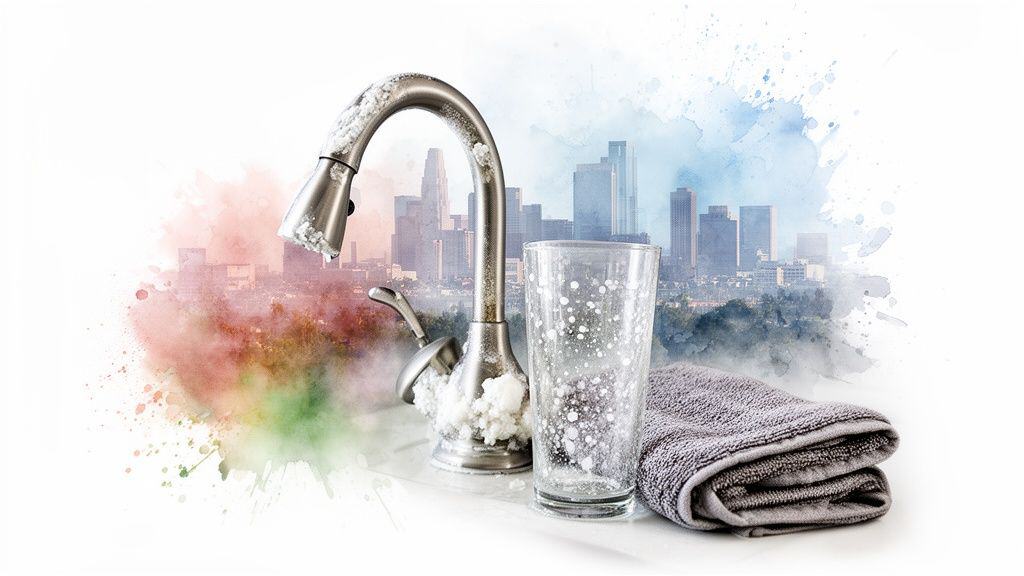
Here in Los Angeles and across Southern California, hard water is the unseen culprit behind countless household headaches. The mineral buildup it leaves behind, known as limescale, is like cholesterol clogging the arteries of your home’s plumbing. It slowly chokes the efficiency out of your appliances and causes serious damage over time.
So, what is it? Put simply, hard water is water with a high concentration of dissolved minerals, mostly calcium and magnesium. While these minerals aren’t harmful to drink, they create expensive and annoying problems around the house.
Everyday Signs of Hard Water
You don’t need a fancy water test to diagnose a hard water problem. The evidence is usually hiding in plain sight once you know what to look for.
- In the Kitchen: Your “clean” glasses come out of the dishwasher looking foggy or covered in a white film. Your coffee maker sputters, and your ice machine gets clogged with scale. Practical Example: A homeowner in Santa Monica noticed their espresso machine needed descaling every month instead of twice a year, a classic sign of severe hard water.
- In the Laundry Room: Clothes and towels feel rough and scratchy, and colors fade much faster. The minerals keep your detergent from dissolving properly, leaving a dulling residue on the fabric.
- In the Bathroom: You’ll see that stubborn, chalky film building up on faucets, showerheads, and glass doors. You might also notice you have to use more soap and shampoo just to get a decent lather.
The Hidden Damage to Your Home
While the visible signs of hard water are a nuisance, the real damage happens where you can't see it. The same limescale that spots your glassware is also building up inside your pipes and expensive appliances, forcing them to work much harder and eventually fail.
Your water heater is especially vulnerable. Mineral buildup acts as an insulator on the heating element, forcing it to use up to 30% more energy just to heat your water. This drives up your utility bills and can lead to premature failure—a costly and messy repair. The value here is clear: soft water lowers your energy costs.
It's the same story for your dishwasher, washing machine, and coffee maker. They're all silently fighting a losing battle against scale. This internal damage can dramatically shorten their lifespan, turning long-term investments into frustrating and recurring replacement costs.
To solve these issues effectively, you need the right tool. One solution protects your home and appliances, while the other purifies your drinking water.
How Ion Exchange Water Softeners Work
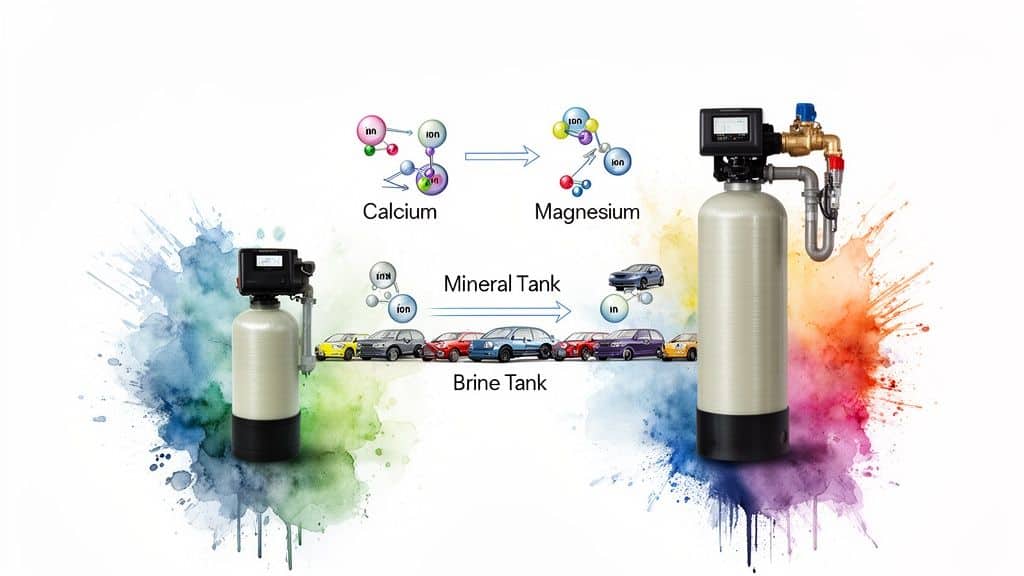
Traditional water softeners use a process called ion exchange, the gold standard for stopping destructive scale buildup. Think of it as a magnet for the minerals that make your water hard.
Here's the simple breakdown: The main tank is filled with tiny resin beads that hold sodium ions. When hard water flows through, the calcium and magnesium ions—the real culprits behind scale—are attracted to the resin. They stick to the beads, and in exchange, a small amount of sodium is released into the water. This effectively removes the hardness minerals from your water supply.
The Key Components of a Water Softener
An ion exchange softener has three key parts working together to deliver soft water throughout your home.
- The Mineral Tank: This is the large tank filled with resin beads that capture calcium and magnesium from all the water entering your house.
- The Brine Tank: This smaller tank holds a simple solution of salt and water. This "brine" is only used to clean and "recharge" the resin beads when they get full.
- The Control Valve: This is the brains of the system. It's a smart meter that tracks your water usage and knows exactly when the resin beads need to be cleaned.
The real value of a water softener is asset protection. Its main purpose is to guard your home’s plumbing, water heater, dishwasher, and washing machine from the expensive damage caused by limescale. Actionable Insight: By installing a softener, you are actively extending the life of your appliances and reducing energy consumption, saving you money on bills and future repairs.
This technology has proven so reliable that it remains the backbone of the water treatment industry. The global water softener market was valued at USD 3.5 billion in 2024 and is expected to climb to USD 6.8 billion by 2033. Ion exchange systems are still the dominant force, accounting for roughly 61% of the market share as of 2022. You can learn more by checking out the full water softener market report.
Understanding the Regeneration Cycle
Eventually, the resin beads become full of calcium and magnesium. When this happens, the control valve automatically starts a cleaning process called regeneration, usually in the middle of the night.
Here’s a quick look at what happens:
- Backwash: Water flow is reversed to flush out any sediment.
- Brine Draw: The system pulls the salty brine solution from the brine tank to wash the resin, stripping away the trapped hardness minerals.
- Rinse: The tank is thoroughly rinsed with fresh water, washing the minerals and any leftover brine down the drain.
- Recharge: The resin beads are now clean, coated with sodium ions, and ready to soften water again.
This automatic cycle ensures you always have a steady, uninterrupted supply of soft water protecting your home.
How Reverse Osmosis Creates Ultra-Pure Water
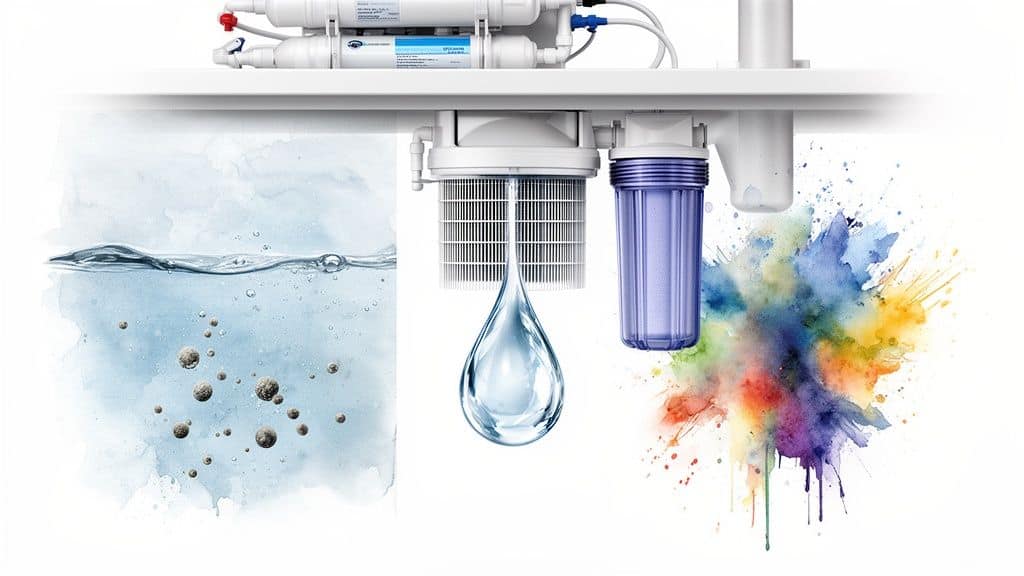
While a water softener protects your home, a reverse osmosis (RO) system has a different mission: ultimate purification. It provides some of the purest drinking water possible from a dedicated tap in your kitchen.
Picture it as a microscopic filter for your water. Your home's water pressure forces tap water through an incredibly fine, semi-permeable membrane. The pores in this membrane are about 0.0001 microns—so tiny they block a massive list of impurities, leaving you with exceptionally clean, great-tasting water.
The Multi-Stage Purification Process
A good RO system is a team of filters working together. A typical under-sink system breaks the process down into three key stages.
- Pre-Filtration: Before the main event, water passes through a sediment filter (to catch rust and grit) and a carbon filter (to trap chlorine). This step is crucial because chlorine can ruin the delicate RO membrane.
- The RO Membrane: This is the heart of the operation. Pressurized water is pushed through the membrane. Pure water molecules pass through to a small storage tank, while rejected contaminants are flushed down the drain.
- Post-Filtration: When you turn on the RO faucet, water leaves the storage tank and passes through one last "polishing" filter (usually carbon) to remove any lingering off-tastes, ensuring it's perfectly fresh.
The demand for this level of purity is growing. The global reverse osmosis market is expected to jump from USD 7.616 billion in 2024 to USD 11.21 billion by 2032, showing how much people value clean water.
What Does Reverse Osmosis Actually Remove?
This is where RO technology truly shines. It removes a whole range of dissolved solids and chemicals that other filters can't touch.
An RO system’s primary function is purification. It removes up to 99% of Total Dissolved Solids (TDS), which is a catch-all term for the inorganic salts and small amounts of organic matter in water. This provides a powerful barrier against unwanted substances.
So what gets removed? Here are a few examples:
- Heavy metals like lead and mercury
- Chlorine and chloramine
- Pesticides and herbicides
- Dissolved solids, including sodium and sulfates
- Fluoride (learn more in our article on how RO removes fluoride)
- Viruses and bacteria
Because it removes so many dissolved solids, an RO system does remove calcium and magnesium. However, it’s designed to purify small batches of water for drinking, not treat every drop in your house. Using it that way is incredibly wasteful and expensive.
Reverse Osmosis Vs. Water Softener: A Direct Comparison
One of the biggest questions we get is: "Do I need a water softener if I'm getting an RO system?" The truth is, they're designed for completely different jobs and can’t be swapped for one another.
While a reverse osmosis (RO) system does remove hardness minerals, it is absolutely not a substitute for a whole-home water softener. Trying to use an RO system to soften all the water in your house is an expensive, inefficient strategy that will quickly wreck your equipment.
The difference comes down to scale and purpose. An RO system is a purification specialist for drinking water. A water softener is a workhorse built to protect your entire home's plumbing and appliances.
Why You Can't Soften a Whole House with RO
Using an RO system for your whole home is like using an artist's pen to paint a house. It’s the wrong tool for the job.
Here’s why that approach doesn't work:
- It Destroys the RO Membrane: Hardness minerals like calcium and magnesium are brutal on the delicate RO membrane, which is the most expensive part of the system. A constant stream of hard water will clog and ruin it quickly.
- It Wastes a Staggering Amount of Water: To create pure water, an RO system flushes away contaminants in a stream of wastewater. If you ran all your water—for showers, laundry, and toilets—through it, your water bill would skyrocket.
- It Cripples Your Water Pressure: An RO system filters water slowly and can't keep up with household demand. You'd need a huge storage tank and a second pump just to get the water pressure back up, adding major cost and complexity.
Actionable Insight: The bottom line is simple: RO systems are finishers, not fighters. They are designed to purify already-treated water to the highest degree, not to take on the frontline battle against the high volume of minerals found in hard water.
Water Softener vs. Reverse Osmosis At A Glance
So, how do you pick the right solution? It all starts with your main goal. Are you focused on protecting your pipes from scale, or is your top priority getting the purest drinking water?
This table breaks down the key differences to help you decide.
| Feature | Ion Exchange Water Softener | Reverse Osmosis (RO) System |
|---|---|---|
| Primary Goal | Asset Protection | Water Purification |
| Main Function | Removes hardness minerals (calcium & magnesium) to prevent scale buildup. | Removes up to 99% of all dissolved contaminants for pure drinking water. |
| Treatment Point | Whole-Home (Point-of-Entry). Treats all water entering the house. | Typically Kitchen (Point-of-Use). Treats water at a single faucet. |
| Impact on Appliances | Excellent. Prevents scale, extends lifespan, and improves efficiency. | Poor. Not designed for high volumes; hard water will damage the system. |
| Impact on Drinking Water | Minimal. Does not purify water or remove a wide range of contaminants. | Excellent. Removes lead, chlorine, fluoride, pesticides, and more. |
| Water Waste | Minimal. Only uses extra water during its brief, periodic regeneration cycle. | Significant. Generates wastewater as part of the purification process. |
| Ideal Use Case | You want to eliminate hard water spots, protect your water heater, and make cleaning easier. | You want the best-tasting, safest water for drinking, cooking, and making ice. |
As you can see, a "reverse osmosis water softener" isn't a single device. It's a two-part strategy for total water quality. The water softener handles the heavy lifting for the whole house, and the RO system provides the final polish for the water you drink.
Designing Your Perfect Water Treatment System
Now let's get practical. For those of us in Los Angeles dealing with notoriously hard water, this isn't about choosing one system over another. It’s about figuring out your main priority and building a solution that actually solves your water problems for good.
Think of it as a simple "if-then" choice. Pinpointing your biggest frustration points you directly to the foundational piece of your home water setup.
Your Primary Goal Dictates Your First Step
What's more frustrating: chalky residue on appliances, or the taste of your drinking water? Answering that one question tells you exactly where to start.
- IF your top priority is to stop limescale from ruining your pipes, dishwasher, and water heater…
- THEN a whole-home ion exchange water softener is your non-negotiable first step. It’s the only effective way to tackle hard water issues throughout your entire house.
But maybe your focus is more on what you're drinking.
- IF your main goal is getting the purest, cleanest-tasting water—free from chlorine, lead, and other contaminants…
- THEN a point-of-use reverse osmosis (RO) system under the kitchen sink is the perfect tool for the job.
This decision flow helps visualize how your goal—either protecting your home or purifying your water—guides your choice.
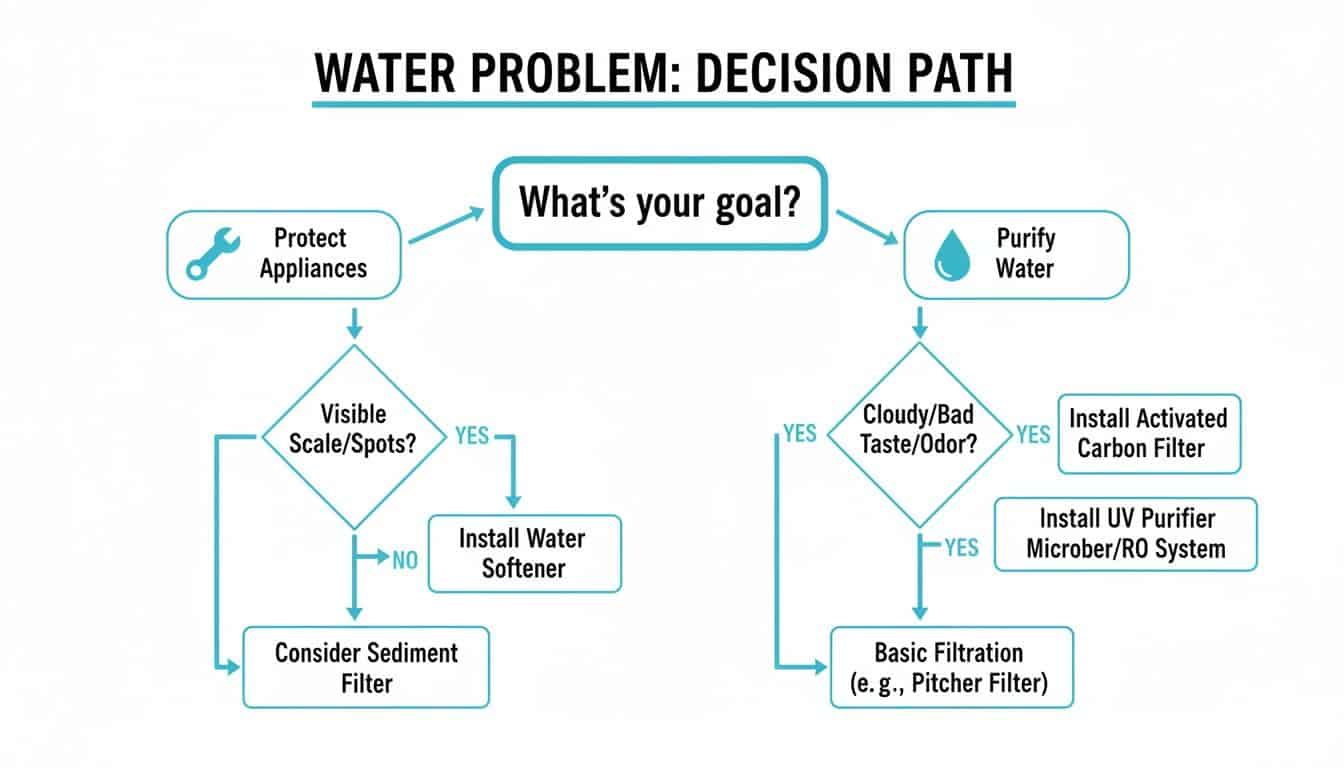
Actionable Insight: Choose the system that solves your biggest headache first. You can always add the second component later.
The Ultimate Strategy: The Two-Part Solution
While starting with one system is a huge improvement, the gold standard for total home water quality is combining both. This creates a powerful duo where each unit makes the other better. A reverse osmosis water softener combination is what the pros recommend for a reason.
Here’s why this tag-team approach works so well:
- The Water Softener Protects Everything: Installing a whole-home softener first protects every pipe and appliance that uses water—including the RO system itself. The softener acts as a bodyguard, tackling the hard minerals that would otherwise destroy the delicate RO membrane.
- The RO System Perfects Your Drinking Water: Once the hard water is taken care of, the RO unit is free to do its real job: purification. It takes the now-softened water and filters it to an incredible level, removing up to 99% of any remaining contaminants.
Practical Example: A family in the San Fernando Valley was frustrated with their dishwasher leaving a white film on their glasses and their new coffee maker constantly clogging. Their goal was clear: protect their appliances. They installed one of our whole-house water softener systems, and the scale problems vanished immediately. A few months later, they decided they wanted better-tasting water for cooking and for their kids to drink. We added an under-sink RO system. The result? No more spots, longer-lasting appliances, and amazingly pure water on tap.
This "soften first, purify second" method is the most logical and cost-effective way to get total peace of mind and achieve maximum value from your investment.
Installation, Maintenance, And Cost Realities
So, you’re thinking about a top-tier water treatment system. That’s great! Let’s talk about the practical side—setup, upkeep, and budget. Getting a clear picture of the whole process will help you feel confident in your decision.
When it comes to installation, we always recommend a professional setup. A certified specialist knows how to handle the plumbing, calibrate the system to your home's water pressure, and ensure everything is up to code.
It can be tempting to DIY to save a few dollars, but we've seen it lead to headaches like leaks, improper drainage, or even voiding the warranty. A professional installation protects your investment and ensures everything works perfectly from the start.
Ongoing Upkeep And Maintenance
The good news is that day-to-day upkeep is surprisingly simple. Each system has one main task to keep it performing at its best.
- Water Softeners: Your only job is to keep the brine tank topped up with salt. Most households only need to add a bag of salt every one to two months, depending on water hardness and usage. It’s a quick and easy chore.
- Reverse Osmosis Systems: For an RO system, maintenance is all about the filters. The pre- and post-filters need to be swapped out about once a year, while the central RO membrane lasts anywhere from two to five years. These regular changes guarantee your drinking water stays pure.
Budgeting For Your Water Treatment System
Think of a water system as an investment in your home's infrastructure and your family's health. The costs break down into the initial setup and minimal ongoing expenses.
The upfront cost covers the equipment and professional installation. Thinking through the complete reverse osmosis system installation cost is a key part of planning. For a closer look at our services, we've put together a guide on the Praz Pure Water reverse osmosis system installation cost.
After that, ongoing costs are predictable: about $10-$20 for a bag of salt every couple of months and around $80-$150 for annual RO replacement filters. When you stack those small expenses against the cost of replacing a dishwasher or water heater ruined by scale, the long-term value is undeniable. You're not just buying equipment; you're actively protecting your home's most expensive appliances.
Frequently Asked Questions About Water Treatment Systems
Even after weighing your options, a few questions might still be floating around. Let's clear up the common concerns.
Will A Water Softener Make My Water Salty?
This is a common myth, but the short answer is no. A water softener doesn't make your water taste salty.
The ion exchange process adds a tiny amount of sodium—typically less than you'd find in a slice of bread. The salt you add to the brine tank is only for cleaning the resin beads and is completely flushed out during the regeneration cycle. It never makes it to your tap.
How Can I Find Out How Hard My Water Is?
Knowing your water's specific hardness level is the first step to getting the right system.
Actionable Insight: The most reliable method is to schedule a free, no-obligation water assessment with a professional. We at Praz Pure Water will give you a detailed analysis of your water quality. This data empowers you to make a truly informed choice.
While DIY test strips offer a rough estimate, a professional evaluation provides the full picture—mineral content, pH levels, and other contaminants. This ensures your new system is perfectly dialed in for your home's unique needs.
Can I Install These Systems Myself?
While technically possible if you have serious plumbing skills, we strongly advise against it. Professional installation is crucial for peak performance.
A pro install prevents costly leaks or water damage and protects your equipment's warranty. Having an expert technician set it up guarantees everything works perfectly from day one.
Do RO Systems Waste A Lot of Water?
It's true that older RO systems were known for being inefficient. Thankfully, technology has come a long way.
Modern, high-efficiency models have drastically cut down on wastewater. Many systems we install today operate at a near 1:1 ratio. This means for every one gallon of pure water, only about one gallon goes down the drain—a massive improvement.
Ready to feel the difference that perfectly treated water can make in your Los Angeles home? The team at Praz Pure Water, Inc. is here to help you design the ideal solution, whether that’s a whole-home softener, an under-sink RO system, or a combination of both.
Contact us today for your free water assessment and get started.