
Testing your water’s pH is one of the simplest, most revealing actions you can take to understand what’s really coming out of your tap. It’s a quick check that gives you a number on a 0-14 scale, telling you if your water is acidic (below 7), neutral (7), or alkaline (above 7). The value you gain from this single number can be the difference between a healthy home and thousands of dollars in surprise repairs.
Why Testing Your Water's pH Is So Important
Before we get into the how, let's talk about the why. Most people don't think about their water's pH until something goes wrong. But by then, the damage is already done. An unbalanced pH isn't just a science problem; it's a direct hit to your wallet and your daily routine.
Practical Example: A local Los Angeles café owner called in a panic because her high-end espresso machine—the heart of her business—was on the fritz again. A technician found it choked with mineral scale, a classic sign of highly alkaline water. Each repair meant downtime, lost revenue, and unhappy customers. A simple, regular pH test could have caught this early, saving her a fortune.
The Hidden Costs of Unbalanced Water
That same problem hits homeowners just as hard, especially in areas like Los Angeles where hard water is common.
- Acidic Water (pH below 7.0): Have you noticed faint blue-green stains in your sinks or bathtubs? That's not just an eyesore. It's the physical evidence of your copper pipes slowly dissolving from the inside out.
- Alkaline Water (pH above 7.0): This is the culprit behind that stubborn, chalky white scale on your faucets, showerheads, and inside dishwashers and water heaters. That buildup makes your appliances work harder, waste energy, and eventually fail years before they should.
Actionable Insight: Testing your water's pH is a crucial maintenance step that delivers immense value. It protects your plumbing, helps you get the full lifespan out of your appliances, and even improves the taste of your morning coffee.
Understanding the pH Scale for Water
To grasp what these numbers mean for your home, it helps to see the scale broken down. Each level has a direct impact on your property.
| pH Range | Water Type | Common Problems & Effects |
|---|---|---|
| 0-6.9 | Acidic | Corrodes metal pipes (copper, iron, lead), leading to leaks and heavy metal contamination. Causes blue-green stains in sinks. Can taste metallic. |
| 7.0 | Neutral | Ideal for drinking water and plumbing. It's balanced and non-corrosive, posing no threat to pipes or appliances. |
| 7.1-14 | Alkaline | Leads to scale formation (limescale) in pipes and appliances, reducing efficiency. Can cause skin dryness. Water may have a bitter taste. |
As you can see, drifting too far from the neutral 7.0 mark spells trouble. Knowing your water's pH is the first step toward preventing these issues.
The concept of measuring water balance was invented in 1909 by Danish biochemist Søren Peter Lauritz Sørensen to control beer quality. He realized that the concentration of hydrogen ions was critical.
That same principle holds true for our tap water today. With over 70% of households in areas like Los Angeles dealing with hard water, companies like Praz Pure Water use precision pH testing to prevent the kind of pipe damage that costs U.S. homeowners $2.5 billion annually in repairs.
For those with specific hobbies, like maintaining an aquarium, pH is even more critical. If you're managing an aquatic environment, this guide on How to Test Aquarium Water is a fantastic resource that dives deep into the techniques involved.
Alright, you know why you should test your water's pH. But what’s the right tool for the job? Choosing a method isn't about a simple pros and cons list. It's about matching the tool to your specific situation, budget, and how much accuracy you truly need. You have three main options: pH test strips, a digital meter, or a professional lab analysis.
pH Test Strips for a Quick Sanity Check
For a fast, ballpark reading, pH test strips are the go-to. They're inexpensive, easy to use, and widely available. You just dip the strip in water, wait a few seconds, and match the color to the chart on the package.
But here’s the trade-off: convenience comes at the cost of precision. Practical Example: We’ve seen low-quality strips give misleading results. Research shows that strips can underestimate pH by as much as 0.27 units compared to a calibrated meter. You can read the study on pH test accuracy on pmc.ncbi.nlm.nih.gov if you want the data. They’re fine for a quick check, but don't rely on them for making big decisions.
Digital pH Meters for When Accuracy Matters
If you need a reliable, precise number, you'll want a digital pH meter. This is the tool for anyone who can't afford to guess—like a restaurant owner whose water quality directly impacts coffee flavor, or a homeowner monitoring a new whole-house filtration system. These devices provide a direct numerical reading, removing any guesswork.
When you're shopping for one, our technicians always stress one key feature: Automatic Temperature Compensation (ATC). Water temperature can alter a pH reading, and a meter with ATC automatically corrects for it, ensuring a reliable result.
Expert Tip: Calibrate your digital meter before every single use. It takes less than a minute using a buffer solution, but it’s the only way to guarantee your reading is dead-on accurate. An uncalibrated meter is just for show.
Professional Lab Analysis for Certified Results
Sometimes, a simple pH number isn't enough. You need irrefutable, certified proof of your water's quality. That’s when you call the pros for a lab analysis.
This is the standard for:
- Property Managers ensuring water is safe for tenants.
- Commercial Operations needing certified water reports to comply with health codes.
- Complex Water Problems where you suspect issues beyond pH, like heavy metals or bacteria.
A lab analysis gives you a comprehensive breakdown of your water's entire chemical makeup. It is the most expensive route, but the detailed insights are invaluable if you're facing persistent issues. A professional assessment is the best way to pinpoint the root cause and find the right solution.
A lab report can help you decide what equipment you actually need. Explore our guide on the best water treatment systems available in our article to get an idea of your options.
Here's a quick breakdown of how these methods stack up.
Comparison of Water pH Testing Methods
| Method | Best For | Accuracy | Cost | Ease of Use |
|---|---|---|---|---|
| pH Test Strips | Quick, occasional checks & general estimates. | Low | $ | Very Easy |
| Digital pH Meter | Regular, accurate monitoring for homes or businesses. | High | $$ | Moderate |
| Professional Lab | Certified results, complex issues & compliance. | Very High | $$$ | N/A (Done by pros) |
Actionable Insight: Choosing the right tool comes down to what's at stake. For a casual check, strips are fine. For managing your home's water quality or a business, a digital meter is a wise investment. For legal, commercial, or complex health concerns, nothing beats a professional lab report.
How to Get an Accurate pH Reading Every Time
Getting a trustworthy pH reading is what matters most. An inaccurate test can lead to costly mistakes, so it’s worth doing right from the start. Accuracy begins long before you test the water.
It all comes down to the sample. The water sitting in your pipes overnight gives a different reading than water from the municipal main. For the best insight into your plumbing's health, use a "first-draw" sample. Collect water first thing in the morning before any water is used. This sample reveals your pipes' impact on the water's pH, which is crucial for spotting corrosion.
If you’re trying to measure the water entering your home, flush the pipes by running the cold tap for at least 60 seconds before collecting your sample. Always use a clean glass jar, as plastic containers can affect results.
Using pH Test Strips the Right Way
pH strips are great for a quick reading, but common mistakes can make them useless. Inconsistent results usually come down to technique.
- Quick Dip: Submerge the strip for just a second or two. Soaking can cause the chemical dyes to bleed.
- No Shaking: After dipping, hold the strip flat and tap it on the edge of the glass to remove large drops. Shaking it will make the colors run together.
- Proper Color Matching: Wait about 15-30 seconds (or as instructed) for the color to develop. Hold the strip next to the color chart on the bottle. Do not let the wet strip touch the paper chart, as this can transfer dye.
Practical Example: In a Los Angeles home, a first-draw sample from the kitchen sink might test at an acidic 6.4, but water from an outside hose bib (after flushing the line) reads a neutral 7.2. This difference is a big clue that the home's plumbing is lowering the water's pH.
This flowchart breaks down the testing options.
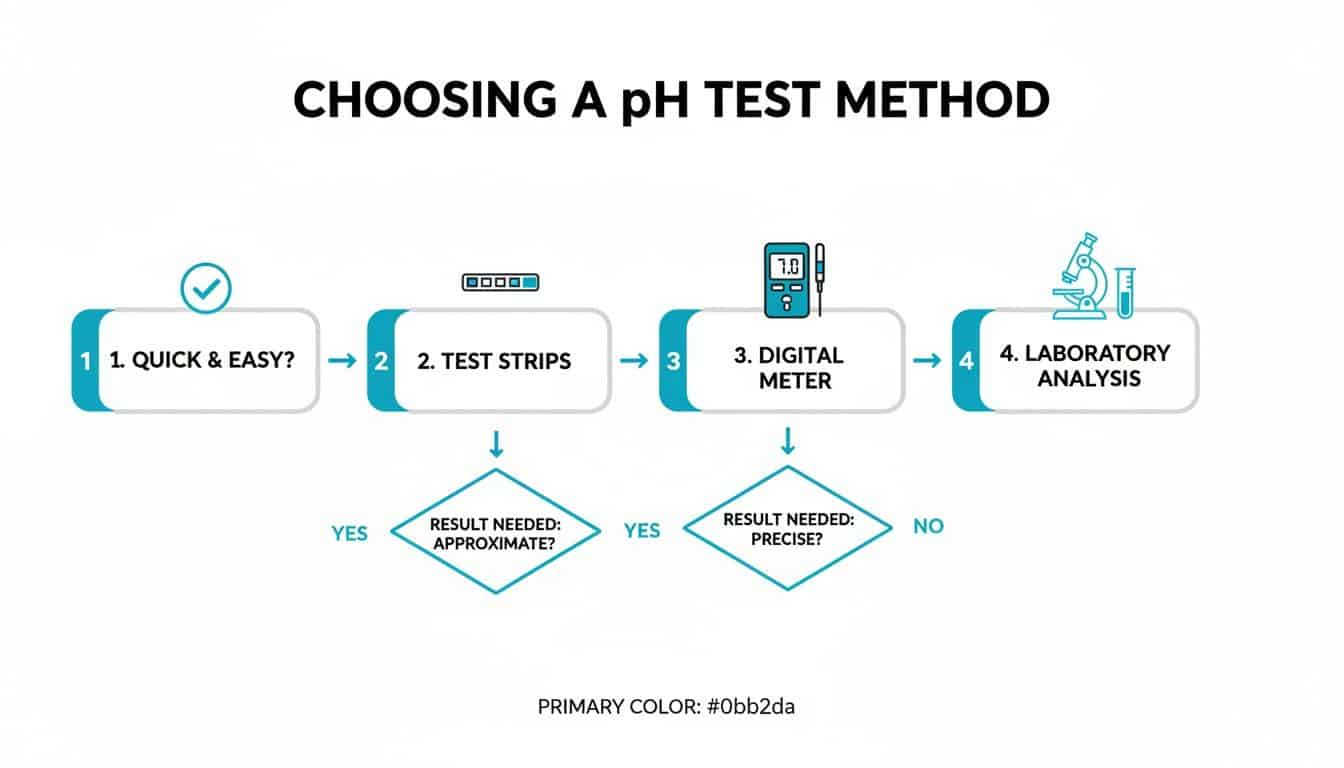
While strips are good for a gut check, meters and lab tests provide the accuracy needed for confident decisions about water treatment.
Mastering Your Digital pH Meter
For real precision, nothing beats a digital pH meter. However, its accuracy is entirely in your hands. An uncalibrated meter is just a random number generator.
The most important habit is calibration. You must calibrate your meter before every use with buffer solutions—liquids with a precise pH (typically 4.0, 7.0, and 10.0). This process syncs the meter’s electrode, ensuring reliable readings.
Actionable Insight: Always calibrate a digital meter before each use for trustworthy results. An uncalibrated meter is no more reliable than guessing. This simple, two-minute step is the most important factor for accurate pH testing.
Once calibrated, place the probe into your water sample and swirl gently to dislodge air bubbles. Now, be patient. The numbers will jump around for 30 to 60 seconds before settling. That final, stable number is your true pH.
What Your pH Results Mean and What to Do Next
Okay, you've tested your water and have a number. Now what? That number is a direct clue about your water's health and its interaction with your plumbing. Understanding its meaning is key to creating a smart action plan.
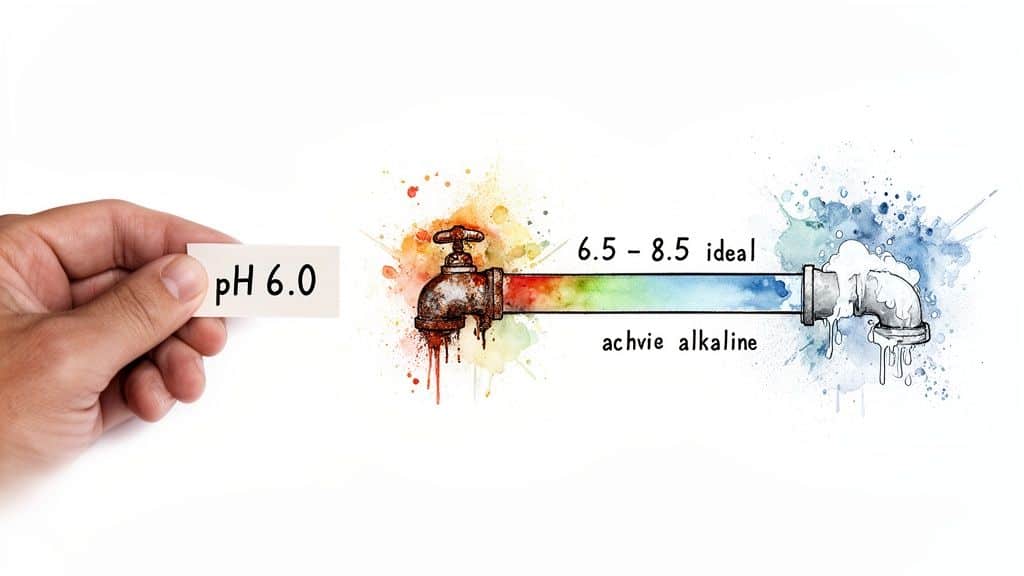
For drinking water, aim for a sweet spot between 6.5 and 8.5. A result outside this range often explains issues you’ve noticed around the house.
When Your Water Is Acidic
If your test shows a reading below 7.0 (especially below 6.5), you have acidic water. This common problem can silently eat away at your plumbing.
Practical Example: A client gets a reading of 6.0, and suddenly it all makes sense. The subtle metallic taste in their coffee and the blue-green stains around the sink drain aren't their imagination. The low-pH water is dissolving their copper pipes and leaching metals into their water.
Actionable Insight: Acidic water acts like a slow-moving solvent on your pipes. Ignoring a low pH reading is like letting a small leak drip for years—the long-term damage is more expensive than fixing the problem upfront. A direct and effective fix is an acid neutralizing filter, which raises the pH as water passes through.
When Your Water Is Alkaline
If your test came back above 8.5, you’re dealing with alkaline water. While generally not a health risk, high alkalinity causes hard water scale, a major headache for homeowners.
Practical Example: A family bought a new dishwasher. Months later, their glasses are cloudy and the machine is caked with a chalky film. A pH test shows 8.8. The high pH is causing minerals to build up, ruining appliance efficiency.
The most reliable solution for hard, alkaline water is a water softener, which swaps out "hard" mineral ions for "soft" sodium ions, stopping scale. To learn more, explore our guide on how water filtration works.
Turning Your pH Reading Into a Plan
Once you know your pH, you can take targeted action. Understanding how to improve water quality is easier with a clear test result.
Here’s a quick breakdown of your next steps:
- Ideal (6.5 – 8.5): Perfect. Your water is balanced. Re-test annually to ensure nothing changes.
- Acidic (< 6.5): The priority is protecting pipes. Action: Look into acid neutralizing filters.
- Alkaline (> 8.5): The focus is protecting appliances. Action: A water softener is likely your best bet.
Knowing your water's pH is the first step. Taking the right action based on that knowledge is how you protect your home and gain peace of mind.
When You Should Call a Water Treatment Professional
DIY test strips are great for a quick snapshot, but they only tell you so much. Knowing when to call an expert can save you frustration and prevent serious, long-term damage.
The most obvious sign? When your fixes don't work. If you're constantly fighting acidic or alkaline readings, it’s a red flag of a deeper issue.
Signs That Demand an Expert Eye
Visible evidence is another key sign. When you see chalky scale buildup clogging your showerhead or blue-green stains in sinks, the problem has moved past a minor imbalance. These are symptoms of a systemic issue that needs a professional diagnosis before it leads to pipe leaks or a fried water heater.
This is where a true water treatment professional provides value. They bring advanced tools and the experience to design a permanent, whole-home solution.
- Comprehensive Water Analysis: A pro doesn't just check pH. They run a full panel, looking at hardness, total dissolved solids (TDS), chlorine, and other contaminants.
- Root Cause Diagnosis: An expert connects the dots, figuring out if low pH is from the city's water or old pipes in your home.
- Custom System Design: Instead of a band-aid, they engineer a system tailored to your water profile, like an acid neutralizer or water softener.
Actionable Insight: Calling a professional isn't giving up; it's a smart investment in your home's health. It’s the difference between guessing and implementing a lasting solution.
Think of it this way: a test strip tells you if your water is alkaline. An expert can tell you why and build the right system to fix it for good. If you're weighing different technologies, our article comparing reverse osmosis vs alkaline water is a great resource. For any stubborn water quality problem, professional help is the surest path to clean, safe, and balanced water.
Frequently Asked Questions About Water pH Testing
pH testing often brings up many questions. Let's clear up a few of the most common ones from homeowners and businesses.
What Is the Ideal pH Level for Drinking Water?
The "perfect" pH is more of a "perfect range." The U.S. Environmental Protection Agency (EPA) sets the guideline for municipal water between 6.5 and 8.5. Water in this range tastes better and won't corrode pipes or leave scaly deposits.
You've likely seen ads for high-alkaline water (pH above 8.5). While it's a hot topic, there isn't much science to back many of those health claims. The main goal for your home or business should be keeping the pH balanced within the EPA's recommended range to protect your plumbing and get safe, great-tasting water.
How Often Should I Be Testing My Water's pH?
Your testing schedule depends on your needs. Consistency is key to catching problems early.
Here’s a simple, actionable guide:
- Homeowners: A seasonal check (four times a year) is a great rule of thumb to catch gradual shifts.
- Businesses (Cafes, Restaurants): Water is an ingredient, so test monthly at a minimum to guarantee a consistent product.
- After Installing a New Treatment System: Test weekly for the first month to confirm the equipment is working. Then, switch to a seasonal routine.
Actionable Insight: Think of regular pH testing as preventative maintenance for your plumbing. Catching a small pH drift early delivers significant value by saving you from thousands of dollars in corrosion or scale damage down the road.
Can I Fix My Water's pH Myself?
You can, but it’s crucial to know the difference between a quick patch and a real solution.
Some people try manually adding chemicals like soda ash to raise pH. This might work for a small batch of water, but it's not practical for a whole building. You'll be stuck in a constant cycle of testing and dosing.
A permanent fix means installing a system that solves the problem automatically. For acidic water, an acid neutralizer is the answer. For hard, alkaline water, a targeted water softener brings it back into balance. These are set-and-forget solutions that provide peace of mind.
If your tests show a persistent pH issue, or you're ready to stop guessing and find a permanent solution for your Los Angeles home or business, it's time to bring in a professional. The team at Praz Pure Water, Inc. can provide a comprehensive water assessment and recommend a system to keep your water perfectly balanced.