
Have you ever noticed those stubborn, chalky white spots on your shower door? Or wondered why your skin feels so dry and itchy right after a shower? These aren't just minor annoyances; they're the classic signs of hard water. A whole-house water softener for home isn't just a luxury—it's the most effective solution to solve these problems for good, protecting your home's value and making your daily life more comfortable.
Why Hard Water Is a Problem for Los Angeles Homes
The water coming out of your tap might look perfectly clear, but it could be the secret saboteur behind some of your biggest household headaches. Think about those stiff, scratchy towels that never seem to get soft, or a major appliance giving out years before it should. The culprit is almost always hard water, which is simply water loaded with dissolved minerals like calcium and magnesium.
For anyone living in Los Angeles, this is a daily reality. Our region's water sources are famous for being incredibly hard. This means that mineral deposits—that crusty stuff we call limescale—are constantly building up inside your home's pipes. Over time, this buildup acts like a clog in an artery, choking off water flow and damaging everything it touches.
The Hidden Costs of Mineral Buildup
Practical Example: You invested in a brand-new, high-efficiency dishwasher, but after just a few years, it’s not cleaning like it used to. Your glasses come out cloudy, and its spray arms are caked in a white, chalky residue. That’s not a faulty appliance; it’s the destructive power of hard water scale, which makes your appliances work harder, consume more energy, and ultimately fail much sooner.
This problem doesn’t stop at the dishwasher. Hard water wreaks havoc in nearly every corner of your home:
- Appliances: Your water heater, coffee maker, and washing machine all lose efficiency and are prone to premature breakdowns.
- Plumbing: Limescale slowly narrows your pipes, leading to frustratingly low water pressure and setting you up for costly plumbing emergencies.
- Surfaces: Faucets, sinks, and shower doors become a battleground, constantly covered in soap scum and hard-to-clean water spots.
- Personal Care: Those hard minerals interfere with soap, preventing it from lathering properly. Instead, it leaves a sticky film on your skin and hair, leading to dryness, dullness, and irritation.
This isn't a rare issue. In fact, over 85% of homes in California are battling hard water. It's more than an inconvenience—it can shorten the lifespan of your major appliances by up to 30%. Worse, the reduced efficiency can quietly add an extra $100-$200 to your energy bills every single year.
Taking Control of Your Water Quality
The good news is you don't have to put up with it. Installing a water softener for home is the most direct and effective way to stop mineral buildup right at the source. Think of it as a proactive investment that safeguards everything from your plumbing system to that fancy espresso machine on your counter.
Actionable Insight: By tackling the root cause, you can finally learn how to get rid of hard water and all its frustrating side effects. In this guide, we'll walk you through everything you need to know, drawing on our 20 years of hands-on experience helping homeowners just like you across the Los Angeles area.
How a Water Softener Works Its Magic
The science behind a home water softener might sound complex, but the idea is actually straightforward. Imagine your softener is like a magnet designed to pull specific things out of your water. The "hard" minerals we want to get rid of, mainly calcium and magnesium, are positively charged. So, the softener uses a negatively charged "magnet" to grab them.
This "magnet" is actually a tank full of millions of tiny resin beads. Each bead is loaded with a negative charge, making it irresistible to the positively charged calcium and magnesium floating in your water. As your water flows through this tank, the hard minerals are pulled out and stick tight to the beads.
In their place, the beads release a harmless sodium ion. This swap, known as ion exchange, is the core process that turns damaging hard water into the soft water that protects your home. You're left with water that won't leave behind that chalky scale, stubborn soap scum, or shorten the life of your appliances.
The problems caused by hard water are more than just a nuisance; they create a chain reaction that affects your pipes, appliances, and even your skin.
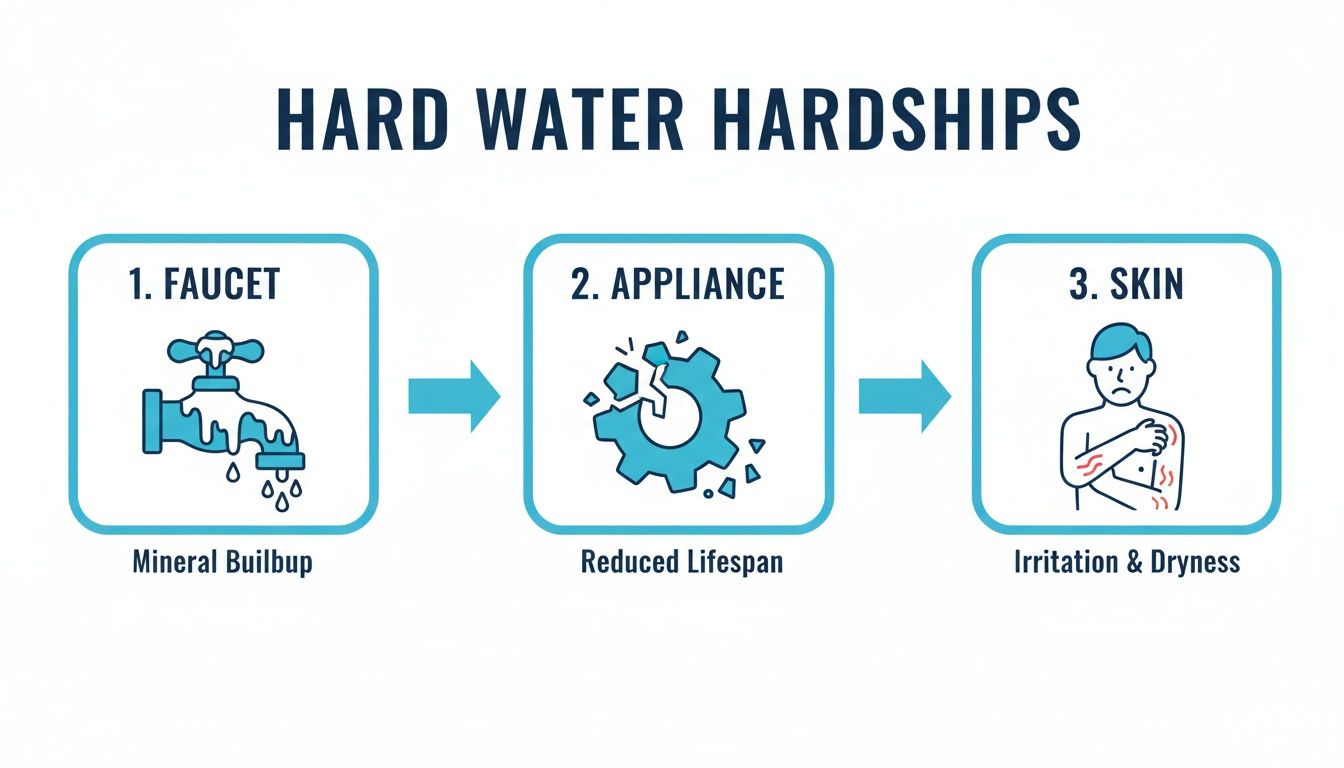
As you can see, what starts as a crusty faucet can lead to a broken dishwasher and dry, itchy skin.
Keeping the System Clean with Regeneration
After a while, those little resin beads become completely coated with all the calcium and magnesium they’ve pulled from the water. They're full and can't grab any more minerals. That's when the softener's built-in self-cleaning cycle, called regeneration, kicks in to refresh everything.
The regeneration process is an automatic, multi-step wash-and-recharge cycle:
- Backwash: First, water flow is reversed to flush out any dirt or sediment that's settled in the tank. Think of it as a quick pre-rinse.
- Brine Draw: A powerful saltwater solution, or brine, is slowly pulled from a separate brine tank and washed over the resin beads. The sheer amount of sodium in the brine is enough to knock the "hard" minerals off the beads.
- Slow Rinse: The system gently rinses away the brine and the now-free hard minerals, sending them all down the drain.
- Fast Rinse: A final, more powerful rinse ensures every last bit of the salty brine is flushed out, leaving the resin beads clean.
- Refill: The brine tank is topped off with fresh water, which dissolves the salt to get a new brine solution ready for the next time.
This whole cycle is the secret to a water softener's lasting power. By automatically cleaning itself out and recharging the resin, the system gives you a constant, uninterrupted supply of soft water.
Knowing how this works helps you understand the real-world benefits—like why your coffee maker stops getting clogged and your dishwasher keeps running like new. While ion exchange is specific to softeners, you can learn how does water filtration work to understand how other systems target different contaminants. For a wider view, you can also explore general water system processes to compare different technologies.
Choosing the Right Water Softener for Your Home
Finding the right water softener isn't about picking the "best" one on the market—it's about finding the best one for your home. Think of it like buying a car. You wouldn't buy a two-seater sports car for a family of six, and you wouldn't choose a massive SUV if you just need to zip around the city. The same logic applies here; the right system has to match your family's size, your water usage, and the specific problems you're trying to solve.
The world of water softeners can seem confusing, but the main differences really come down to how they handle hard minerals, how much you'll have to interact with them, and what they cost to run over time. Let's walk through the most common types you'll come across.
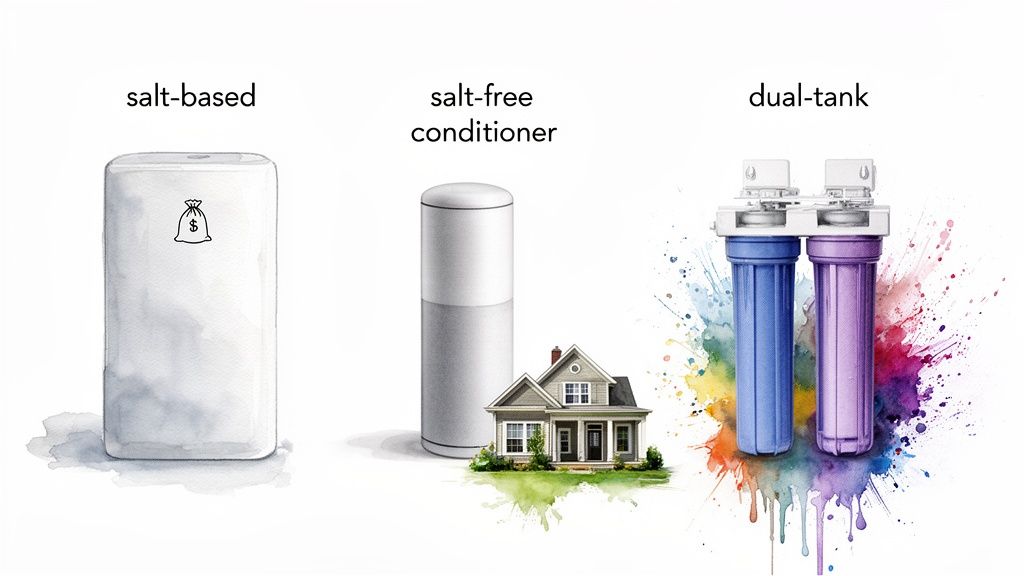
Salt-Based Ion Exchange Systems: The Industry Standard
When most people picture a water softener for home, this is what they're thinking of. The salt-based, or ion exchange, system is the classic, time-tested workhorse of the industry. It's the only technology that physically pulls the hard minerals—calcium and magnesium—out of your water.
Practical Example: A family of four in a Los Angeles neighborhood with notoriously hard water is fed up with cloudy glasses, laundry that feels stiff and scratchy, and the endless scrubbing of soap scum in the shower. A salt-based system is their best bet because it completely removes the minerals causing all that frustration. The result is truly soft water and a difference they can see and feel every single day.
Their unmatched performance is why salt-based systems remain the go-to choice globally. Projections show they will account for a massive 68.24% share of the market in 2025 simply because they work so well. By swapping out hardness minerals for sodium ions, these systems can slash scale buildup by over 95%—a level of effectiveness other technologies just can't touch. You can dive deeper into these performance stats and market trends over at Data Bridge Market Research.
Salt-Free Water Conditioners: The Low-Maintenance Alternative
Now, for homeowners who want to stop scale from destroying their pipes and appliances but would rather not deal with salt, a salt-free water conditioner is a fantastic alternative. It’s crucial to know that these systems don't technically "soften" the water; they condition it.
Instead of removing the hard minerals, they use a clever process called Template Assisted Crystallization (TAC). This technology changes the physical structure of the minerals so they can't cling to surfaces.
A salt-free conditioner is like giving the inside of your pipes a non-stick coating. The minerals are still in the water, but they just flow right past without building up into destructive scale.
This makes them a true "set it and forget it" solution for protecting your home’s plumbing and expensive appliances.
- Best For: Households looking for a zero-maintenance way to protect their water heater and pipes from scale damage.
- Key Benefit: No heavy bags of salt to buy and haul, no electricity required, and no wastewater from a regeneration cycle.
- Limitation: It won't give you the other perks of truly soft water, like richer soap lather, softer skin and hair, or less soap scum on your shower doors.
Dual-Tank Water Softeners: For Uninterrupted Soft Water
For larger families, homes with exceptionally hard water, or just households with very high water usage, the dual-tank system is the undisputed champion. It’s essentially two salt-based softeners working in a perfectly coordinated team.
Here's how it works: while one tank is actively softening water for your home, the second one is clean, regenerated, and waiting on standby. The moment the first tank is exhausted, the system seamlessly and automatically switches over to the fresh tank. No downtime. Ever.
Practical Example: A busy home with five people, three bathrooms, and a washing machine that seems to run constantly. A standard single-tank unit might need to regenerate right in the middle of the morning shower rush, leaving you with hard water when you least want it. A dual-tank system completely eliminates that possibility, guaranteeing a 24/7 flow of perfectly soft water. This makes it the only real choice for demanding environments where consistency is key.
To make the decision even clearer, let's compare these technologies side-by-side.
Comparing Home Water Softener Technologies
This table breaks down the core features of each softener type, helping you quickly see which one aligns best with your home's needs and your personal preferences.
| Softener Type | How It Works | Best For | Maintenance | Key Benefit |
|---|---|---|---|---|
| Salt-Based Ion Exchange | Uses salt to physically remove hardness minerals (calcium & magnesium) from water. | Homes with very hard water and those wanting all the benefits of soft water (softer skin, less soap use, no spots). | Regularly adding salt (typically every 4-8 weeks) and occasional servicing. | Delivers truly soft water by eliminating the root cause of hardness. |
| Salt-Free Conditioner | Uses Template Assisted Crystallization (TAC) to alter mineral structure, preventing them from forming scale. | Protecting pipes and appliances from scale buildup with zero maintenance. | None. The media inside the tank typically lasts for years without intervention. | No salt, no electricity, no wastewater, and completely hands-off operation. |
| Dual-Tank (Salt-Based) | Two ion exchange tanks work in tandem; one is always active while the other regenerates or is on standby. | Large families, homes with extremely high water usage, or anyone who needs an uninterrupted soft water supply. | Same as a single-tank salt-based system (adding salt) but regenerates less frequently per tank. | Uninterrupted 24/7 soft water supply, even during peak usage times. |
Actionable Insight: Choose the system that matches your primary goal. If you want every benefit of soft water (softer skin, less soap use), a salt-based system is for you. If your main concern is protecting your pipes and appliances with zero maintenance, a salt-free conditioner is a great fit.
Getting Your Water Softener Sized and Installed
You’ve figured out what kind of water softener you want—that's a great first step. But picking the right model is only half the battle. To actually get the soft water you're after, your system needs to be sized perfectly for your home and installed without a hitch.
Think of it like an air conditioner. Too small, and it'll run constantly without ever cooling your house. Too big, and you're just wasting energy. A water softener that's undersized will struggle to keep up, while an oversized one will burn through salt and water. Nailing this part is critical for getting the most out of your investment.
How to Size Your Water Softener
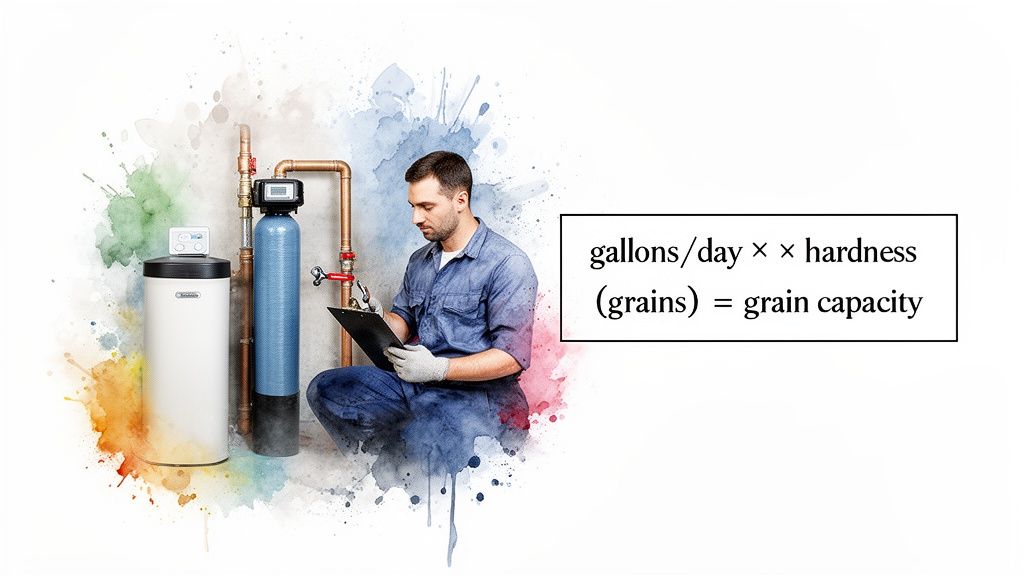
Sizing a water softener isn't guesswork; it's simple math. You need to figure out your home's daily softening requirement, which is measured in grains per day (GPD). It all comes down to two numbers: how much water your family uses and how hard that water is.
Here's the formula:
(Number of People in Home) x (Gallons Per Person Per Day) x (Grains Per Gallon of Hardness) = Daily Grains to Remove
Let's walk through a real-world example for a typical family in Los Angeles.
- Step 1: Figure Out Your Daily Water Use: On average, each person uses about 75 gallons of water a day. So, for a family of four, we’re looking at 300 gallons total (4 people x 75 gallons).
- Step 2: Know Your Water Hardness: The water in Los Angeles is notoriously hard, often hovering around 15 grains per gallon (GPG). A professional water test will give you the exact number for your home.
- Step 3: Calculate Your Daily Softening Needs: Now, just multiply the two numbers. 300 gallons x 15 GPG = 4,500 grains that need to be removed every single day.
This means the family needs a system that can handle at least 4,500 grains of hardness daily. To avoid having the softener regenerate every day (which is inefficient), we size it to last about a week. So, we multiply 4,500 by 7 days, which equals 31,500 grains. In this scenario, a 32,000-grain capacity softener is the perfect fit.
DIY Installation vs. Professional Expertise
Once you’ve got the right-sized unit, it’s time to get it installed. It can be tempting to go the DIY route to save a few bucks, but this is one of those jobs where experience really matters. It requires some serious plumbing know-how and a well-stocked toolbox.
Thinking About a DIY Installation?
- You’ll need specialized tools like pipe cutters, multiple wrenches, and possibly a soldering torch if you have copper pipes.
- You have to be comfortable shutting off your home’s main water supply and physically cutting into that line.
- One small mistake can lead to major leaks, water damage, or a system that just doesn't work right—and it could even void your warranty.
Understanding the basics of how water lines are connected is crucial. The principles are similar even in larger-scale projects; you can see the level of detail required in commercial water line installation processes to get a feel for the complexity.
Why Go with a Pro like Praz Pure Water?
- Done Right, The First Time: Our technicians ensure your system is installed correctly, meets all local plumbing codes, and is dialed in for your home's specific layout.
- Total Peace of Mind: A professional installation is backed by our workmanship warranty. You won’t have to worry about surprise leaks or performance issues.
- We Handle Everything: Let us deal with the hassle. We have the expertise to get the job done quickly and correctly, saving you a ton of time and stress.
There’s a reason the demand for water treatment is so high. Hard water is a problem for a staggering 89% of U.S. households. Here in California, where water hardness averages 150-300 mg/L, the number of homes with softeners has jumped 25% since 2015. In the Los Angeles area, our team at Praz Pure Water has the experience to install the right solution for any home or business, big or small. You can dig into more of these market trends at Allied Market Research.
Breaking Down the Cost and Long-Term Value of a Water Softener
When you first start looking at a water softener for your home, it's easy to focus on the initial price. But thinking only about that number is a bit like judging a car by its paint job—it completely misses the story of its performance, reliability, and all the money it saves you over time. A quality water softener isn't just a purchase; it's a genuine investment in your home.
The total cost really breaks down into three parts. First, there's the system itself, which can run from several hundred to a few thousand dollars, depending on its capacity, type, and features. Then, you have the professional installation, which is crucial for making sure everything is set up to work perfectly and is covered by a warranty.
Finally, you have the day-to-day running costs. For the most common salt-based systems, this is mainly the cost of salt. A typical family of four might go through a 40-pound bag every month or two, which is a minor, predictable expense.
The Real Return on Your Investment
Here’s where the story gets interesting. A water softener starts paying you back the moment it’s turned on. Hard water quietly drains your wallet in ways you might not even realize, and soft water plugs those leaks, putting cash right back into your budget. The savings pile up faster than you’d think.
A study by the Water Quality Research Foundation uncovered a powerful statistic: soft water can slash your soap and cleaning product usage by up to 50%. For most families, that’s hundreds of dollars a year saved on laundry detergent, shampoo, dish soap, and household cleaners.
But the savings go way beyond the cleaning aisle. Let's look at the bigger financial picture:
- Lower Energy Bills: Have you ever seen that crusty white buildup inside a kettle? That’s limescale, and it’s coating the inside of your water heater, too. This buildup acts like insulation, forcing your heater to work overtime just to get the water hot. Soft water stops this, and studies show it can cut your water heater's energy use by as much as 29%.
- Appliances That Actually Last: Limescale is public enemy number one for any appliance that uses water. By getting rid of it, a water softener can significantly extend the life of your dishwasher, washing machine, and coffee maker, helping you sidestep those frustrating—and expensive—repair and replacement bills.
- Protecting Your Plumbing: That same scale that wrecks your appliances is also slowly clogging your pipes. Preventing it from forming protects your home’s entire plumbing system from blockages and corrosion, saving you from a future plumbing emergency.
Don't Want to Buy? Rental Options Offer an Easy Start
If you want all the benefits of soft water without the upfront investment, renting a system is a fantastic option. A straightforward monthly fee usually covers the equipment, professional installation, and any maintenance or repairs that pop up.
This approach gives you a low-risk way to immediately feel the difference soft water makes. It's a popular choice for renters or anyone who simply prefers a predictable, all-inclusive monthly payment.
A Simple Maintenance Checklist to Keep It Running Smoothly
The good news is that keeping a water softener in top shape is incredibly simple. A few minutes of attention here and there will ensure it runs efficiently for years to come.
- Check Salt Levels Monthly: This is the big one. Just pop the lid on the brine tank once a month to make sure it's at least half-full of salt. If it’s low, top it off.
- Break Up "Salt Bridges": Every so often, a hard crust of salt can form near the top of the tank—we call this a "salt bridge." If you see one, just give it a few gentle taps with a broom handle to break it apart.
- Use the Right Kind of Salt: Always stick to high-quality salt pellets or crystals made specifically for water softeners. Cheaper salt can contain impurities that can clog up the system over time.
- Schedule an Annual Tune-Up: Having a pro like Praz Pure Water give your system a quick inspection once a year is the best way to catch small issues before they become big problems. It’s the key to getting decades of reliable service.
Your Los Angeles Water Softener Partner: Praz Pure Water
Picking the right water softener is a huge decision, but it's really only half the battle. The other, equally important half is choosing the right team to guide you—from picking the unit to installing it and keeping it running smoothly down the road. After all, even the best system in the world won't do you much good if it’s not installed or maintained correctly.
For over 20 years, Praz Pure Water has been the go-to expert for families across Los Angeles. We’ve built our name on trust, genuine expertise, and a simple commitment to doing the job right the first time. Our entire process is built around giving you total peace of mind, making sure your investment delivers the results you expect.
Your Water Quality Journey Starts Here
Before we talk about any equipment, we need to understand your water. That’s why everything starts with a detailed, in-home water analysis. This isn’t a sales call; it’s a scientific assessment where one of our technicians tests your water right in your kitchen. We’ll find out its exact hardness level and check for other common contaminants, giving you a crystal-clear picture of what you're dealing with.
Armed with that data, we can then give you a straight-up, personalized recommendation for a water softener for your home that’s a perfect fit for your family’s needs and your water’s specific chemistry.
We only install top-tier, American-made equipment. We’ve learned over the years that quality and durability matter, and we stand by systems that are built to last, giving you and your family worry-free soft water for decades to come.
Our installation standards are just as high. Our technicians are professionals—they're courteous, meticulous, and they make sure every connection is perfect. We treat your home like it’s our own, and we always leave the workspace cleaner than we found it.
More Than Just a Softener
For many homeowners in Los Angeles, soft water is just the beginning. They also want the purest, best-tasting drinking water possible. We’ve got you covered there, too, with complete water solution bundles that give you the best of both worlds.
- The Ultimate Combination: Pair a whole-house water softener with an under-sink reverse osmosis (RO) system.
- Total Protection: This setup is the gold standard. The softener tackles scale to protect your pipes and appliances, while the RO system delivers water that’s better than bottled, right from its own dedicated faucet.
- Maximum Value: Bundling these two systems is not only effective but also the most cost-efficient way to get total water purity for your entire home.
Our job isn’t done once the system is installed. We believe in being a long-term partner for your home’s water quality. That means proactive maintenance checkups and rock-solid warranties that cover both parts and labor. When you work with Praz Pure Water, you’re not just getting a piece of equipment—you’re getting a team that’s completely dedicated to the health and quality of your water for years to come.
Common Questions About Home Water Softeners
It’s completely normal to have a lot of questions when you start looking into water treatment. As you consider a water softener for your home, you're probably wondering about everything from how the water will taste to whether it's safe. We’ve heard them all, and this section is here to give you straight answers based on years of experience.
We'll cut through the confusion and give you the facts you need to feel confident about your decision.
Will My Water Taste Salty After Softening?
This is, without a doubt, the number one question we get. The short answer is no, not at all. When a water softener is working correctly, it won't make your water taste salty.
The salt you add to the brine tank is strictly for cleaning the resin beads inside the system—the ones that grab the hard minerals. It doesn’t get flushed into your pipes. During the softening process, a minuscule amount of sodium is exchanged for the hardness minerals, but it's typically so low you'd never notice it.
Practical Example: An 8-ounce glass of softened water usually contains less sodium than a single slice of white bread. If you're curious or experiencing issues, you can learn more about why your water might taste salty and what to do about it.
How Often Will I Need to Add Salt?
How often you’ll need to top off the salt really depends on two things: how hard your water is and how much of it your family uses. There’s no magic number, but we can give you a pretty good idea.
A typical family of four in the Los Angeles area, dealing with our moderately hard water, can expect to go through one 40-pound bag of salt every 6 to 8 weeks. Of course, today's high-efficiency softeners are designed to be much more salt-conscious. One of our technicians at Praz Pure Water can help you dial in the settings to get you on a predictable schedule.
Is softened water safe for everyone to drink?
Yes, absolutely. For the vast majority of people, softened water is perfectly safe for drinking, cooking, and everything else. The added sodium is minimal and poses no health risk. The only exception would be for someone on a strict, doctor-ordered low-sodium diet. If that's you, it's always a good idea to check with your physician first.
Is a Salt-Free Conditioner the Same as a Softener?
This is a key distinction to make. Salt-free conditioners and salt-based softeners are two very different technologies that tackle the problem of hard water in fundamentally different ways.
A salt-free system is more of a "scale preventer." It works by crystallizing the hardness minerals, which stops them from sticking to your pipes, faucets, and water heater. It's a fantastic, low-maintenance choice if your only goal is protecting your plumbing and appliances.
However, a conditioner doesn't actually remove the minerals from the water. That means you won't get the other benefits that come with truly soft water, like:
- Rich, soapy lather when you shower or wash your hands
- Softer skin and silkier hair
- Brighter, less scratchy laundry
- No more stubborn soap scum on your shower doors
For the complete package of benefits, especially in a hard water area like Los Angeles, a traditional salt-based softener is still the gold standard.
Ready to feel the difference truly soft water can make in your home? The experts at Praz Pure Water, Inc. are here to provide a free, no-obligation water analysis and recommend the perfect system for your needs. Contact us today to schedule your consultation!