
When you start looking into a whole-house water softener, your first question is likely about the price. On average, you can expect the total cost for a new system and professional installation to land somewhere between $1,500 and $6,000. Where your home falls in that range depends on the type of system you choose, its capacity, and the specifics of the installation.
Your Quick Guide to Water Softener Costs
Budgeting for a water softener can feel complex, but it boils down to two key components: the price of the unit itself and the cost of labor. While the initial investment is a major factor, remember that different systems also have ongoing operational costs for things like salt and maintenance. This upfront investment delivers significant value by protecting your home's plumbing and appliances.
The demand for high-quality water is growing, and homeowners are increasingly seeing the value in these systems. The global water softener market was valued at USD 3.46 billion in 2025 and continues to expand, driven by residential demand. Salt-based systems, the traditional industry standard, remain the most popular choice in this growing market. You can explore these market trends and how they influence pricing.
Breaking Down the First-Year Expenses
To give you a clear financial picture, let's break down the numbers for the most common types of systems. This provides a solid baseline for what to expect in your first year.
Here’s a look at how the upfront and first-year operational costs typically stack up for different water softener systems.
Estimated First-Year Cost for Water Softener Systems
| System Type | Average Unit Cost | Average Installation Cost | Estimated First-Year Total |
|---|---|---|---|
| Salt-Based | $500 – $2,000 | $400 – $1,200 | $900 – $3,200+ |
| Salt-Free | $800 – $2,500 | $400 – $1,200 | $1,200 – $3,700+ |
| Twin-Tank | $1,200 – $3,000 | $600 – $1,500 | $1,800 – $4,500+ |
This table gives you a ballpark idea of the total initial outlay, but remember that the complexity of your home's plumbing can shift these numbers.
Visualizing the Total Cost
It often helps to see a visual breakdown of where your money is going. This chart clearly shows how the total cost is split between the system itself and the installation fees.
As you can see, professional installation is a significant and crucial part of the upfront investment.
What to Expect in a Quote
When you get a quote from a professional, it should be completely transparent. A reliable quote will always separate the cost of the equipment from the installation labor. This clarity helps you avoid surprise charges and compare different offers accurately.
Actionable Insight: Always ask for an itemized quote. It should break down the cost of the softener unit, the labor for installation, and any extra parts needed, like bypass valves or new plumbing lines. This is the best way to ensure there are no hidden fees.
Practical Example: A simple installation in a garage that’s already pre-plumbed for a softener might only cost $400-$600 in labor. However, if the job involves running new pipes through a finished basement or a tricky crawlspace, that installation cost could easily jump over $1,200. Knowing these details helps you set a realistic budget from the start.
What Really Drives the Price of a Water Softener
You've probably seen water softeners listed for anywhere from $600 to $3,000 and wondered what justifies the price difference. The water softener systems cost isn’t arbitrary; it’s a direct reflection of the technology, capacity, and smart features that determine its performance and efficiency.
Understanding these key drivers helps you see beyond the initial price tag and recognize the long-term value. A cheap, undersized unit might seem like a deal, but it can lead to higher costs from wasted salt, water, and poor performance down the road.
Let's break down what actually goes into the cost.
System Type: The Biggest Cost Factor
By far, the most important factor influencing a water softener's price is the technology it uses. The two main types work in fundamentally different ways, and their price points reflect that.
- Salt-Based (Ion Exchange) Systems: These are the industry standard for a reason. They use ion exchange to physically remove hardness minerals like calcium and magnesium from your water, delivering truly soft water. This is the most effective method for solving hard water problems.
- Salt-Free "Conditioners": These systems don't remove minerals. Instead, they use technologies like Template Assisted Crystallization to alter the minerals' structure, making them less likely to form scale on pipes. While helpful for scale prevention, they won't provide the other benefits of soft water, like better soap lather or softer skin.
A high-quality, salt-based system is an investment that protects your home’s plumbing and appliances. To see how much they can safeguard your home, you can learn more about the benefits of a whole house water softener system.
Capacity: How Much Work Can It Do?
Think of a water softener's capacity like the fuel tank in your car—a bigger tank means fewer stops. For a softener, capacity is measured in “grains” and indicates how many hardness minerals it can capture before it needs to clean itself (a process called regeneration).
A 32,000-grain capacity system might be perfect for a small family with moderately hard water. But for a larger household in Los Angeles, where water is notoriously hard, a 64,000-grain or even an 80,000-grain system is often necessary to avoid constant regeneration.
Practical Example: A family of four using 100 gallons of water per person daily (400 gallons total) in a neighborhood with 15 GPG (grains per gallon) hardness needs to remove 6,000 grains of hardness each day (400 gallons x 15 GPG). A 32,000-grain unit could go about five days between cycles. A smaller 24,000-grain unit would have to regenerate every four days, using more salt and water over time.
Larger capacity requires a bigger tank and more resin media, which increases the price. Sizing the system correctly from the start is crucial for both performance and long-term operating costs.
Control Features and Efficiency
The "brains" of the system—the control valve—is another major factor in the final cost. This is where you see the difference between basic models and high-efficiency systems.
- Timer-Based Controls: This is an older, budget-friendly option. The system regenerates on a fixed schedule (e.g., every three days), regardless of your water usage. This method is simple but often wasteful.
- Metered (On-Demand) Controls: This is the smarter, more efficient choice. These systems track your actual water usage and only regenerate when the resin is near capacity. They cost more upfront but provide significant long-term savings on salt and water. Many modern systems even include Wi-Fi for remote monitoring.
Investing in a metered, on-demand system is almost always the best decision. The efficiency pays for the higher initial cost within a few years, making it a smarter choice for both your budget and the environment.
Understanding Installation and Setup Costs
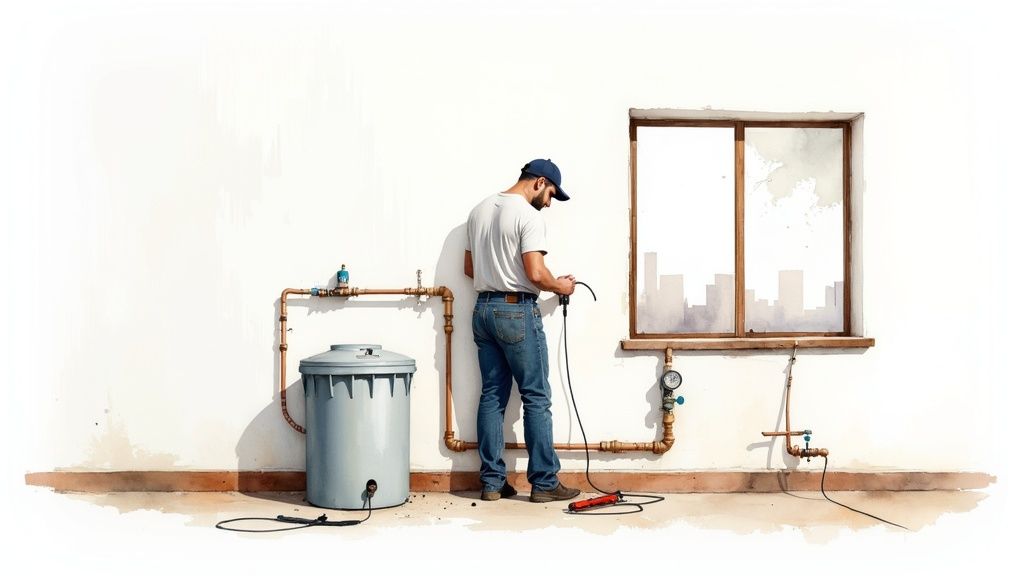
The price tag on the water softener unit is just one part of the equation. The total cost includes professional installation, where prices can vary significantly based on your home’s plumbing. Hiring a professional is an investment in ensuring the job is done right, protecting your home and your new equipment.
Think of it this way: a powerful engine's performance depends entirely on proper installation. A sloppy setup can lead to leaks, pressure drops, or system failure, negating any savings you thought you made by cutting corners.
From Simple Setups to Complex Retrofits
Installation labor isn't a one-size-fits-all fee. An experienced installer assesses the job's complexity to determine the price.
A straightforward installation in a garage that is "pre-plumbed" for a softener might take a couple of hours and cost between $400 and $600. In contrast, a more involved project requiring new plumbing can easily exceed $1,500.
What makes an installation complex? Common challenges include:
- No Existing Loop: If your home lacks a "softener loop"—a dedicated section of pipe for easy connection—a plumber must cut into your main water line.
- Location Challenges: Installing a unit in a cramped crawlspace, a finished basement, or an outdoor location that needs a protective cover adds time, material, and labor.
- Plumbing Rerouting: If the ideal location for the softener isn't near the main water inlet, new pipes may need to be run through walls or ceilings.
Common Additional Installation Requirements
Installation often involves more than just connecting pipes. Several small but critical tasks are needed to ensure your system operates correctly and meets local codes, each potentially adding to the cost.
A transparent quote from a professional will detail all these elements, so there are no surprises on the final bill.
Actionable Takeaway: When getting quotes, confirm if the price includes installing a bypass valve, a proper drain line, and any necessary electrical work. A complete quote prevents unexpected costs and simplifies the process.
Here are a few common extras:
- Bypass Valve: This is essential. It allows you to route water around the softener for maintenance or for watering plants without shutting off water to the entire house.
- Dedicated Drain Line: Salt-based systems must flush out collected minerals. This salty discharge requires its own drain line, which often needs to be newly installed.
- New Electrical Outlet: The control valve needs power. If an outlet isn't nearby, an electrician may need to install one.
The process is similar to other water treatment installations. For comparison, check out our guide on the cost to install a reverse osmosis system. Choosing a professional installer ensures every detail is handled correctly, protecting your warranty and providing peace of mind.
Budgeting for Long-Term Maintenance and Upkeep
The initial purchase price is just the beginning. Like any major home appliance, a water softener has ongoing needs to keep it running efficiently. Factoring in these long-term costs upfront gives you a true picture of your investment.
Think of it like owning a car: you budget for gas and oil changes, not just the sticker price. Your water softener requires similar care to protect your home from hard water day after day.
The Ongoing Cost of Salt
For traditional salt-based softeners, your most regular expense will be salt. The system uses salt pellets to create a brine solution that cleans and "recharges" the internal resin beads, allowing them to continue removing damaging minerals from your water.
Your salt consumption depends on two things:
- Your Water Hardness: Harder water contains more minerals, causing the resin to fill up faster and requiring more frequent regeneration cycles.
- Your Water Usage: A larger family will use more water, triggering more cleaning cycles.
A typical family of four with moderately hard water might use one 40-pound bag of salt per month, costing between $5 and $10. This adds up to $60 to $120 annually. In areas with extremely hard water, like Los Angeles, that cost could easily double.
Factoring in Utilities and Regular Service
Beyond salt, a few other minor costs should be on your radar.
- Electricity: This cost is minimal. The power needed for the digital control valve is very low—most high-efficiency systems use less than $10 in electricity per year.
- Water Usage: The regeneration cycle flushes minerals to the drain. A modern, metered system is efficient, using only about 20-25 gallons per cycle, adding just a few dollars to your monthly water bill.
- Professional Servicing: While not required annually, having a professional inspect your system every few years is a wise investment. A routine service call might cost $125-$200 and can catch small issues before they become major problems.
Pro Tip: While modern softeners are low-maintenance, they aren’t no-maintenance. Budgeting for salt and occasional check-ups is the best way to ensure your system runs perfectly for its entire lifespan, which is a great way to protect your initial investment.
10-Year Ownership Cost Comparison: Salt-Based vs. Salt-Free
The long-term upkeep is where the debate between salt-based and salt-free systems often arises. While salt-based systems currently hold a 58.7% market share, salt-free systems are seeing faster growth due to their lower maintenance and eco-friendly design.
So, how do the costs compare over a decade?
| Cost Factor | Salt-Based System (Average) | Salt-Free System (Average) |
|---|---|---|
| Annual Salt Cost | $70 – $150 | $0 |
| Annual Electricity | ~$10 | $0 (for most models) |
| Filter/Media Changes | Resin replacement every 10-15 years | Media replacement every 5-7 years |
| Replacement Parts Cost | $400 – $800 (for resin) | $800 – $1,500 (for media) |
| Total 10-Year Upkeep | $1,110 – $2,310 | $800 – $1,500 (if one media change is needed) |
While a salt-free conditioner often costs more upfront, you can recoup that difference over time through lower maintenance expenses, making the total cost of ownership very competitive.
How Soft Water Pays You Back Over Time
Focusing on the initial price tag overlooks the significant long-term savings a water softener provides. The real financial value becomes clear when you see how soft water actively saves you money every month. This is an investment that starts paying dividends immediately.
Hard water acts like a hidden tax on your household, damaging appliances, increasing your use of cleaning supplies, and forcing your water heater to work harder. A water softener eliminates that "tax," putting money back in your wallet.
Extending the Life of Your Appliances
One of the greatest financial benefits is the protection of your expensive appliances. Hard water minerals create limescale that builds up inside your water heater, dishwasher, and washing machine, forcing them to work harder and leading to premature failure.
- Water Heaters: Limescale acts as an insulator on heating elements, reducing a gas water heater's efficiency by up to 24% and driving up energy bills.
- Dishwashers and Washing Machines: Chalky buildup clogs water jets and damages pumps, leading to costly repairs. Soft water prevents this damage, helping your appliances last their full intended lifespan.
By eliminating scale, a water softener can effectively double the life of some appliances, saving you thousands of dollars in replacement costs.
Slashing Your Household Supply Budget
You will notice immediate savings on cleaning and personal care products. The minerals in hard water interfere with soaps and detergents, preventing them from lathering properly and reducing their effectiveness.
Real-World Savings: With soft water, you can often cut your use of soap, laundry detergent, dish soap, and shampoo by up to 50%. If your family spends $50 a month on these supplies, that’s an immediate savings of $300 per year.
This means fewer trips to the store and a lower household budget. Plus, your clothes will feel softer, your dishes will be spot-free, and your skin and hair will feel cleaner without the residue left by hard water. Learning how to get rid of hard water is the first step toward these benefits.
Avoiding Costly Plumbing Repairs
Limescale also damages your plumbing. Over time, it narrows your pipes, reducing water pressure and causing clogs and leaks. Repairing scale-choked plumbing can be a messy and expensive ordeal.
A water softener acts as a 24/7 guardian for your plumbing system, preventing this slow, costly damage. This value is a key reason the global water treatment market is growing so rapidly. That market is valued at USD 13.9 billion in 2025 and is projected to hit USD 25.5 billion by 2035. You can find more details on these trends over at futuremarketinsights.com.
Common Questions About Water Softener Costs
Even with the numbers laid out, you likely have more practical questions. Here, we address common concerns to help you decide if a water softener is the right long-term investment for your home.
Is Renting a Water Softener Ever a Good Idea?
Renting can seem appealing with its low monthly fee of $25 to $50 and included maintenance. It offers soft water without a large upfront investment.
However, when you look at the long-term math, buying almost always comes out ahead.
Let's do a simple calculation: A $40 per month rental fee is $480 a year. A quality purchased system might cost $2,400 installed.
The Break-Even Point: In this scenario, you'd break even on your purchase in exactly five years ($2,400 / $480). After that, the money you would have spent on rent becomes savings. Since a well-maintained water softener can last 15-20 years, you could enjoy a decade or more of "free" soft water. For most homeowners, owning is the smarter financial choice.
How Does L.A.'s Hard Water Affect the Price?
Living in Los Angeles means dealing with some of the hardest water in the country, which directly impacts the water softener systems cost. The harder the water, the more robust the system needs to be.
First, you need a higher-capacity unit. A small system would be overwhelmed by L.A.'s mineral-rich water, regenerating constantly and leading to a shorter lifespan and wasted salt and water. A professional will recommend a system with adequate capacity—typically 64,000 grains or higher for this area—which costs more than a standard unit.
Second, your operating costs will be higher. Because the softener removes more minerals, it must regenerate more often, meaning you'll use more salt.
Here’s a practical way to think about it:
- Capacity Needs: Multiply your family's daily water use (in gallons) by your water's hardness level (in GPG).
- Real-World Example: A family of four using 320 gallons a day with LA's typical 18 GPG water needs to remove 5,760 grains of hardness every single day. A 64,000-grain unit can handle that for over a week between cycles.
Trying to save money with an undersized system is a recipe for disappointment and wasted resources.
Will a Water Softener Actually Increase My Home's Value?
Absolutely. A high-quality, professionally installed whole-house water softener is a significant feature that makes your home more attractive to buyers, especially in areas with hard water like Southern California.
A water softener signals to a potential buyer that the home has been well-maintained. It provides tangible proof that the plumbing system, faucets, and expensive appliances have been shielded from destructive limescale.
A buyer sees a water softener and thinks:
- Appliance Protection: The water heater and dishwasher have been protected and will likely last longer.
- Healthy Plumbing: They have peace of mind knowing pipes aren't clogged with scale.
- Move-In Ready: They can enjoy the benefits of soft water immediately without budgeting for an installation.
While it may not add a specific dollar amount to an appraisal, a water softener is a powerful selling point that can help your home stand out and justify its asking price.
What Hidden Costs Should I Be Watching Out For?
When calculating the total water softener systems cost, transparency is crucial. Most reputable installers provide clear quotes, but it pays to know what to ask to avoid surprises.
The biggest "hidden" cost often comes from an incomplete installation quote. Some companies offer a low price for a "standard" installation, then add charges for anything outside that narrow definition.
Actionable Tip: To avoid this, always insist on an itemized quote and ask these direct questions:
- Old Equipment: Is there a fee for removing and disposing of my old unit?
- Plumbing Work: Does the price include creating a softener loop if I don't have one?
- Drain & Electrical: Is the cost of running a new drain line or installing an electrical outlet included?
- Proprietary Parts: Does this system use special filters or parts that can only be purchased from you?
Asking these questions upfront ensures you get a true all-in price. A trustworthy installer will gladly walk you through every line item, so the price you agree on is the final price you pay.
Ready to find out the exact cost for a system perfectly sized for your Los Angeles home? The experts at Praz Pure Water, Inc. provide transparent, all-inclusive quotes with no hidden fees. Get your free water assessment and personalized estimate today!