
Trying to pin down the cost of testing your well water can feel confusing. As a quick guide, a basic safety check usually runs between $150 and $300. For a more thorough analysis, a comprehensive test can cost anywhere from $500 to over $800. The final price tag depends entirely on how detailed a look you need into your water's quality.
Your Quick Guide to Well Water Testing Costs
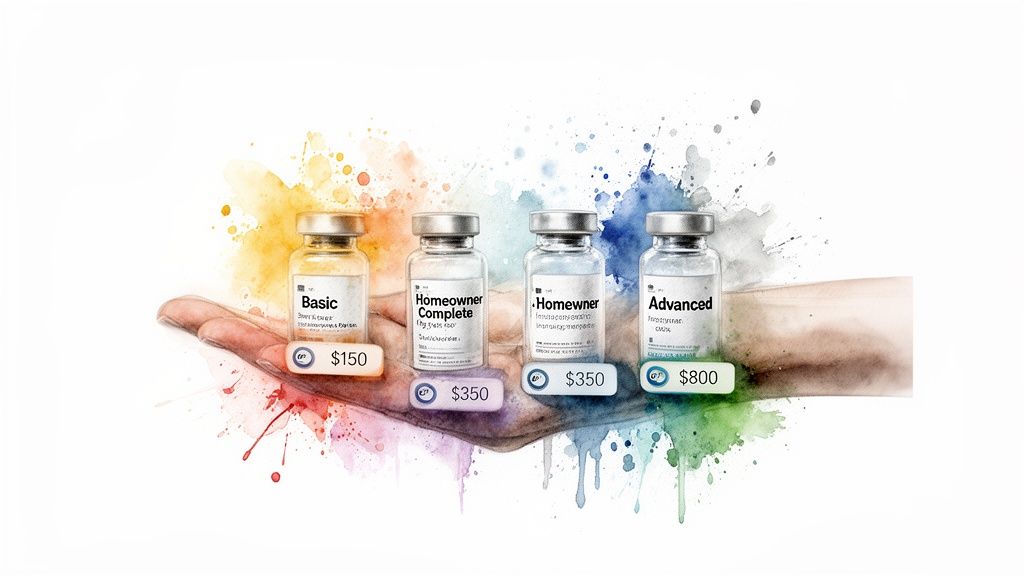
Think of a water test as a health checkup for your well. You can opt for a simple screening or a full diagnostic workup, and the cost will reflect the level of detail you receive. Understanding these costs is the first step toward ensuring your family has safe, clean water. The key is to match the test to your specific needs so you invest in information that provides real value.
This isn't a minor concern for homeowners. In 2024, North America accounted for 49.3% of the entire global water testing market. Statistics show why: it's estimated that 15-20% of private wells in the U.S. have nitrate levels above the EPA's safety limit, which makes regular testing feel less like a choice and more like a necessity.
Comparing Common Test Packages
Most labs and testing services offer bundled tests to simplify the selection process. This structure helps you see exactly what you get at different price points, from essential safety screens to highly detailed chemical profiles. It empowers you to pick the right level of analysis, whether you're performing a routine annual check or investigating a specific issue like a strange taste or odor.
- Basic Safety Test: This is your go-to for yearly checkups. It’s an affordable way to confirm your water is free from immediate health threats, like E. coli.
- Homeowner’s Complete Test: This offers a much clearer picture of your water's overall health. It covers the basics plus common nuisance minerals and heavy metals like lead and arsenic.
- Advanced Contaminant Test: This is the most thorough option. This panel is designed to detect synthetic chemicals, such as pesticides or industrial runoff, that might be a concern in your area.
Valuable Insight: Choosing the right test is about more than saving money; it's about buying confidence. For example, a basic test provides annual peace of mind, but a comprehensive test delivers the hard data you need before buying a house or investing thousands in a whole-home filtration system.
To help you budget, the following table breaks down what you can generally expect from these common test packages and their typical costs.
Estimated Well Water Testing Costs in 2026
Here’s a breakdown of common well water test packages, what they include, and their typical price ranges to help you budget accordingly.
| Test Package Type | Common Contaminants Tested | Best For | Estimated Cost Range |
|---|---|---|---|
| Basic Safety | Total Coliform, E. coli, Nitrates, Nitrites, pH | Routine annual checkups for established wells to ensure microbiological safety. | $150 – $300 |
| Homeowner's Complete | Bacteria, Nitrates, Lead, Arsenic, Iron, Hardness, Manganese | New homeowners, families with young children, or wells with known taste/odor issues. | $300 – $600 |
| Advanced Contaminants | All of the above, plus Volatile Organic Compounds (VOCs), Pesticides, Herbicides | Wells near industrial sites, gas stations, or agricultural land; unexplained health issues. | $600 – $1,200+ |
Once you have your results, you'll know exactly what your next steps should be. If your test uncovers any issues, our guide to finding the best water treatment systems is a great resource for finding the right solution.
What Factors Influence Your Final Testing Price
Trying to pin down a single price for well water testing is tricky because a few key variables can significantly impact the final cost. You might wonder why your neighbor paid $150 while you received a quote for over $600. The price isn’t arbitrary—it’s directly tied to what, exactly, you need to learn about your water.
Practical Example: Think of it like a car service. An oil change has a standard price. But if the mechanic needs to run a full engine diagnostic, check the transmission, and align the wheels, the bill will be much higher. Water testing works the same way. The more contaminants you test for and the faster you need results, the higher the cost.
Understanding these factors helps you make a smarter decision for both your wallet and your well-being. When you know what drives the price, you can find the right balance between being thorough and staying on budget.
The Scope and Type of Contaminants Tested
The single biggest factor affecting your well water testing cost is the scope of the analysis. A simple, basic screening is vastly different from a comprehensive panel that searches for dozens of specific contaminants.
Practical Example: For a routine annual check, a basic test for total coliform bacteria and nitrates—two common and immediate health concerns—is an excellent choice. This type of test usually costs between $150 and $300 and provides a solid, affordable baseline for your water's safety each year.
But what if you're buying a home near a former orchard or an old gas station? Your concerns are different, so your test should be, too. In that situation, you would want a much broader panel that looks for things like:
- Volatile Organic Compounds (VOCs): These are industrial chemicals often linked to fuel spills or solvents.
- Pesticides and Herbicides: A real concern in agricultural areas where runoff can seep into groundwater.
- Heavy Metals: This goes beyond just lead to include arsenic, mercury, and cadmium.
- Radionuclides: These are naturally occurring radioactive elements like radon and uranium found in certain geological formations.
This kind of deep-dive testing requires specialized lab equipment and significant analyst time, which is why the cost can easily climb to $600, $800, or even higher.
The Chosen Testing Method
Another major factor is the testing method you choose: sending a water sample to a state-certified laboratory or using a DIY home test kit. Each comes with a different price tag and serves a distinct purpose.
A state-certified lab analysis is the gold standard for accuracy and reliability. This is the path you must take for real estate transactions or to meet local health department requirements. The cost reflects the precision equipment, controlled environment, and professional expertise involved.
Actionable Insight: If you're involved in a home sale in a place like Los Angeles, a certified lab test is non-negotiable. It provides the official documentation needed to prove the water is safe, protecting both the buyer and seller from future disputes.
On the other hand, DIY test kits are much cheaper, often under $50. They offer instant feedback on general quality indicators like pH, hardness, or chlorine. However—and this is a critical point—they are not nearly as accurate or comprehensive as a lab test. They simply cannot reliably detect dangerous contaminants like arsenic, lead, or bacteria at low levels.
Turnaround Time and Special Handling
Need your results in a hurry? Speed comes at a price. The standard turnaround time for most labs is about 7 to 10 business days. If you're on a tight deadline for a home purchase or have a pressing health concern, you can almost always pay a rush fee for expedited service.
These rush fees can add anywhere from 25% to 100% to your total well water testing cost. For instance, a standard $400 test could easily become a $600 test if you need the results back in 24 to 48 hours.
Finally, some specific tests require special handling or collection methods that can increase the cost. A perfect example is testing for radon in water. This requires a special vial and must be rushed to the lab to prevent the gas from escaping the sample, often incurring extra fees. It’s always a good idea to ask upfront if your chosen tests involve any special procedures that could affect the final price.
When it comes to testing your well water, you’re faced with a trade-off: speed and cost versus accuracy and peace of mind. Deciding between a quick do-it-yourself (DIY) kit and a full-blown professional lab analysis can be confusing, but they serve entirely different needs. Making the right choice from the start ensures you get the answers you’re looking for without wasting money or, worse, getting unreliable results.
This decision-making flowchart breaks down how the scope of your test, the method you choose, and how quickly you need results all play into the final cost.
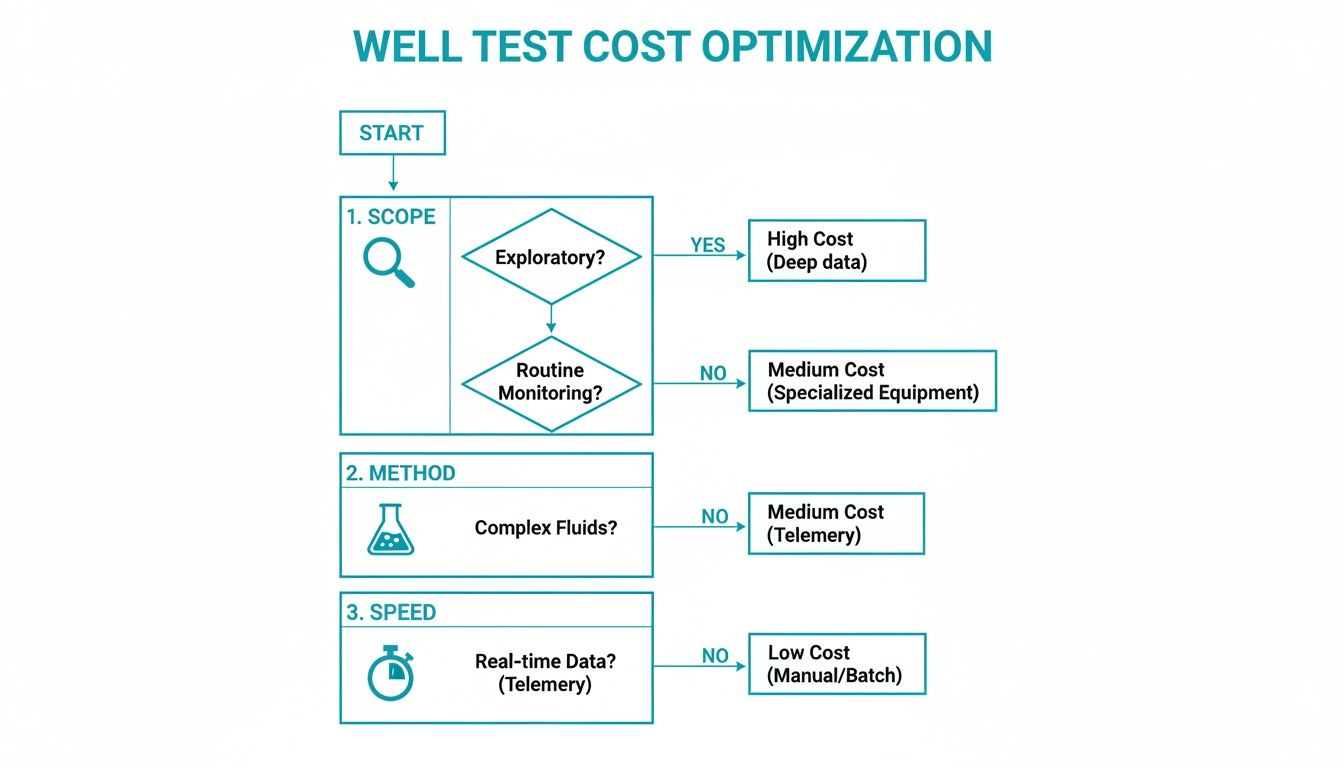
As the chart shows, your specific needs directly shape what you’ll end up paying. A simple screening test is a world away from a comprehensive analysis needed for health or legal reasons.
DIY Home Test Kits
Think of a DIY test kit as a quick screening tool. They are the fastest and most affordable option, typically costing between $20 and $50. These kits usually rely on simple test strips or color-changing drops to give you an instant reading for basic parameters like pH, chlorine, and water hardness.
- Practical Example: You’ve noticed stubborn white spots on your dishes and your soap won't lather well. A $25 hardness test kit can confirm you have hard water in minutes. It's a quick, easy way to diagnose this common nuisance problem.
But here’s the catch: DIY kits have serious limitations. They are not sensitive enough to detect contaminants at the low levels where they become dangerous. A test strip might show "zero" for lead, but it can't pick up on concentrations that are still above the EPA's action level. For health-related concerns, they provide a false sense of security.
Professional Lab Testing
When you need results you can rely on, professional lab testing is the only real option. This process involves sending a water sample to a state-certified laboratory for a highly accurate analysis. While the well water testing cost is higher, the quality of information you receive is vastly superior.
There are a couple of ways to do this:
- Mail-In Lab Services: This is a great middle-ground. You order a kit, follow specific instructions to collect the sample yourself, and mail it back to the lab.
- On-Site Professional Collection: A trained technician comes to your property to draw the sample. This is the best way to eliminate any chance of contamination or error, which is crucial for bacteria testing or when you need the results for legal purposes.
The demand for reliable water testing is surging worldwide, with the market projected to grow from $1.3 billion in 2026 to $2.2 billion by 2036. A significant part of that cost comes from the specialized equipment needed to detect bacteria, viruses, and heavy metals. This is why residential tests can run $200-$600, while a full-spectrum commercial analysis can easily top $1,000.
DIY vs. Professional Water Testing Comparison
To help you choose the best path for your situation, this direct comparison breaks down the main pros, cons, and ideal uses for each method.
| Testing Method | Pros | Cons | Best Use Case |
|---|---|---|---|
| DIY Home Kit | Inexpensive ($20-$50), instant results, very easy to use. | Lacks accuracy and sensitivity; can't detect low levels of many harmful contaminants; not legally certified. | Quick checks for aesthetic issues like water hardness, pH balance, or chlorine levels. |
| Mail-In Lab | Accurate, reliable results from a certified lab; wide range of tests available; more affordable than on-site collection. | Requires careful sample collection (user error is possible); turnaround time is typically 7-10 days. | Annual checkups; a new homeowner wanting reliable data on common health-risk contaminants like lead, arsenic, and bacteria. |
| Professional On-Site Collection | Highest possible accuracy and reliability; legally defensible results; zero risk of sampling error. | The most expensive option; requires scheduling an appointment with a professional. | Real estate transactions; satisfying health department codes; investigating serious or unexplained health concerns. |
Ultimately, the right choice depends on the question you're trying to answer. While a DIY kit is fine for spotting basic issues, it's not the tool for protecting your family's health from unseen threats.
Actionable Takeaway: If you’re a new parent concerned about lead in the water you use for baby formula, a professional lab test is the only route that delivers genuine peace of mind. Likewise, if you're a landlord who needs to prove your rental property's water meets health codes, only certified lab results will do. Once you have your results, you can explore our guide on how water filtration works to figure out your next steps.
Decoding Your Test Results and Planning Next Steps
When the lab report for your well water arrives, it can feel like you need a chemistry degree to understand it. You’ll be looking at a page full of unfamiliar terms, numbers, and acronyms. Don’t worry—that’s a normal reaction.
The key is to see that report not as a final exam, but as a clear roadmap. It tells you exactly what’s happening in your well so you can take targeted, effective action. Let's walk through how to read that map and turn those confusing results into a confident plan for clean, safe water.
Understanding Your Water's Health Report
Your lab report will list various contaminants and show their concentration in your water, usually measured in milligrams per liter (mg/L) or parts per billion (ppb). The most important column to find is often labeled “MCL,” which stands for Maximum Contaminant Level.
This is the legal limit set by the EPA for public water systems. While private wells aren't regulated by the EPA, these MCLs are the best benchmark for safety. If any of your results are close to or exceed that MCL, it’s a clear signal that you need to address the issue.
Valuable Insight: Your test results aren't just abstract data; they're the direct answers to your questions. For example, a high hardness level finally explains the stubborn film on your dishes, while a positive coliform test is a direct warning about a potential health threat.
Now, let's look at a few of the most common red flags in well water reports and what to do about them.
Common Contaminants and What They Mean
Once you have your results, you'll want to scan for a few key items first. These are the usual culprits behind most well water problems, ranging from annoying maintenance headaches to serious health risks.
1. Total Coliform and E. coli
- What this means: Total coliform is a broad category of bacteria found in the environment. Its presence in your well is a red flag that surface water may be seeping in, creating a path for harmful germs. If the test specifically finds E. coli, it means your water has been contaminated with human or animal waste, posing an immediate health risk.
- Actionable Step: If any coliform bacteria are present, disinfect the well, usually through shock chlorination. For a permanent, worry-free solution, installing a UV purification system is the best way to neutralize bacteria and viruses continuously without adding chemicals to your water.
2. Nitrates
- What this means: Nitrates often come from agricultural runoff (fertilizers), failing septic systems, or animal waste. The EPA’s safety limit is 10 mg/L. High levels are particularly dangerous for infants, as they can cause "blue baby syndrome," a condition that interferes with the blood's ability to carry oxygen.
- Actionable Step: If your nitrate levels are over the limit, a reverse osmosis (RO) drinking water system installed at your kitchen sink is one of the most reliable ways to remove them from your drinking and cooking water.
3. Water Hardness (Calcium and Magnesium)
- What this means: Hardness is not a health concern, but it is the source of many household frustrations. Caused by dissolved calcium and magnesium, it’s responsible for soap scum, spots on glasses, and damaging scale buildup that can shorten the life of your water heater and other appliances.
- Actionable Step: For water that's considered hard (typically over 7 grains per gallon), a whole-home water softener is the best solution. It protects your entire plumbing system and every water-using appliance, saving you money on repairs and replacements.
By matching each result on your report to a specific solution, you can create a smart, effective plan. This approach ensures the money you invested in testing leads directly to a safer and more enjoyable home environment.
Getting an Accurate Estimate and Avoiding Hidden Fees
Getting a straight answer on well water testing costs shouldn't be a guessing game. To ensure the price you're quoted is the price you pay, you should approach it with the right information and questions.
Think of it this way: when you call a contractor for an estimate, the more details you provide, the more accurate the quote will be. The same principle applies to water testing. A little preparation helps the lab understand your specific situation, allowing them to recommend the right tests without upselling you on services you don't need.
Prepare for Your Call with a Pro
Before you pick up the phone, it pays to gather a few key details about your well. This homework will make your conversation more productive and help the professional provide a solid quote.
Have this checklist handy:
- Well Age and History: Do you know how old the well is? Are there records of past tests or maintenance?
- Noticeable Issues: Are you seeing any red flags? Note things like cloudy water, a "rotten egg" smell, or stubborn rust-colored stains on sinks and clothing.
- Property Location: Is your well near potential contamination sources like farms, gas stations, or industrial areas?
- Household Information: Who is drinking the water? Let the professional know if you have young children, elderly family members, or anyone with a compromised immune system.
This context is invaluable to a water expert. It allows them to move beyond generic price lists and tailor a testing package that addresses your actual risks.
Key Questions to Ask Every Testing Company
Not all labs or testing services are the same. Asking a few targeted questions is the best way to uncover hidden fees and distinguish a reputable company from one that’s just trying to make a quick sale.
Valuable Insight: A trustworthy company will welcome your questions and provide clear, direct answers. If they are vague about costs or cannot produce their certifications, that's a major red flag. Don't be afraid to seek another provider.
Here are the essential questions to ask before you agree to anything:
- "Is your laboratory state-certified?" This is the most important question. Only a state-certified lab can provide results that are scientifically accurate and legally sound.
- "Are there any extra fees for sample collection or shipping?" Some companies add a separate trip fee for on-site collection, while others have handling charges for mail-in kits. Get all costs in writing.
- "What is the standard turnaround time, and what are the rush fees?" You need to know when to expect your results and how much it will cost if you need them sooner.
- "Does the price include a detailed report explaining the results?" You're paying for answers, not just a sheet of numbers. Ensure they will provide a clear interpretation.
The global water testing market is booming, with one report projecting it to climb from $5.86 billion in 2026 to $7.27 billion by 2030. This growth is fueled by new regulations and a 30% jump in testing for specific contaminants like arsenic. You can discover more insights about this growing market and its impact on pricing. Asking these questions helps you navigate this complex field like an informed consumer.
Finding True Value Beyond the Initial Cost
The best companies don't view the test as a one-off transaction. They see it as the first step toward a real solution. A significant value-add to look for is a company that will credit some or all of your testing fee toward a water treatment system if one is needed.
This policy effectively turns your diagnostic cost into a down payment on a permanent fix. For example, if a $400 comprehensive test reveals hard water and high iron, that $400 could be applied directly to the cost of a new water softener or a more advanced setup that includes the cost of a reverse osmosis system installation. It’s a good sign that the company is committed to solving your water problem, not just selling you a test.
Your Well Water Testing Questions Answered
If you own a home with a well, you likely have questions about water testing. Getting straight answers is the best way to protect your family's health and your investment. Let's cover a few of the most important questions homeowners ask.
How Often Should I Test My Well Water?
The general rule of thumb, recommended by most health departments, is to test your well water annually. This yearly test should check for bacteria (like total coliform and E. coli) and nitrates. Think of it as your well's annual physical—a routine checkup to catch common problems before they become serious.
That said, some situations require immediate testing. You should schedule a test if:
- You notice a change: If your water's taste, smell, or color suddenly shifts, your well is signaling that something is wrong.
- After a major event: Events like heavy flooding, drilling a new well, or major repairs to your plumbing or septic system can introduce contaminants.
- Someone in your home is vulnerable: If you have an infant, an elderly person, someone who is pregnant, or anyone with a compromised immune system, more frequent testing provides crucial peace of mind.
Is a Basic Test Good Enough?
Whether a basic test is sufficient depends on your specific situation. For a routine annual check on a well with no history of problems, a basic test covering bacteria and nitrates is often a great, affordable choice to monitor key health risks.
However, there are times when a more thorough test is a much smarter investment.
Practical Analogy: A basic test is like a smoke detector—it alerts you to immediate danger. A comprehensive test is like a full home inspection—it uncovers hidden issues that could cause serious problems down the road.
You should strongly consider a comprehensive test if:
- You're buying a new home and want to know exactly what’s in the water.
- Your property is near potential pollution sources, like farms, gas stations, or industrial sites.
- Someone in your household is experiencing unexplained health issues that could be water-related.
Can I Get My Well Water Tested for Free?
You will likely see advertisements for "free" water tests. It’s important to understand what you're really getting. These offers are almost always a sales tactic, not a legitimate health analysis. A representative might use a simple test strip to show you have hard water and then launch into a high-pressure pitch for a water softener.
That is not a real water test. A free screening is a non-certified, surface-level check that cannot reliably detect dangerous contaminants like arsenic, lead, or harmful bacteria.
For real, unbiased results you can trust, you need a paid, state-certified laboratory analysis. The well water testing cost for this service covers the sophisticated equipment and expert review needed to give you hard data for making important health decisions. It's the only way to get a true picture of your water's safety.
Ready to get a clear, accurate picture of what's in your water? At Praz Pure Water, Inc., we provide detailed water assessments to help Los Angeles homeowners and businesses identify issues and find the perfect solution. Contact us today to schedule your expert water analysis.