
Ever wondered what’s actually in your tap water besides, well, water? The answer lies in a simple but powerful measurement called Total Dissolved Solids, or TDS. Think of it as a quick snapshot of all the invisible minerals, salts, and metals that have dissolved into your water on its long journey to your faucet.
A high TDS reading doesn't automatically mean your water is bad—in fact, some dissolved minerals are good for you. However, understanding this number is your first step toward gaining real control over your water's quality, taste, and impact on your home.
What Are Total Dissolved Solids?
Imagine water flowing through underground rock formations, rivers, and even your home's plumbing. Along the way, it acts like a natural solvent, picking up tiny, invisible particles of everything it touches. Total Dissolved Solids is the combined measurement of all these dissolved substances.
We measure this in parts per million (ppm), which is the same as milligrams per liter (mg/L). A TDS reading gives you a general idea of your water’s purity, but it doesn't identify what those dissolved solids are. It’s the first clue in understanding your water's overall quality and what actions you might need to take.
What's Actually in the Water?
So, what are these "dissolved solids"? It’s usually a mix of different things, some good, some not so good. Knowing the difference empowers you to make smarter choices.
- Healthy Minerals: Things like calcium, magnesium, and potassium often come from the rocks and soil water passes through. These are not only harmless but can be beneficial to your health and often give water a pleasant, characteristic taste. For example, the "hard water" common in Los Angeles is high in calcium and magnesium.
- Salts and Metals: Common elements like sodium and chloride can find their way into the water, along with trace metals like iron or copper, sometimes from the pipes themselves.
- Potential Contaminants: A very high TDS level could sometimes indicate the presence of less desirable substances from agricultural runoff or industrial discharge, which is why testing is so important.
The goal isn't necessarily to have a TDS of zero. In fact, completely pure water can taste flat and unappealing. To get a better sense of this, it's helpful to understand the distinction between ultrapure water and drinking water, as what’s ideal for a laboratory isn't what's best for your glass.
What's a "Normal" TDS Level?
Because of this mix, what's considered a "good" TDS reading can be subjective, but there are some helpful benchmarks. To help you take immediate action, use this chart to see where your water stands.
Actionable Guide to Understanding TDS Levels
| TDS Level (ppm) | Water Quality Classification | Common Perception & Actionable Insight |
|---|---|---|
| 0 – 50 | Excellent / Highly Purified | Very clean taste. Ideal for appliances like coffee makers. Found in distilled or reverse osmosis water. |
| 50 – 150 | Good / Ideal for Drinking | Clean, crisp taste. This is the sweet spot for drinking water—pure but with beneficial minerals. |
| 150 – 300 | Fair | Generally acceptable, but may have a slight taste or odor. Good candidate for a simple carbon filter. |
| 300 – 500 | Poor | Noticeable mineral taste. This is the EPA's recommended maximum of 500 ppm. Consider filtration. |
| 500+ | Unacceptable | Strong taste, likely causing scale. Not recommended for drinking. A water softener or RO system is strongly advised. |
This table provides a great starting point, but remember that your local water's TDS will vary widely based on its source. The key is knowing what's in your specific water. If you're curious about how to control these levels, a great place to start is our guide on how does water filtration work.
The Journey of Water: Where Do TDS Come From?
Total Dissolved Solids don’t just appear out of thin air. They are picked up on water's long journey to your faucet. Understanding these sources helps you see what your TDS reading is really telling you about your water.
From Mountains to Aquifers: Natural Sources
Water is called the "universal solvent" for a reason—it has an incredible ability to dissolve almost anything it touches. As soon as rain hits the ground, it starts dissolving particles from the earth.
- Rock and Soil: Water readily dissolves minerals like calcium, magnesium, and potassium from rock formations. A practical example is the water in Southern California, which flows through limestone and is naturally high in these minerals, resulting in "hard water" and high TDS levels.
- Mineral Springs: Ever wonder why famous mineral springs have such high TDS? The water has spent ages underground, absorbing a rich concentration of minerals that give it a distinct taste.
Your takeaway: Your water’s TDS level is a direct reflection of its environment. Water from a pristine mountain spring will have a very different mineral profile than water sourced from a sprawling urban area.
Runoff and Treatment: Human-Made Sources
Of course, nature isn't the only contributor. Human activity plays a huge role in what ends up in our water, introducing a whole range of substances that wouldn't normally be there.
- Practical Example: Urban and agricultural runoff is a major culprit. In colder climates, road salts used for de-icing wash into water sources. In farming areas, fertilizers and pesticides can do the same. These compounds dissolve easily and can send TDS readings soaring.
- Water Treatment: Even your local water treatment plant adds to the count, using chemicals like chlorine to keep the water supply safe.
Knowing where these solids come from is the first step. It helps you see that your water's TDS tells a story. This knowledge gives you the power to ask the right questions and take control of your water quality.
How High TDS Levels Affect Your Home and Health
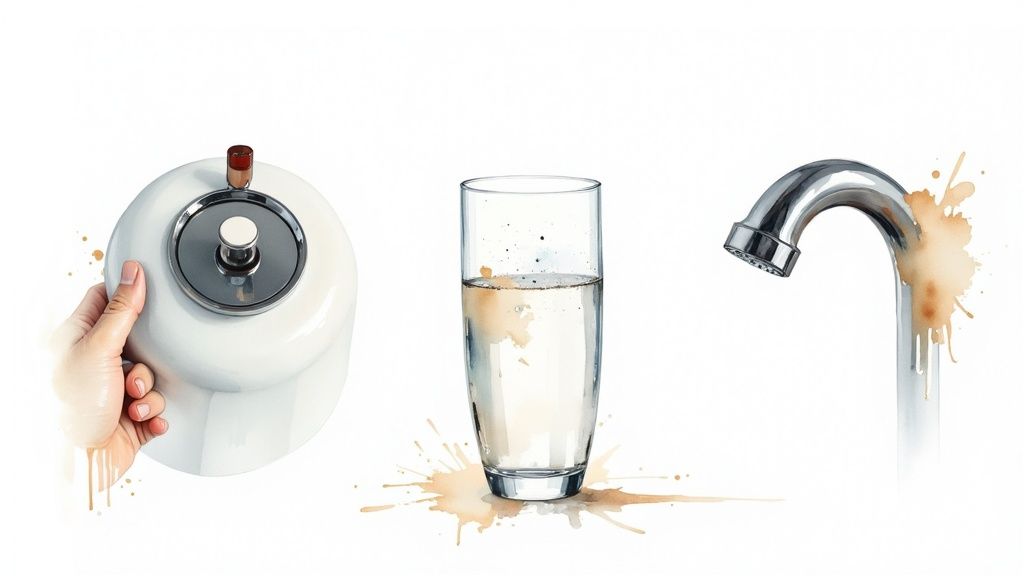
Knowing your water's TDS number is one thing, but understanding what it actually means for your daily life is what really matters. That single measurement can explain a lot—from why your coffee tastes "off" to why your dishwasher seems to be on its last legs. The value in understanding this is saving money and improving your quality of life.
The Unmistakable Taste of High TDS
Ever notice how tap water tastes completely different from one city to the next? You can thank the local TDS level for that. Here are some real-world examples of what you might taste:
- Salty or brackish: A practical example of this is in coastal areas where seawater can sometimes mix with freshwater supplies, increasing sodium chloride levels.
- Bitter or metallic: This can be a sign of high sulfates. For instance, water with high levels of iron or manganese can have a distinct metallic tang.
- Earthy or chalky: This is the classic taste of "hard water," rich in calcium and magnesium. It's why coffee brewed in one city can taste bold and rich, while in another, it tastes chalky and flat.
Actionable Insight: If your water tastes off, high TDS is a likely culprit. Filtering your water can restore a clean, neutral taste, significantly improving the flavor of coffee, tea, and cooked foods.
The Hidden Damage to Your Home and Appliances
This is where high TDS really starts to hit your wallet. The most significant impact is the costly, slow-moving damage it inflicts on your home, especially when the main culprits are hardness minerals like calcium and magnesium.
You’ve probably seen the evidence of this mineral buildup all over your home:
- Fixtures: That crusty white gunk around your faucets and showerheads is limescale. Practical Example: You might need to use harsh chemicals to clean it, and over time, it can permanently damage chrome finishes.
- Glassware: If your dishes and glasses have a cloudy film, that’s mineral residue. This forces you to re-wash dishes or use extra rinse aids, costing you time and money.
- Appliances: The most expensive damage happens where you can't see it. Limescale coats the heating elements in your water heater, coffee maker, and dishwasher, forcing them to work harder and use more energy. This leads to higher utility bills and premature appliance failure.
The financial toll is significant. TDS levels over 500 mg/L can cause so much scaling that it leads to major maintenance costs. For a deeper dive, the International Code Council explains Total Dissolved Solids in great technical detail. Simply put, ignoring high TDS is a direct threat to the investments in your home.
How to Test Your Water's TDS at Home
Ready to find out what's in your water? Measuring your Total Dissolved Solids is surprisingly straightforward. Here’s your actionable guide to getting a clear, accurate reading.
Using a Digital TDS Meter
The easiest way to get started is with a digital TDS meter. They're inexpensive and give you an instant snapshot of your water's dissolved solids. It works by measuring the water's electrical conductivity (EC).
Pure H₂O is a poor conductor of electricity. But when mineral salts dissolve in it, they allow a current to flow through. The meter sends a tiny electrical charge into the water, measures how well it conducts, and converts that into a TDS score in ppm. This method is so reliable it's used globally; the World Health Organization offers detailed guidelines on Total Dissolved Solids.
Here’s your simple, actionable plan for testing:
- Get a Sample: Grab a clean, dry glass and fill it with cold tap water.
- Turn on the Meter: Switch on your TDS meter.
- Dip and Test: Submerge the meter's probes about an inch into the water.
- Check the Reading: Gently swirl and wait for the number to stabilize. That's your TDS level. Practical Example: Test both your tap water and your filtered water to see the immediate difference your current filter is making (or not making).
Looking Beyond the Basic Number
A TDS meter is a fantastic starting point, but it tells you the quantity of dissolved stuff, not the quality. For that, you need to dig deeper.
Actionable Insight: Your local utility's annual water quality report (Consumer Confidence Report or CCR) is a valuable free resource. It details your municipal water source, including average TDS levels and tests for specific contaminants. If you live in Los Angeles, you can find this report on the LADWP website.
For the most precise picture, nothing beats professional water testing. A specialist sends a sample from your tap to a lab for a comprehensive analysis. This identifies the exact minerals and potential contaminants, giving you the complete story so you can solve the right problems.
Choosing The Right Solution To Reduce High TDS
So, you've discovered you have high TDS. The next question is, what can you do about it? Luckily, you have several great options. Your goal is to find the right tool for the job to maximize value.
Understanding these technologies is the first step. For anyone wanting to get a handle on high TDS, looking into reliable water purification methods that target dissolved solids is the best place to start.
Reverse Osmosis: The Gold Standard For Purity
When it comes to the biggest reduction in TDS, nothing beats Reverse Osmosis (RO). It's the gold standard for purity.
An RO system uses pressure to force water through a special membrane with pores so tiny that they block almost everything that isn't a pure water molecule. This process is remarkably effective, removing up to 98% of all dissolved solids.
- Practical Example: If your tap water has a TDS of 450 ppm (common in Southern California), an RO system can bring it down to around 20-30 ppm, providing incredibly clean and crisp-tasting water. It also removes other contaminants, as shown in our guide "does reverse osmosis remove fluoride?".
Actionable Insight: An RO system is usually installed under the kitchen sink. This "point-of-use" approach gives you pristine water for drinking and cooking without the cost of treating every gallon in your home, delivering maximum value where it matters most.
Water Softeners: A Specialist For Hardness
A common mix-up is that water softeners lower TDS. In reality, a water softener has one specific job: to remove "hardness" minerals, mainly calcium and magnesium.
It works through ion exchange, swapping hard mineral ions for soft sodium ions. This is fantastic for preventing limescale and protecting appliances, but it doesn't lower the TDS reading because it just trades one type of dissolved solid for another.
- Practical Example: If you install a water softener, your glassware will come out of the dishwasher sparkling and your showerhead will stay clog-free, but a TDS meter will show roughly the same reading as before.
This decision tree illustrates how to approach your water's TDS level.
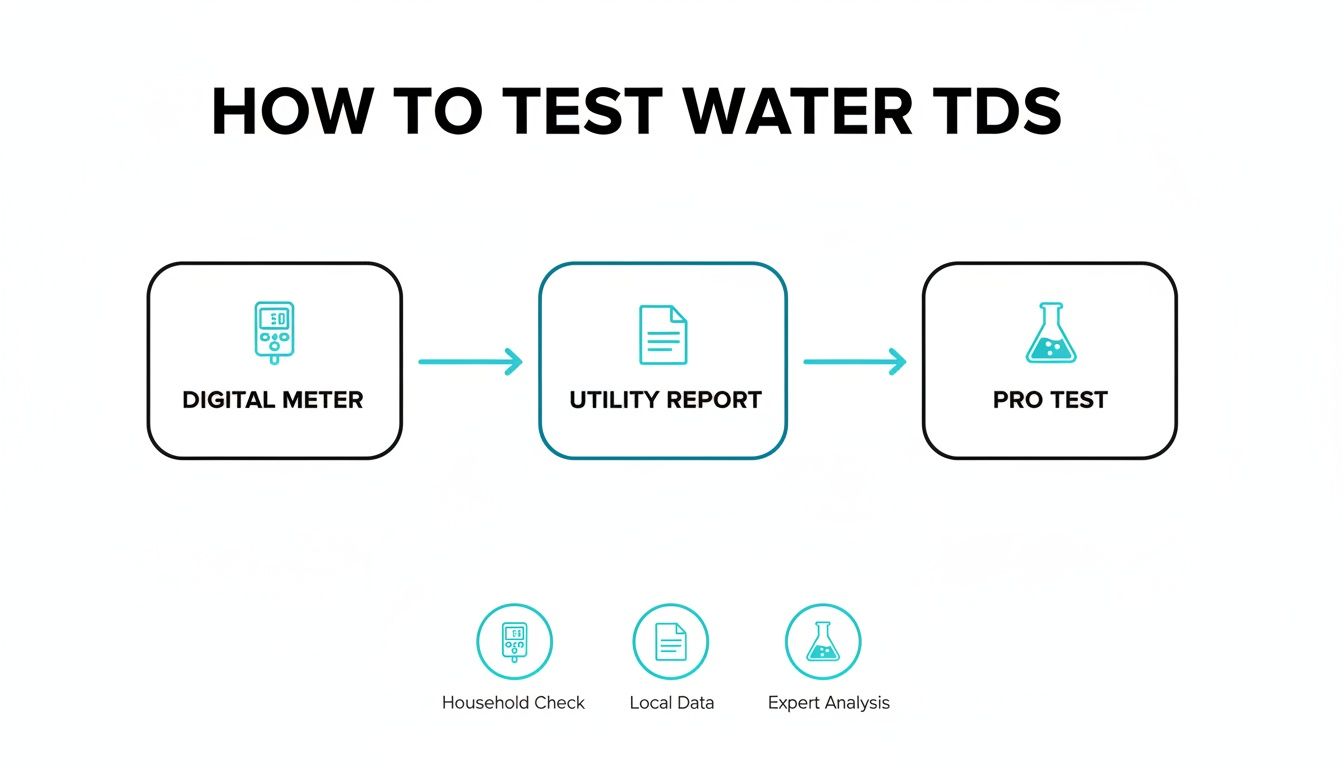
As the chart shows, you have options ranging from a quick DIY digital reading to a comprehensive professional analysis, depending on how detailed you need to be.
Distillation And Other Methods
Another highly effective method for reducing TDS is distillation. This process mimics nature's water cycle: water is boiled into steam, leaving impurities behind, and the pure steam is condensed back into liquid. While distillation produces incredibly pure water, it's generally slower and less energy-efficient than reverse osmosis, making it less common for typical household use.
To make things a bit clearer, here’s a quick comparison to help you choose the right solution.
Comparing TDS Reduction Methods
| Treatment Method | How It Works | TDS Reduction Rate | Best For (Actionable Insight) |
|---|---|---|---|
| Reverse Osmosis | Forces water through a semipermeable membrane, blocking dissolved solids. | Up to 98% | Getting the best-tasting drinking water and protecting appliances that use small amounts of water, like coffee makers. |
| Water Softener | Exchanges hardness minerals (calcium, magnesium) for sodium ions. | ~0% | Protecting your entire home's plumbing, water heater, and dishwasher from costly scale buildup. |
| Distillation | Boils water into steam, leaving impurities behind. | Up to 99%+ | Creating small batches of extremely pure water for medical or specific applications. |
| Activated Carbon | Adsorbs contaminants like chlorine to improve taste and odor. | Very Low | A simple, low-cost way to make water taste and smell better, but not for TDS reduction. |
Each technology excels in its own way. The key is identifying your primary concern to get the best value from your investment.
Your Action Plan for Better Water in Los Angeles
Let's pull all of this together into a clear, actionable plan. You now have a solid handle on what TDS is in water and why it matters. For those of us in Los Angeles dealing with notoriously hard water, the next steps are clear.
- Get a Baseline: Start with an inexpensive digital TDS meter to get your number.
- Understand the "Why": A TDS meter gives you a number, but not the story behind it. A professional analysis is the best way to understand exactly what’s in your water. This targeted knowledge ensures you invest in a system that solves your home's unique problems, not just a one-size-fits-all solution.
- Choose the Right Tool: If your goal is pure drinking water, a reverse osmosis system is your best bet. If you need to protect your entire home from scale, a whole-house water softener is the answer. For information on costs, our guide on reverse osmosis system installation cost is a good place to start.
Your Immediate Takeaway: Schedule a professional consultation. It's the most direct way to safeguard your appliances, improve your water's taste, and gain complete peace of mind. Taking this step shifts you from simply knowing a number to actively taking control of your water for good.
Got Questions About TDS? We've Got Answers.
To wrap things up, let's tackle a few of the most common questions we hear about Total Dissolved Solids. Getting straight answers will help you feel more confident about making the right choices.
Is Lower TDS Always Better?
Not necessarily. While a very low TDS reading points to purity, a TDS of zero isn't ideal for drinking. Water with almost no dissolved solids—like distilled water—is stripped of beneficial minerals like calcium and magnesium, which give water its crisp, refreshing taste. This "ultra-pure" water can taste flat and may even become slightly corrosive, potentially leaching metals from your home’s pipes. The goal is balance, not total elimination.
What Is the Ideal TDS Level for Drinking Water?
There’s definitely a sweet spot. Most people find that water with a TDS level between 50 and 150 ppm tastes best. It's clean and pure without strong mineral notes, but still has enough electrolytes to avoid tasting bland.
Actionable Tip: The EPA sets the recommended maximum TDS level at 500 ppm. If your reading is above this, you'll likely notice a distinct mineral taste and significant scale buildup. This is a clear signal to consider a treatment system.
Can a Standard Pitcher Filter Reduce TDS?
This is a common misconception. Most standard pitcher filters (like Brita or Pur) are not designed to lower TDS. They primarily use activated carbon. Activated carbon is great for adsorbing chlorine to improve taste and smell, but it doesn't touch the dissolved mineral salts that make up most of a TDS reading. If you want to significantly lower your TDS, you need a system like reverse osmosis.
Understanding TDS is the first step. Taking action is the next. If you're a Los Angeles resident tired of dealing with hard water, weird tastes, or appliances that die too soon, the experts at Praz Pure Water, Inc. are here to help. We can provide a professional assessment and find a solution that works for you.