
When you hear the term "water hardness," it's a simple way to describe the amount of dissolved minerals in your water—specifically calcium and magnesium. If you've ever pulled a glass from the dishwasher and noticed stubborn white spots, or seen a chalky film build up on your shower door, you’ve already seen hard water in action.
Understanding the Basics of Water Hardness
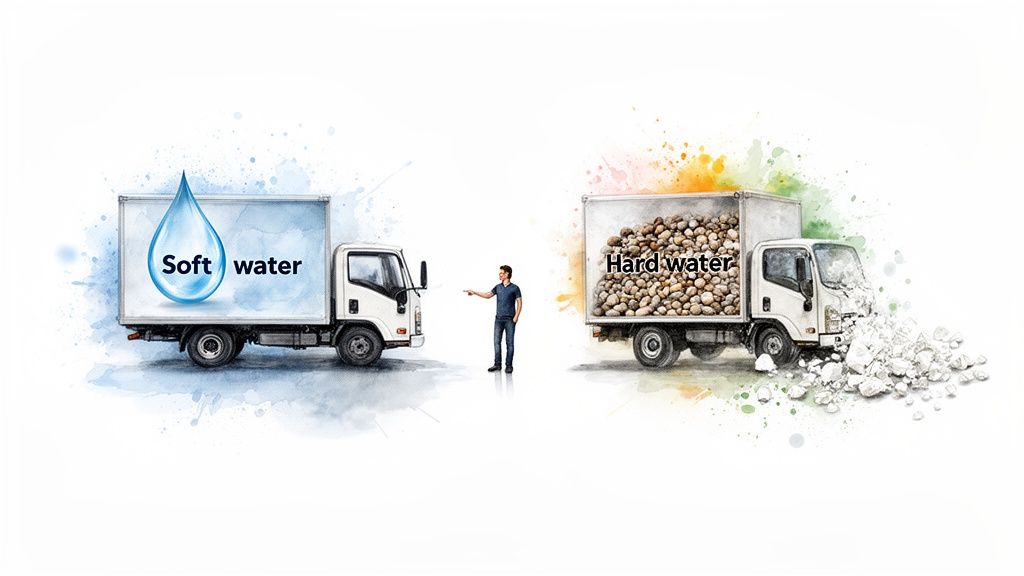
Imagine water making its way to your faucet. It starts as rain, which is naturally soft. But as it seeps into the ground and travels through layers of rock like limestone and chalk, it acts like a solvent, dissolving and carrying tiny mineral particles with it.
The more rock it passes through, the more calcium and magnesium it collects. This is a completely natural process, but the result is "hard" water, which can create a surprising number of headaches for your home’s plumbing, appliances, and even your morning shower.
How Water Hardness Is Measured
So, how do we put a number on this? Professionals use a couple of standard units to measure the mineral content in water. Understanding them is your first step to solving hard water problems.
- Grains Per Gallon (GPG): This is the most common measurement in the U.S. It’s pretty straightforward—one grain is equal to about 17.1 milligrams of dissolved minerals in a liter of water. Think of it like measuring sugar in your coffee; the more "grains," the higher the mineral concentration.
- Parts Per Million (PPM): You’ll also see this unit, which is basically the same as milligrams per liter (mg/L). It’s a more universal scientific measurement, but it tells the same story as GPG.
The tipping point for most homes is when water hardness hits 7 GPG or 120 PPM. At that level, your water is officially considered "hard," and you’ll start noticing the tell-tale signs. For more on how water quality varies worldwide, you can find great insights into global water quality.
Actionable Insight: Knowing your water's GPG or PPM number is the key to choosing the right solution. A higher number means a more robust system is needed to effectively soften your water and prevent damage.
Knowing these numbers helps you move from just suspecting you have a problem to actually diagnosing it.
Water Hardness Levels At a Glance
What do all these numbers mean in practical terms? Water is typically categorized on a spectrum from soft to very hard. This little chart is a handy reference for seeing where your water stands.
| Classification | Grains per Gallon (GPG) | Parts per Million (PPM) |
|---|---|---|
| Soft | Less than 1.0 | 0 – 17 |
| Slightly Hard | 1.0 – 3.5 | 17 – 60 |
| Moderately Hard | 3.5 – 7.0 | 60 – 120 |
| Hard | 7.0 – 10.5 | 120 – 180 |
| Very Hard | Over 10.5 | Over 180 |
Once you get your water tested, you can use this table to quickly pinpoint the severity of your situation and decide on the right course of action.
Why Los Angeles Water Is Among the Hardest in the Country
The hard water coming out of your faucet isn't a random fluke. It’s a direct consequence of Southern California's geography and the incredible journey your water takes to get to you. For anyone living in Los Angeles, understanding what makes our water hard means tracing it back to its source—often hundreds of miles away.
The vast majority of our water is imported from two massive sources: the Colorado River and Northern California. The long path from these sources is the primary reason our water supply is so packed with minerals.
Think of it this way: water is a natural solvent. As it travels across the land, it's constantly dissolving and picking up tiny bits of everything it touches.
The Long Journey and Its Mineral Baggage
Imagine a snowball rolling downhill. It starts small and pure, but as it travels, it gathers more layers. Our water does the same thing, but instead of snow, it collects minerals.
The water’s path from the Colorado River and the Sierra Nevada mountains crosses vast stretches of earth that are naturally rich in limestone and chalk. These rocks are loaded with calcium and magnesium, the two minerals that define water hardness.
As the water flows over and seeps through these geological formations, it dissolves these minerals and carries them along. By the time this water finally reaches your home in Southern California, it's accumulated a heavy mineral load. This is precisely why Los Angeles consistently ranks as having some of the hardest water in the U.S., with levels often hitting 10.5 GPG (Grains Per Gallon) or more, which is classified as "Very Hard".
It's important to know that hard water in Los Angeles isn't a sign of contamination or poor quality. It's simply the natural result of our water traveling through mineral-rich landscapes.
Because our water sources are naturally hard, this will always be a challenge for local homeowners and businesses unless the water is treated at the point of use.
Local Groundwater Makes It Even Harder
While imported water is the biggest piece of the puzzle, our local groundwater sources also contribute to the problem. The underground aquifers in the L.A. basin are surrounded by rock formations, so any water pumped from them is also naturally high in minerals.
Water agencies often blend this local groundwater with the imported supply, especially during periods of high demand. This practice can cause the exact hardness level to fluctuate throughout the year, but it keeps the overall trend pointing squarely toward mineral-heavy water.
- Colorado River Aqueduct: This water travels through hundreds of miles of mineral-dense desert landscapes.
- California Aqueduct: Water from the Sierra Nevada crosses many different geological regions on its long journey south.
- Local Groundwater: The water here naturally absorbs minerals from the subterranean rock of the L.A. Basin.
At the end of the day, every drop of water arriving at your home has finished an epic journey, picking up the very minerals that cause soap scum, appliance scale, and plumbing issues. Understanding this is the first step to managing it.
The Everyday Problems Caused by Hard Water
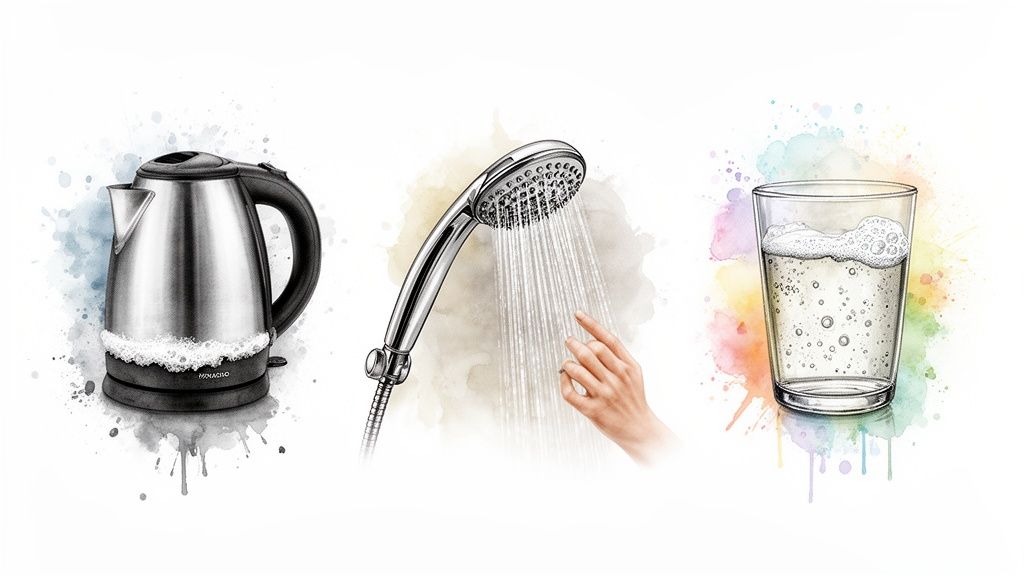
Hard water isn't just a chemistry term; it creates real, tangible problems that affect your home, your wallet, and your daily comfort. While you can't see the dissolved minerals, their effects become frustratingly obvious once you know what to look for. These aren't just minor annoyances, either—they cause costly damage that quietly builds up over time.
Damaged Appliances and Skyrocketing Energy Bills
The most expensive victims of hard water are your home's water-using appliances. The constant flow of mineral-heavy water leads to limescale, a crusty, chalk-like deposit of calcium and magnesium carbonate. This buildup is relentless and surprisingly destructive.
- Practical Example: Take your water heater. As scale builds on its heating element, it acts like insulation, forcing the unit to work harder to heat water. This inefficiency leads directly to higher energy bills and can slash a water heater's life from 12 years down to just 8. It also inflates energy costs by an average of 29%, costing a typical family around $148 extra per year.
This same damaging process hits other crucial appliances:
- Dishwashers: Limescale clogs the spray arms, coats heating elements, and leaves that permanent, cloudy film on your "clean" glasses.
- Washing Machines: Mineral buildup can wreck internal components and leave your laundry feeling stiff and scratchy, not to mention causing colors to fade faster.
- Coffee Makers and Kettles: Those tell-tale white flakes you see floating around are pure limescale. They don't just mess with the taste of your coffee; they can eventually clog and ruin the machine entirely.
Clogged Pipes and Poor Water Pressure
The damage doesn't stop with your appliances; it extends deep into your home’s plumbing. Just like scale builds up inside your water heater, it also forms a rock-hard layer on the interior walls of your pipes. Think of it like arteries slowly clogging over time.
This mineral accumulation gradually shrinks the pipe's internal diameter, restricting water flow. The most common symptom? A noticeable drop in water pressure.
- Practical Example: Your shower might start to feel weak, and faucets may only produce a trickle. Low-flow fixtures are especially vulnerable, as the small openings get clogged easily, forcing you to constantly clean or replace them.
Over many years, severe limescale buildup can lead to complete blockages, requiring expensive and disruptive plumbing repairs or even a full pipe replacement.
Effects on Your Skin, Hair, and Laundry
Hard water’s impact isn’t just mechanical; you can literally feel its effects. The calcium and magnesium ions react with soap to form a sticky curd—what we all know as soap scum.
This gunk does more than just leave a ring around your tub. It creates a film on your skin that can clog pores, leading to dryness, irritation, and even making conditions like eczema worse. That same film coats your hair, leaving it looking dull and feeling brittle.
- Practical Example: In the laundry, soap scum traps dirt in the fabric fibers, leaving clothes looking dingy and feeling rough. You'll find yourself using more and more detergent just to get a decent lather, but the results are never quite right. In commercial settings, this can create huge maintenance challenges, requiring specialized techniques for descaling commercial ice machines and other equipment.
How to Get a Clear Picture of Your Water Hardness
Guessing you have hard water because of a few spots on your dishes is one thing, but knowing for sure is another. To actually solve the problem, you need a clear picture of just how hard your water is. Thankfully, figuring this out is easy, with options ranging from simple home checks to precise professional analysis.
The Simple DIY Soap Test
This old-school method works because of the way soap reacts with minerals in hard water. It’s a great first step to see if your suspicions are on the right track.
- Find a clean, clear bottle with a cap. An empty plastic water bottle works perfectly.
- Fill it about one-third full with your tap water.
- Add 10-15 drops of a simple liquid soap—like castile soap, not a detergent.
- Shake it vigorously for about 15 seconds.
Now, take a look. If your water is soft, you'll see a healthy layer of sudsy foam on top of clear water. But if you have hard water, you’ll get very few bubbles and the water itself will look cloudy or milky. That cloudiness is soap scum forming right before your eyes.
Using Water Hardness Test Strips
For a more specific number, inexpensive water hardness test strips are your next best bet. You can find these kits online or at most home improvement stores.
You just dip a strip into a sample of your tap water for a few seconds, pull it out, and watch it change color. Then, you match that color to a chart that comes with the kit.
Actionable Insight: The chart gives you a reading in both Grains Per Gallon (GPG) and Parts Per Million (PPM). This number is the key piece of data you need to choose the right solution. For example, knowing you have 15 GPG of hardness allows a professional to recommend a softener correctly sized for your home's needs.
For Ultimate Accuracy: Professional Water Analysis
While test strips are great for a quick diagnosis, nothing beats the precision of a professional water analysis. This is the gold standard for understanding exactly what’s in your water. Many local water treatment specialists offer this service, sometimes for free as part of a consultation.
A professional test goes beyond just hardness. It can spot other potential issues like high chlorine levels, sediment, or other contaminants that might be affecting your water's taste and quality. The detailed report you get is invaluable for selecting one of the best water treatment systems that is correctly sized for your home, ensuring it works efficiently for years.
Finding The Right Solution For Your Hard Water Problem
Okay, so you've tested your water and know what you're up against. Now for the good part: picking the right solution. Dealing with hard water isn't about endlessly scrubbing away at limescale; it's about stopping the problem at its source before it ever gets into your pipes.
Getting a handle on how each system functions is the key to choosing the right one for your home and budget. The most common and direct approach is to get those troublesome minerals out of your water completely.
Ion-Exchange Water Softeners: The Gold Standard
When it comes to truly fixing hard water, the most powerful and trusted solution is a traditional ion-exchange water softener. Think of it as a bouncer at the door of your plumbing system, specifically for calcium and magnesium.
Here's how it works: hard water flows into a tank filled with tiny resin beads that are loaded with sodium ions. The calcium and magnesium ions are drawn to the resin beads like tiny magnets. The beads grab onto the hardness minerals and, in a simple swap, release the sodium ions into the water. This process physically removes the minerals that cause all that havoc, giving you genuinely soft water for your entire home.
This method is so effective because it doesn't just treat the symptoms—it eliminates the cause. To see how these systems fit into a home's plumbing, take a look at our complete guide on a whole house water softener system.
Comparing Water Treatment Technologies
While ion-exchange is the most common route, it's not the only game in town. Other technologies offer different advantages depending on your specific goals. Let's break down the main players.
This flowchart gives you a great visual for how to move from initial suspicion to a confirmed diagnosis of your water, which is the first step toward finding the right fix.
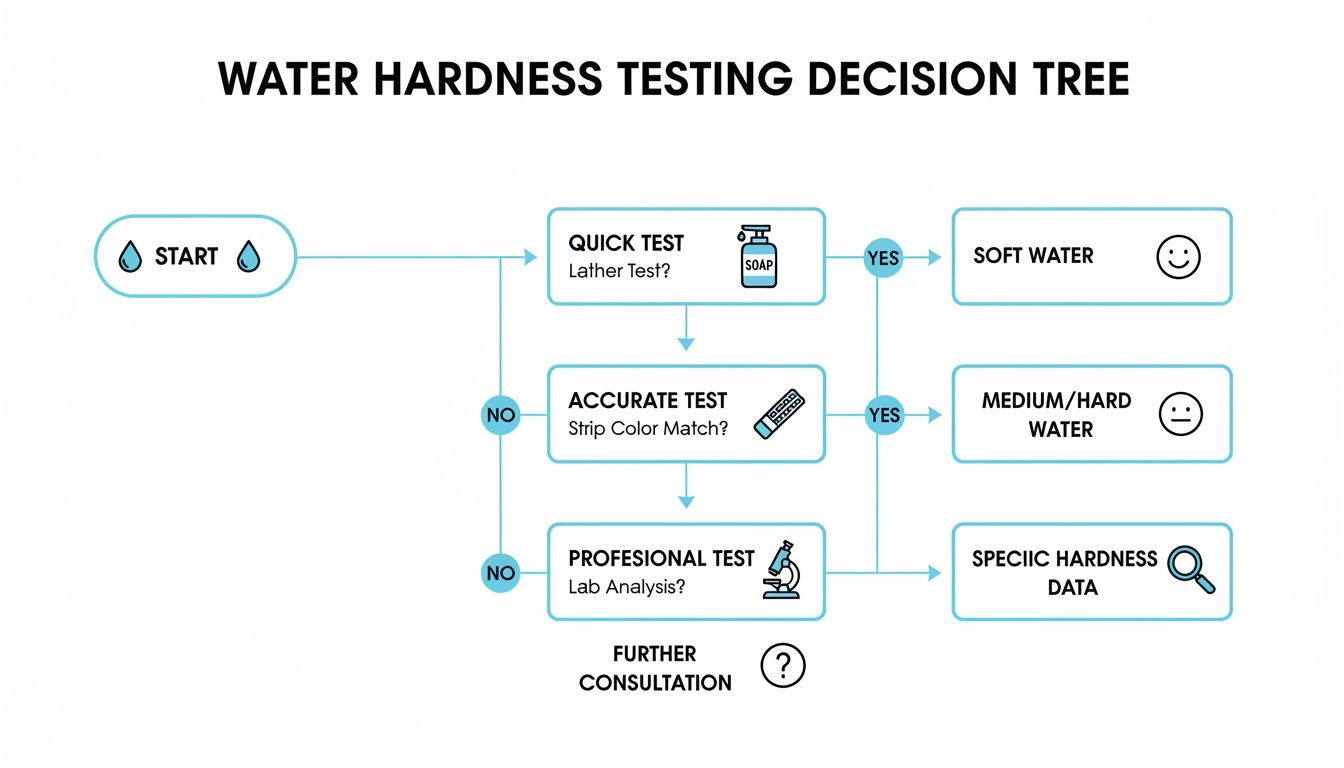
As you can see, the more precise your test, the better equipped you are to choose a system that truly matches your needs.
- Salt-Free Water Conditioners: These systems don’t actually remove the hardness minerals. Instead, they use technology to change the physical structure of the minerals, making them less "sticky" so they can't build up as scale. They’re a good option for scale prevention, but you won't get the other perks of soft water, like richer soap lather or that silky feeling on your skin.
- Reverse Osmosis (RO) Systems: An RO system is a purification powerhouse, but it's not designed to soften water for your whole house. It works by forcing water through an extremely fine membrane that filters out a huge list of contaminants—including hardness minerals, chlorine, lead, and much more. It’s perfect for the kitchen sink but not a practical solution for the shower, laundry, and dishwasher.
For homes and especially businesses battling very hard water, a hybrid approach is often the smartest strategy. Praz Pure Water excels at creating bundled systems that soften water down to 0.5 GPG and then pair that with an RO system for 99.9% contaminant removal at the tap. This combination has been proven to extend the life of equipment by 50% and saves Los Angeles businesses over $3,000 annually.
Actionable Insight: The best solution boils down to your main goal. If you want to eliminate scale everywhere and enjoy softer skin, an ion-exchange softener is your best bet. If your priority is the absolute purest drinking water, then a point-of-use RO system is the clear winner. For total protection, a combined system is ideal.
Making The Right Choice For Your Home
Trying to decide between these options? It all comes down to what you want to achieve. The table below lays out a simple comparison to help you see the differences at a glance.
Comparing Hard Water Treatment Solutions
This table compares the primary methods for treating hard water to help you choose the best option for your home or business.
| Treatment Method | Primary Function | Best For | Key Benefit |
|---|---|---|---|
| Ion-Exchange Water Softener | Removes calcium & magnesium minerals | Whole-home protection from scale | Solves all hard water issues (scale, soap scum, etc.) |
| Salt-Free Conditioner | Prevents minerals from forming scale | Protecting pipes & appliances | No salt or wastewater, but doesn't "soften" water |
| Reverse Osmosis (RO) System | Purifies water at a single point | Ultra-pure drinking & cooking water | Removes the widest range of contaminants |
Ultimately, choosing a major system like a water softener often means calling in a professional. Getting expert advice is critical, and knowing how to go about finding a reputable plumbing business can make all the difference. With your water test results in hand and a clear understanding of your options, you're in a great position to pick the system that’s a perfect fit for you.
Ready to Take Control of Your Home's Water?
We’ve covered everything from the dissolved minerals that define water hardness to the chalky residue they leave behind. You now know why Los Angeles water is notoriously hard, how to spot the signs, and your options for testing and treating it.
This knowledge is your starting point. The next step is turning that understanding into action to protect your home and make your daily life easier.
Finding the Right Solution for Your Home
The only way to truly end hard water headaches is with a system that matches your home’s specific needs. A one-size-fits-all filter from a big-box store might help a little, but it rarely solves the underlying problem for good.
That’s where a professional water assessment comes in. While a DIY test strip gives you a ballpark idea, an expert analysis is far more precise. It will pinpoint your exact water hardness level in Grains Per Gallon (GPG) and can also catch other common issues, like high chlorine levels that impact your water's taste and smell.
This detailed insight takes all the guesswork out of the equation. A specialist can recommend a system that’s properly sized for your household’s water consumption, making sure it runs efficiently for years to come.
The Bottom Line: You don't have to put up with the constant frustration of hard water. A professional, no-obligation consultation provides a clear, straightforward plan to get rid of limescale, save your appliances, and bring softer, better-tasting water to every tap. The value is clear: you'll save money on energy bills, extend the life of your appliances, and use fewer soaps and detergents.
Ready to feel the difference for yourself? The best way forward is to get a clear plan from an expert who knows local water. This is your chance to turn what you’ve learned into a real, lasting improvement for your home.
Schedule your complimentary consultation with a Praz Pure Water specialist today and get a personalized roadmap to finally solving your hard water problems for good.
A Few Common Questions About Water Hardness
Even after getting the facts, it's natural to have a few more questions. Let's tackle some of the most common things homeowners ask so you can move forward with confidence.
Is Hard Water Safe to Drink?
This is the big one, and the answer is a resounding yes. Hard water is completely safe to drink. The minerals that make it "hard"—calcium and magnesium—are actually essential nutrients your body needs.
The problem with hard water isn't about health; it's about the headache it causes for your home. It’s a mechanical and cosmetic nightmare, clogging plumbing, destroying appliances, and leaving skin and hair feeling dry. So while you can drink it without a second thought, you can't ignore the slow-motion damage it's doing everywhere else.
The World Health Organization (WHO) has confirmed there's no evidence linking hard water consumption to negative health effects. The real issues are with your home’s infrastructure, not your personal health.
Will a Water Softener Make My Water Salty?
This is probably the biggest myth out there. A modern water softener doesn't just dump salt into your water. It performs a clever swap. The system uses a bed of resin beads to grab the hard minerals (calcium and magnesium) out of your water, and in exchange, it releases a tiny, proportional amount of sodium.
- Practical Example: A glass of softened water that started at a hardness of 15 GPG has less sodium than a single slice of white bread. For the vast majority of people, this is a completely insignificant amount from a dietary standpoint.
If you are particularly sensitive to sodium or just curious, learning why water might taste salty with a water softener can offer some clarity. A salty taste is almost always a sign of a system malfunction, not how it's supposed to work.
How Much Does It Cost to Fix Hard Water?
Looking at a water softener as just another expense is missing the bigger picture. It's truly an investment—one that starts paying you back from day one by preventing much bigger costs. While the initial price tag varies, the savings are immediate and undeniable.
Here's the value you gain:
- Lower Energy Bills: Your water heater will run up to 29% more efficiently without scale buildup forcing it to work harder.
- Longer Appliance Life: Expect years of extra service from your dishwasher, washing machine, and water heater when they aren't being choked by mineral deposits.
- Reduced Soap and Detergent Use: With soft water, you'll use up to 50% less of everything from laundry detergent and dish soap to shampoo and body wash.
- No More Costly Plumbing Repairs: You can cross "emergency plumber visit for a scale-clogged pipe" off your list of future worries.
When you add it all up, a quality water treatment system doesn't just solve a problem. It actively puts money back in your pocket, year after year.
Ready to finally solve your hard water issues for good? The team at Praz Pure Water, Inc. has over 20 years of experience designing and installing the perfect water treatment solutions for Los Angeles homes and businesses. Schedule your complimentary consultation today!