
Figuring out where to install a water softener might seem like a puzzle, but it’s usually simpler than you think. The best spot is almost always right where the main water line comes into your house. This is typically in the garage, a basement, or a utility closet.
By placing it there, you ensure every drop of water gets treated before it can cause that chalky, damaging scale buildup in your pipes, showerheads, and appliances. This simple, upfront decision provides immense value by protecting your entire home.
Finding the Ideal Spot for Your Water Softener
Nailing down the perfect installation spot is the first, and honestly, most important step in tackling your hard water issues. The goal is to treat the water at its source, creating a shield for your entire plumbing system. This "point-of-entry" strategy is the gold standard for a reason—it works, delivering value to every faucet in your home.
Before you get too deep into placement specifics, it's helpful to get a feel for how different systems work. Taking a few minutes to read up on understanding water filtration systems can give you some great background knowledge.
This flowchart gives you a quick visual on how to think through the best location.
As you can see, it all comes back to one thing: finding that main water line to get whole-home protection.
Locating the Main Water Entry Point
The most effective method, used in the majority of residential installs, is to put the unit right at the main water inlet. This setup guarantees that 100% of the water is softened before it splits off to your water heater, dishwasher, and washing machine.
Keeping that mineral-heavy hard water away from your appliances is critical. For example, scale buildup can slash a water heater's efficiency by 10–30% and lead to costly, premature breakdowns. It's this preventative approach that protects your investments and is a big reason the water softener market was valued at around USD 3.3 billion recently.
Actionable Insight: The best place for a water softener is right after your home's main water shutoff valve but before the water line splits to feed appliances. This guarantees comprehensive treatment and maximum protection for your entire plumbing system, providing long-term value.
Why Your Installation Location Is So Important
Picking the right spot for your water softener isn't just a minor detail—it's the single most important decision you'll make in the fight against hard water. Here in Los Angeles, where water hardness often tops 10 grains per gallon, the placement of your system is what determines its success. Get it right, and you create a gatekeeper that stops damaging minerals before they ever get a chance to wreak havoc on your home.
This proactive approach is your best defense against the limescale buildup that quietly clogs pipes, murders the efficiency of your water heater, and leaves those frustratingly stubborn spots on every glass you own.
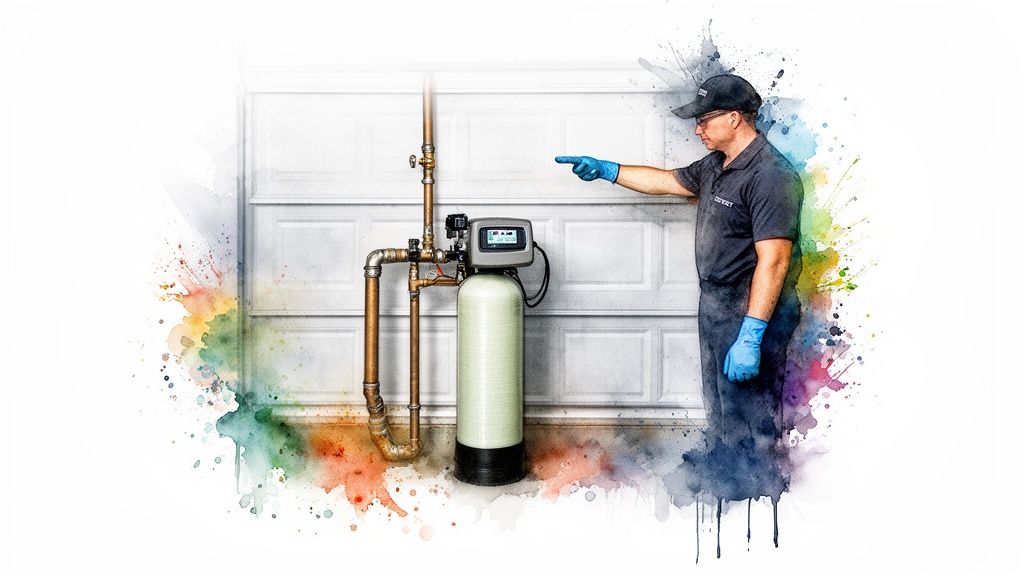
The goal is always a "point-of-entry" installation, meaning we treat the water right as it comes into your house. Think of it like a security checkpoint for your entire plumbing system—no hard water gets past the front door.
The Real-World Impact of Proper Placement
The benefits here aren't just on paper; they show up in your wallet and in how well your appliances run. A real-world example is a client in the San Fernando Valley who was shocked when their energy bills dropped noticeably just a month after we installed their new system right at the main service entrance.
Their water heater wasn't constantly fighting to heat water through a thick, insulating crust of mineral scale anymore. This is a perfect illustration of how one smart decision at the beginning pays you back for years to come.
Actionable Insight: By installing your softener where the main water line enters your property, you create a protective barrier for your entire home. This single action prevents scale from ever forming in your pipes and appliances, saving you money on energy and future repairs.
This whole-house strategy is driven by local conditions. In places like the Southwest, the Midwest, and right here in California, hardness levels regularly hit 180–300 mg/L (or 10–17 grains per gallon). These intense mineral counts are why whole-house installations are the standard; it's all about protecting plumbing and equipment from day one. This trend is a big reason North America made up about 39% of the global water softener market in recent years. You can dig into more data on the water softening systems market to see how regional needs really drive installation practices.
Maximizing Efficiency and Longevity
Getting the placement right doesn't just protect your home—it protects the softener itself. A system tucked away in a stable, dry, and accessible location like a garage or utility closet will simply run better and be easier for us to service. This ensures it performs at its peak and lasts as long as it should.
So, where do you install a water softener? The answer is clear and consistent: as close to the beginning of your plumbing system as possible. This strategic placement is the key to unlocking every benefit of soft water, from lower utility bills and sparkling dishes to appliances that last longer and skin that feels better. It’s the foundation for a hassle-free, hard-water-free home.
Your Pre-Installation Readiness Checklist
A smooth installation day starts long before our technicians arrive. Preparing the spot is the most important thing you can do to ensure your new water softener fits perfectly into your home's plumbing. It all comes down to three things: having enough space, a good power source, and a place for it to drain.
Thinking through these details ahead of time saves a world of headaches. For instance, a restaurant client in Downtown LA needed a commercial system tucked into a tiny utility closet. By walking through these points beforehand, they cleared out just enough room. We were in and out without disrupting their dinner service—a classic case of how a little prep work makes all the difference.
Sizing Up Your Space
First things first, let’s talk about physical space. Even though modern water softeners are more compact than ever, they still need a certain amount of elbow room to work safely and, just as importantly, to be serviced down the road.
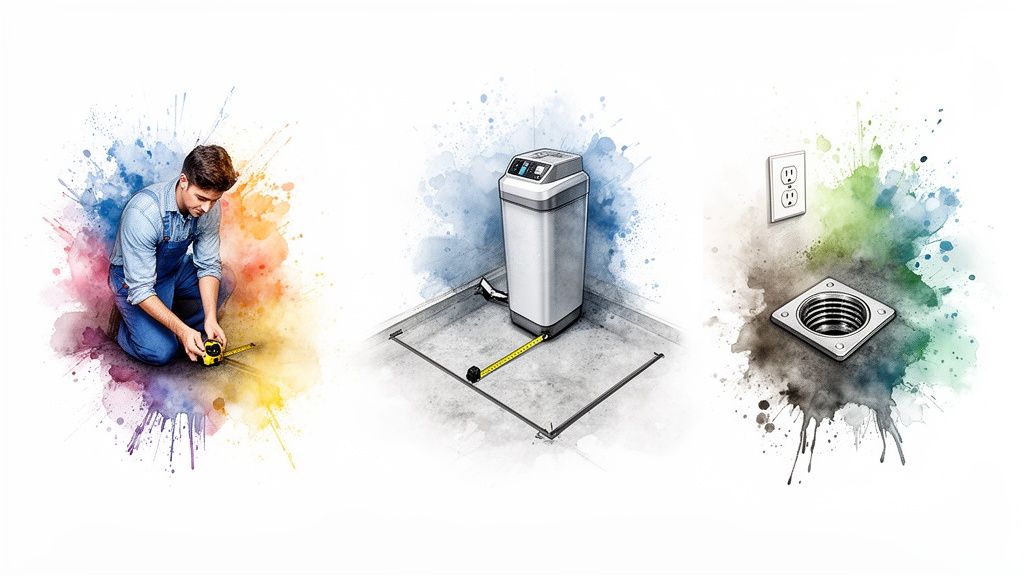
The "where" of an installation often comes down to these practical needs. We usually look for a hard, level floor space of about 2–4 square feet for a typical residential tank. You also need about 12–36 inches of clearance around it for our team to work. This, plus the need for a nearby drain, is why basements, garages, and utility rooms are the go-to spots. The vast majority of systems we install are salt-based—they hold a 58–68% share of the market because the ion-exchange process is simply the gold standard for tackling hard water. If you're curious about the industry, you can get more water softener trend insights from Data Bridge Market Research.
Actionable Tip: Grab some painter's tape and mark out a 2 ft x 2 ft square on the floor where you're thinking of putting the softener. This little trick gives you a real-world visual and immediately tells you if the spot feels too tight or if it's just right.
Power and Drainage Requirements
Beyond just fitting the unit in, your softener needs two critical lifelines to do its job: electricity and a drain.
The system's control valve and regeneration timer need a steady supply of power. All it takes is a standard 110V electrical outlet nearby—no special wiring needed. Just make sure it’s not hooked up to a light switch that someone could accidentally flip off.
Just as critical is access to a drain. When the softener cleans itself out—a process called regeneration—it has to flush away all those hard minerals it collected. This salty brine solution has to go somewhere.
- Ideal Drain Options: A floor drain, utility sink, or a laundry standpipe are all perfect.
- Drain Line Specifics: The drain line needs to be properly secured and must have an air gap. This is non-negotiable, as it prevents any chance of wastewater siphoning back into your clean water.
Here’s a quick-glance table to help you double-check everything before installation day.
Essential Pre-Installation Checklist
This table summarizes the critical requirements for a successful water softener installation, helping you prepare the ideal spot in your home or business.
| Requirement | Why It's Important | Actionable Guideline |
|---|---|---|
| Space & Clearance | Allows for proper operation, airflow, and essential future maintenance or salt refills. | Ensure 2-4 sq. ft. of level floor space with 12-36 inches of overhead/side clearance. |
| Power Source | The control valve and regeneration timer need constant electricity to function. | Locate a standard, non-switched 110V outlet within 6-10 feet of the unit. |
| Drain Access | The system must flush mineral buildup (brine) during its regeneration cycle. | Confirm a nearby floor drain, utility sink, or standpipe capable of handling the backwash flow. |
| Air Gap | Prevents contaminated drain water from siphoning back into your drinking water system. | This is a plumbing code requirement; your professional installer will ensure it's in place. |
Nailing down these three elements—space, power, and drainage—is the final step to ensuring a fast, clean, and efficient installation. If you're still weighing your options, our complete guide to a whole house water softener system breaks down everything you need to know.
Indoor vs. Outdoor Installations in Los Angeles
One of the first big questions we tackle with homeowners is where the softener should actually go. In Los Angeles, with our diverse home styles and lot sizes, the answer isn't always obvious. Should it be indoors or outdoors?
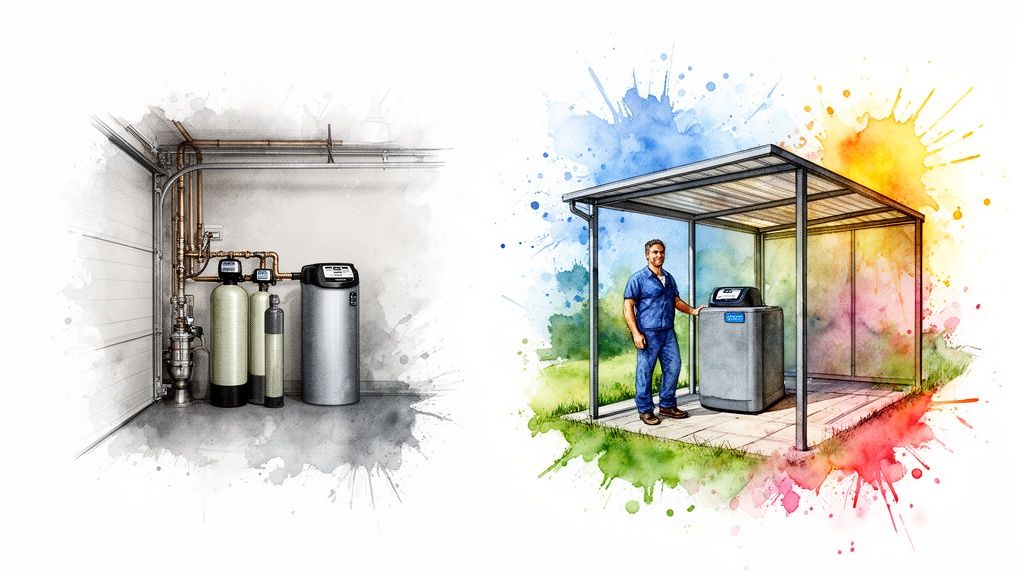
While the textbook-perfect spot is indoors—think a garage or utility room—where the system is completely shielded from the elements, we know that’s not a reality for every home. The good news is, an outdoor installation, when done right, works just as well.
The name of the game is protection. An indoor setup naturally keeps your softener safe from rain, dust, and especially that intense Southern California sun. But if you’re short on space inside, don’t worry. An outdoor spot is a fantastic alternative; we just need to take a few extra steps.
Making an Outdoor Installation Work
When we place a system outside, the biggest threats are direct sunlight and extreme heat. Just like you wouldn't leave your laptop baking in the sun all day, we can't let the softener's sensitive electronic control valve and resin tank get blasted by UV rays. Over time, that exposure can damage the components.
Fortunately, the fixes are straightforward. We just need to create some reliable shade and cover.
- Find Natural Shade: We always look for a spot on the side of the house that doesn't get much direct sun, like a north-facing wall.
- Leverage Existing Structures: A covered patio or even a deep roof eave often provides more than enough protection.
- Build a Simple Enclosure: If needed, a small, well-ventilated housing can be built around the unit to shield it from the elements. It doesn't have to be complicated.
Here’s a practical example: We recently helped a client in a compact Burbank home who was sure they didn't have room for a softener. We ended up installing the unit on their covered side patio. It’s completely protected from sun and rain, but still super easy for them to access for salt refills. It was the perfect solution that balanced protection and convenience.
Key Factors for the L.A. Climate
The Southern California climate definitely has its own set of rules. While we don’t have to worry about our pipes freezing like in other parts of the country, that relentless sun is no joke. Any outdoor installation absolutely must shield the unit from UV rays. This isn't just for performance; it's critical for ensuring the longevity of the system and keeping the warranty intact.
In the end, whether we go with an indoor or outdoor setup really comes down to your home's unique layout. A Praz Pure Water technician can walk your property with you and pinpoint the most practical, effective location.
Whether it’s tucked away in a garage or neatly installed on a shaded patio, we'll make sure your system is set up for peak performance for years to come. To see how we tailor our approach, check out our guide on getting a water softener in Los Angeles CA. We’ll find the perfect spot that works for you.
Installation Tips for Businesses and Apartments
When you’re dealing with a commercial property—be it a restaurant, an office, or an apartment complex—the strategy changes. The goal is to deliver consistently soft water to multiple places at once, from a restaurant's dishwasher to dozens of individual apartment showers. This kind of scale demands a more strategic game plan.
For our commercial and multi-family clients, a centralized installation is almost always the right move. We typically find the perfect spot in a dedicated mechanical room, a basement, or a service area right where the main water line enters the building. This not only keeps the equipment secure and out of the way but also makes maintenance simple and ensures every single tenant and customer gets the benefits of treated water.
Key Considerations for Multi-Unit and Commercial Spaces
In a commercial setting, a bypass valve isn't just nice-to-have; it's absolutely essential. This simple but critical piece of plumbing allows technicians to service or repair the water softener without shutting off the water to the entire building. Preventing disruptions to your tenants or business operations is a lifesaver.
It's also crucial to do your homework on building regulations. If you manage a condo or apartment complex, you need to get familiar with your homeowner's association guidelines. Digging into some general information on understanding HOA rules can give you a head start. These documents will spell out exactly where and how modifications like a water softener can be installed.
Here's a real-world example: We recently worked with a multi-family property in West LA. The building manager was tired of constant plumbing maintenance calls. We installed a single, high-capacity system in the basement utility room, complete with a bypass valve. Now, we can perform routine maintenance with zero disruption to the tenants. It's a win-win that provides clear value to both management and residents.
For businesses, especially in the food and beverage industry, the value is immediate and easy to see.
- Protecting Your Equipment: Hard water scale is the enemy of ice machines, coffee makers, and commercial dishwashers. Soft water stops that buildup, extending the life of your expensive equipment and cutting down on repair bills.
- Improving Your Results: Imagine spot-free dishes and glassware straight out of the wash, every time. Cleaning also becomes far more efficient because you'll use significantly less soap and detergent.
- Ensuring Operational Consistency: A centralized system delivers uniform water quality, which is vital for consistent taste in recipes and beverages.
At the end of the day, installing a water softener in a commercial or multi-unit property is all about protecting your investment and making sure your operations run smoothly. A professionally installed, centralized system is the key to getting it done right.
Why Professional Installation Is a Smart Investment
Going the DIY route on a water softener install can look tempting as a way to save money. But this isn't just about connecting a couple of pipes; it's a full-on plumbing project that demands a real understanding of water flow, local building codes, and how to properly calibrate these systems.
Choosing a professional installation from Praz Pure Water means you're getting it done right the first time. Our certified technicians are experts at integrating a vital appliance into your home’s plumbing network. We take care of everything, from finding the perfect spot that meets plumbing standards to making sure every detail complies with Los Angeles regulations.
Sidestepping Common DIY Disasters
A tiny mistake during a DIY attempt can snowball into a massive headache. We've seen slightly misaligned fittings turn into slow, silent leaks that cause thousands in water damage. An even more common error is an improper drain setup, which can create a cross-connection and allow wastewater to back up into your home's clean water supply.
Here are a few of the most frequent issues we're called in to fix after a DIY job goes wrong:
- Major drops in water pressure from using the wrong pipe size.
- Incorrect system calibration, which means the softener either wastes salt and water or doesn't actually soften your water.
- Voided manufacturer warranties because the installation didn't follow the required specifications.
Actionable Takeaway: Professional installation is an investment in your own peace of mind. Our expertise shields you from the frustration of leaks, pressure issues, or drainage nightmares. It ensures your system just works, day in and day out, for years to come, maximizing its value.
The Real Value of Certified Expertise
When a homeowner asks, "where do you install a water softener," the answer is about so much more than just picking a spot in the garage. It’s about the technical skill to execute the installation flawlessly. Our team doesn't just plug it in; we precisely calibrate the system to the specific hardness of your water, which is key to maximizing its efficiency and lifespan.
We make sure every single connection is leak-proof, every setting is dialed in perfectly, and every local code is met. This careful, professional approach is what protects your home, your investment, and your family's water quality, giving you the reliable performance you paid for.
Your Top Water Softener Placement Questions Answered
When you're ready to get a water softener, figuring out where it should go is one of the first hurdles. After thousands of installations across Los Angeles, we've heard just about every question. Let's tackle the most common ones we hear from homeowners and business managers.
Can a Water Softener Go Outside?
Absolutely. Here in Southern California, outdoor installations are incredibly common. The key is protecting the system from the elements.
Direct, relentless sun can damage the electronics and degrade the resin tank over time. We always recommend finding a spot that offers some cover—think a shaded side of the house, under a covered patio, or within a small enclosure to keep it safe.
Do I Need to Hire a Plumber and an Electrician?
Not when you work with a full-service team like Praz Pure Water. Our technicians are certified to handle the entire job.
We manage all the plumbing connections and the straightforward electrical hookup, which typically just needs a standard wall outlet. This saves you the hassle of trying to coordinate two different contractors and streamlines the whole process from start to finish.
How Close Does It Need to Be to My Main Water Shutoff?
This is a great question. The softener must be installed on the main water line after the shutoff valve but before the line splits off to your water heater or any other fixtures.
However, it doesn't have to be wedged right next to the valve. We can expertly run the necessary piping to place the unit in a more practical spot, like a corner of the garage or a utility closet, freeing up valuable space.
Actionable Tip: Never assume a tight spot near your water main is a dealbreaker. A seasoned installer can almost always find a smart, clean, and code-compliant way to route the pipes to a location that works better for you and your home's layout.
Will Softened Water Taste Salty?
This is one of the biggest myths we encounter. Properly installed and calibrated water softeners do not make your water taste salty.
The ion exchange process does add a tiny trace of sodium, but the amount is so small it's virtually undetectable. If you ever worry about a salty taste, it usually points to a setup or maintenance issue. Our guide on why water might taste salty with a water softener breaks down the real causes and how to fix them.
Ready to protect your home from hard water with a professional installation? The experts at Praz Pure Water can assess your property and find the perfect spot for your system. Visit https://prazpurewater.com to schedule your consultation today.