
White spots on a new faucet usually get blamed on “bad cleaning.” Then the dishwasher starts leaving film, soap won't rinse the way it should, and the water heater seems to work harder than it ought to. In Los Angeles, that pattern is familiar. Hard water shows up first as a nuisance and later as a maintenance problem.
A typical homeowner notices it in the bathroom. A property manager sees it in repeated fixture complaints. A restaurant owner notices it on glassware, ice equipment, and warewashing results. The symptoms look different, but the root issue is often the same. The water needs treatment planned around the building, not just a box dropped into the garage.
That's where a proper los angeles water softener installation matters. The right system can reduce scale and protect plumbing, but a softener alone isn't always the full answer. Some properties also need filtration for taste and odor. Others have drain limitations, HOA rules, or older plumbing that changes the installation plan completely.
The practical goal is simple. Treat the actual water problem, fit the equipment to the building, and install it in a way that's reliable long after day one.
Your Guide to Pure, Soft Water in Los Angeles
A Los Angeles homeowner might replace a kitchen faucet and expect it to stay polished. A few weeks later, there's already a chalky ring around the base and spotting on the finish. The first instinct is usually to clean harder. The better move is to ask what the water is leaving behind every time it dries.
In this market, hard water isn't a rare condition. Regional testing commonly places household hardness in the 127 to 276 ppm range, or about 7 to 16 grains per gallon, which falls in the hard to very hard category for treatment decisions, according to regional hardness guidance for Los Angeles. That's why scale, soap inefficiency, and appliance stress show up so often in homes and commercial spaces across the city.
What this means in daily use
Hard water affects more than the look of fixtures. It changes how soap lathers, how laundry feels, and how quickly mineral buildup forms inside equipment that heats water.
A few common examples:
- Single-family home: Shower glass spots quickly, shampoo feels harder to rinse, and a tank water heater starts collecting scale over time.
- Condo unit: Space is tight, the resident wants softer water, but the building may limit drain access or equipment placement.
- Restaurant or café: The priority may be protecting equipment first, while also improving water quality for drinking and food service.
Soft water planning works best when the property owner stops asking, “Which softener should I buy?” and starts asking, “What is this building actually asking the system to do?”
That shift matters. Some properties need a standard whole-home setup. Others need a compact unit, a paired filtration system, or a plan built around access and compliance constraints. A good installation solves the visible hard-water symptoms and the hidden ones inside the plumbing.
The Pre-Installation Assessment Your Blueprint for Perfect Water
Most softener problems start before installation day. They start when someone guesses.
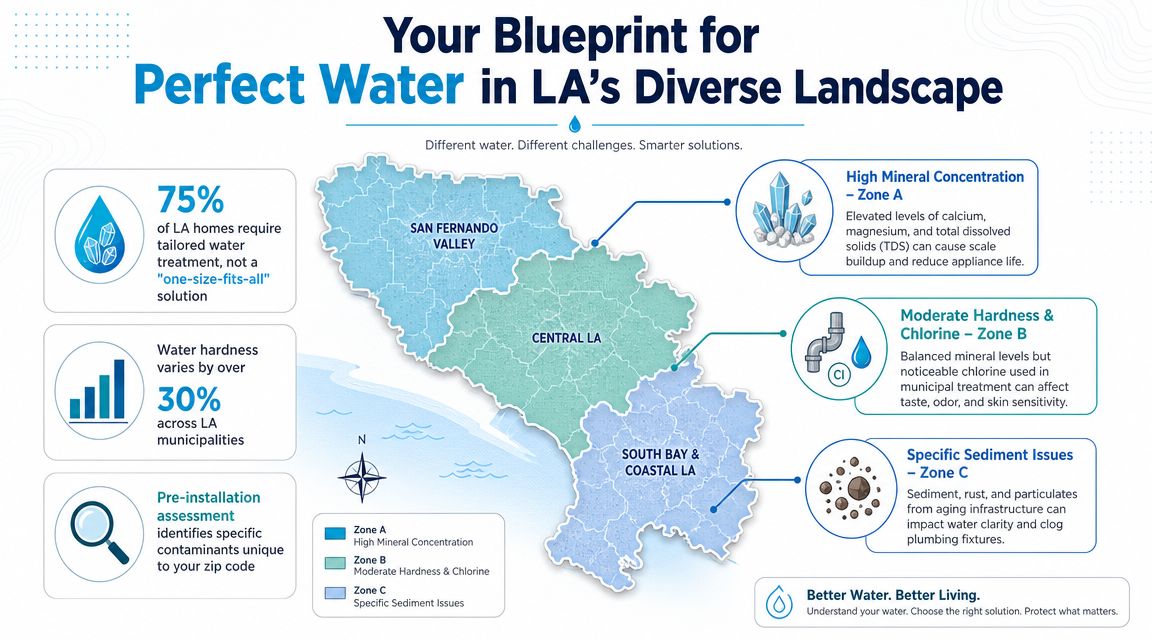
In Los Angeles, guessing is expensive because local properties vary so much. A small bungalow with one bathroom, a hillside home with older plumbing, and a mixed-use commercial unit can all have very different treatment needs even if they're only a few miles apart. The blueprint has to begin with testing and site review.
Start with measured water, not assumptions
A useful benchmark in the field is to size and operate a softener from measured raw-water hardness rather than assumed household averages, with installers commonly testing hardness and often iron before selecting resin capacity and controller settings, as outlined in this water softener installation sizing guide. That matters because under-sizing can increase regeneration frequency and salt use, while over-sizing can also reduce efficiency if the settings don't match the actual demand.
For the property owner, that translates into a few practical questions:
- How hard is the incoming water at this property?
- How much water does the building use during peak periods?
- Is there enough room, power access, and drain access for the right setup?
If those answers aren't clear, the recommendation is guesswork.
What grains per gallon means in real life
“Grains per gallon” sounds technical, but the effect is easy to understand. The higher the hardness, the more calcium and magnesium the system must remove before scale starts coating fixtures and equipment again.
For a homeowner, that might mean a correctly sized system can keep up with two showers, laundry, and kitchen use without constant regeneration. For a business, it can mean the difference between stable performance and a unit that is always chasing demand.
A simple example makes this clear. A family in a larger home may choose a smaller unit because the initial equipment price looks attractive. On paper, it fits the budget. In practice, it regenerates too often, uses more salt than expected, and never feels fully in step with the home's actual usage.
Practical rule: If a system is selected before the water is tested and the site is inspected, the proposal is incomplete.
The site matters as much as the water
Assessment isn't only about chemistry. It also looks at the install conditions that determine whether the job will perform well and remain serviceable.
Key items to check include:
- Main line location: The installer needs a practical tie-in point on the cold-water main.
- Drain path: Regeneration water has to discharge properly.
- Electrical access: Many systems need a nearby outlet.
- Service clearance: Salt loading, maintenance, and future repairs require working space.
- Pipe layout: Straight pipe length and fitting room affect how cleanly the bypass and valve assembly can be installed.
Field mistakes often happen when these details are ignored. Tight corners, poor drain planning, and inaccessible placement usually turn into leak risk, hard service calls, or poor owner experience later.
If you want a clearer overview of the symptoms before booking a site visit, this guide on how to get rid of hard water is a useful starting point.
What a solid assessment should produce
A proper pre-installation visit should end with a recommendation that matches the building, not a generic sales sheet.
That recommendation should identify:
| Assessment area | What it should clarify |
|---|---|
| Water condition | Whether hardness is the main issue or only part of it |
| Equipment size | Capacity matched to actual use patterns |
| Installation constraints | Drain, outlet, space, and plumbing access |
| System type | Single-tank, alternate treatment approach, or combined setup |
| Maintenance path | How the owner will refill, monitor, and service the unit |
That's the blueprint. Without it, the rest of the job is just improvisation.
Selecting the Right System Rental vs Purchase and Essential Add-Ons
A softener is often the foundation of the plan, but it isn't always the entire plan.
That's where many buyers in Los Angeles get steered wrong. They know they have hard water, so they shop for a softener only. Then they're disappointed when taste, odor, or drinking-water concerns remain. That isn't a system failure. It's a mismatch between the problem and the equipment.
What a softener does and does not do
A common misconception is that softeners solve all water problems. The CDC and EPA clarify that softening primarily removes hardness minerals such as calcium and magnesium, but it does not remove many health-related contaminants or fix taste and odor issues. For broader water quality goals, buyers often need a combined approach with softening for scale protection plus filtration or reverse osmosis for drinking water purity, as explained in this Los Angeles water treatment overview.
That distinction matters a lot in real properties:
- Homeowner case: The family wants softer water for showers and less scale on fixtures, but they also want better-tasting drinking water. That often points to a whole-home softener plus a separate drinking-water system.
- Restaurant case: The kitchen needs scale control to protect equipment, while front-of-house service may need purified water for beverages and better glassware results.
- Office case: Staff may care less about softened shower water and more about clean-tasting bottleless drinking water.
Buy, rent, or bundle
The decision often comes down to ownership style. Some clients want to own the equipment and manage the asset long term. Others prefer predictable service with less hands-on responsibility. A bundle makes sense when the property clearly needs more than hardness control.
| Consideration | Buying | Renting | Bundle Package |
|---|---|---|---|
| Upfront commitment | Higher initial investment | Lower upfront barrier | Depends on included equipment |
| Maintenance responsibility | Usually owner-managed or service-plan based | Often simpler for the occupant | Shared across the selected systems and service plan |
| Best fit | Long-term owners who want asset control | Properties prioritizing convenience and flexibility | Homes and businesses with both hardness and drinking-water goals |
| Upgrade path | Owner chooses timing | Easier to adjust within service terms | Useful when softening alone won't solve the full problem |
A property owner comparing vendors should evaluate installation quality, licensing, scope clarity, and service terms the same way they would review expert tips for hiring a builder. The principle is the same. The equipment matters, but the planning and workmanship matter just as much.
Add-ons that make sense in Los Angeles
The best add-on is the one tied to a specific goal.
Common pairings include:
- Reverse osmosis for drinking water: Useful when the owner wants a dedicated purified tap for cooking and drinking.
- Carbon filtration: A practical option when taste and odor are part of the complaint.
- Combination treatment: Appropriate when the property needs both scale reduction and better point-of-use drinking quality.
One practical option in this category is a whole-house water softener system, which can serve as the base layer for scale control before adding drinking-water treatment where needed.
Don't treat “soft water” and “better water” as identical goals. Sometimes they overlap. Often they don't.
For condos, rentals, and businesses, that distinction prevents overbuying in one area and under-solving another.
Navigating LA Permits and Installation Logistics
Los Angeles installation problems are often building problems in disguise.
The equipment may be correct, but the property itself presents the challenge. Older homes may have awkward main-line access. Condos may require HOA approval before plumbing changes. Multi-unit sites may have drain limitations, limited service space, or rules about visible equipment placement. Those constraints shape the installation from the start.
The building type changes the plan
A single-family home with garage access usually gives the installer more room to work. A condo utility closet doesn't. An older home may have a workable location, but the pipe routing may be less straightforward than expected.
A few common Los Angeles scenarios:
- Condo or HOA property: Approval may be required before installation, especially if plumbing changes affect common-area rules or visible building elements.
- Older home: Pipe condition, placement, and limited access often influence where the equipment can realistically go.
- Apartment or managed building: Owners and managers may need a treatment solution that fits maintenance schedules and avoids service disruption.
Independent guidance on Los Angeles systems highlights exactly these issues, including drain access, HOA rules, and space constraints. It also notes that in California, installers generally need a CSLB license when labor-plus-materials reaches $1,000 or more, which adds a compliance layer many consumer pages barely mention, as covered in this Los Angeles softener planning article.
Questions that should be answered before work starts
A serious installer should resolve logistics before the installation date, not after arriving on site.
Use this short checklist:
- Where will the system physically sit? There must be enough room for service access.
- Where will regeneration water discharge? Drain planning is not optional.
- Is there power nearby if the selected unit requires it?
- Does the property need landlord or HOA approval first?
- Will the plumbing modifications trigger permit or licensing requirements?
If any of those answers are vague, the project isn't ready.
Why local experience matters here
Los Angeles is full of awkward mechanical spaces, retrofitted utility areas, and buildings with rules layered on top of plumbing reality. A strong installer solves for the whole site, not just the treatment target.
That same local practicality is why contractors in service trades invest in visibility and trust-building through channels like strategies for contractor local SEO. Property owners search for local specialists because building-specific experience often determines whether the project goes smoothly.
The right install location is the one that treats the water well, meets access needs, and won't become a service headache later.
For many properties, logistics decide the right system as much as water quality does.
Installation Day What to Expect When We Arrive
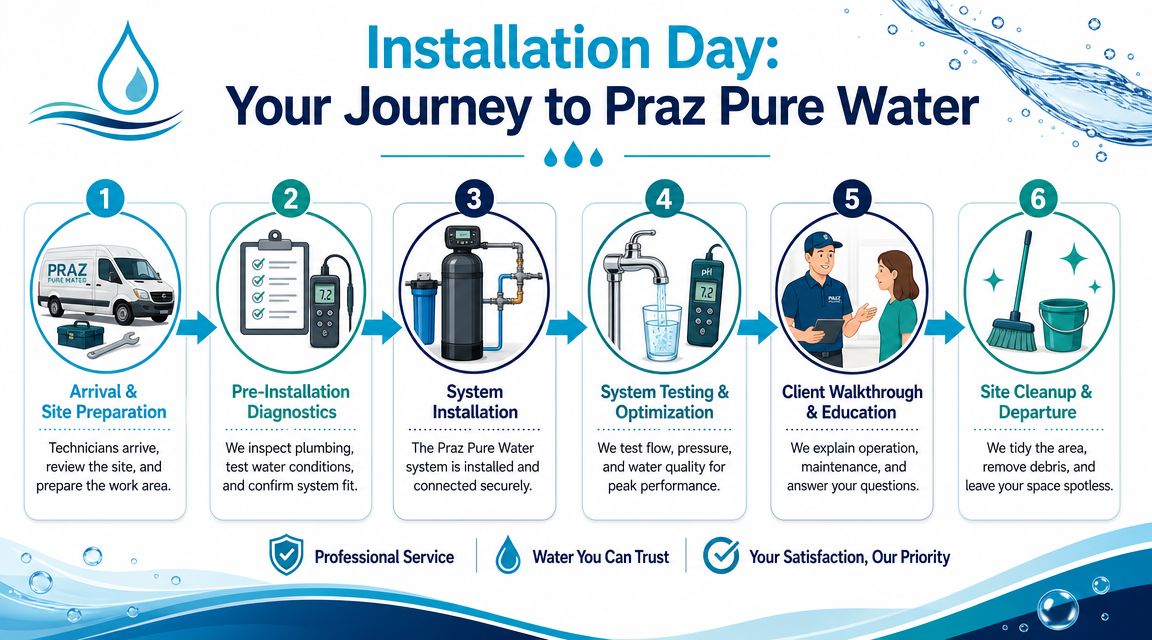
Installation day should feel organized, not chaotic. The homeowner or property manager should know where the unit is going, what water interruption to expect, and what gets tested before the crew leaves.
That's especially important with los angeles water softener installation because a clean install depends on sequencing. If the installer rushes repressurization, skips bypass planning, or treats drain routing as an afterthought, problems tend to show up early.
A visual overview helps before the work starts.
The sequence that protects the system
For a whole-house softener, the technically correct placement is on the cold-water main immediately after the service entrance and before the water heater, so both hot and cold branches are treated while outdoor hose bibs can remain untreated if desired. Installation should include a bypass valve, drain line, and an air gap or equivalent indirect discharge, and a practical commissioning sequence is to shut off the main, depressurize the lowest faucet, cut the cold line, plumb in the bypass, verify the drain path, then slowly repressurize and flush air before putting the unit online, according to this softener installation sequence guide.
That methodical order prevents the kind of issues that frustrate owners right away:
- Water hammer from rapid repressurization
- Leaks at poorly planned fittings or stressed joints
- Poor initial performance from trapped air or improper startup conditions
What the visit usually looks like
From the customer side, the day should unfold in a simple, predictable way.
Arrival and walkthrough
The crew confirms the install location, access path, and any property concerns before tools come out.Water shutoff and depressurization
The main is shut off and the plumbing is safely relieved before the line is opened.Main line connection and bypass installation
The unit is tied into the cold-water main, and the bypass is installed so the system can be isolated later for service.Drain and brine connections
The installer confirms the discharge route and connects the drain and overflow lines correctly.Slow repressurization and startup
Water returns gradually, air is flushed, and the system is brought online in a controlled way.
A lot of owners like to see the process before scheduling. This video gives a useful visual reference:
What a careful installer pays attention to
The best installation details are often invisible once the job is done.
That includes:
- Clean pipe routing: Enough room for fittings, service access, and future maintenance
- Correct bypass orientation: So the owner can isolate the unit without confusion
- Proper drain setup: Including the required air gap or equivalent indirect discharge practice
- Orderly startup: So the system doesn't begin its life under avoidable stress
A good install looks simple because the difficult decisions were handled before the water was turned back on.
By the end of the visit, the owner should know how the bypass works, where the salt goes if applicable, and what normal operation looks like.
Understanding Costs Financing and Long-Term Value
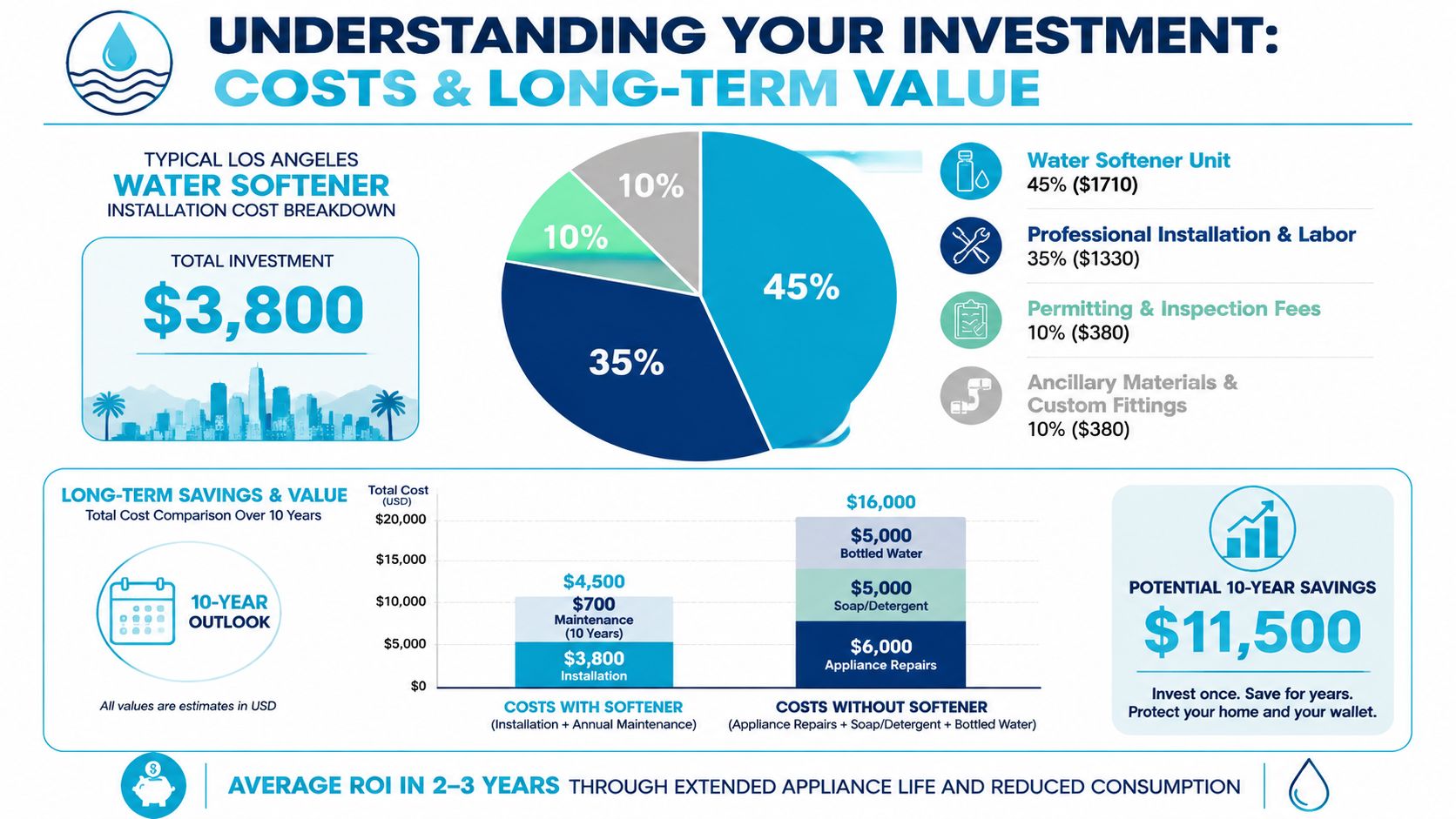
Water softener pricing in Los Angeles is broad because the projects are broad. A simple replacement in an accessible location doesn't cost the same as a first-time whole-property installation with plumbing modifications and added treatment stages.
That's why generic price lists usually mislead people. They flatten projects that are nothing alike.
What the local cost range actually tells you
Angi's Los Angeles cost data shows an average installation cost of $1,704, with a low end of $170 and a high end of $12,496, reflecting major differences in system type, plumbing complexity, and property size, according to this Los Angeles installation cost overview. The main lesson isn't the average. It's the spread. This is not a one-price purchase.
Three jobs can all be called “water softener installation” and still be priced very differently because of:
- Equipment capacity
- Property size and layout
- Existing plumbing access
- Whether filtration or drinking-water systems are added
- How much custom integration the site requires
What makes one quote higher than another
A higher quote isn't automatically overpriced. It may reflect a more demanding site or a more complete treatment plan.
Examples:
| Cost driver | Why it changes pricing |
|---|---|
| System type | Basic softening and multi-stage treatment are different scopes |
| Plumbing complexity | Longer runs, tighter access, and modifications add labor |
| Site conditions | Drain work, outlet needs, and limited space affect installation time |
| Combined solutions | Adding reverse osmosis or filtration increases material and setup scope |
For buyers comparing options, this is where ownership strategy matters too. Some will prefer to finance a purchased system. Others will want a rental structure that shifts maintenance and replacement responsibilities into a simpler monthly arrangement. If drinking-water treatment is also part of the plan, reviewing a related guide on reverse osmosis system installation cost can help frame the added scope.
Long-term value is mostly about avoided problems
The strongest value case usually isn't a dramatic monthly savings claim. It's the reduction of recurring wear and nuisance.
A properly planned system can help with:
- Less visible scale buildup on fixtures and glass
- Better equipment protection for water heaters, dishwashers, and similar appliances
- Less frustration with soap performance
- Fewer hard-water cleaning chores
This is a key budgeting lens. Don't ask only what the install costs. Ask what repeated hard-water wear is already costing the property in maintenance, cleaning effort, and equipment stress.
Your Checklist for a Praz Pure Water Project
A good water treatment project moves faster when the owner is prepared. Most delays come from unclear goals, unanswered site questions, or waiting until installation day to think about access and logistics.
Use this checklist if you're planning a softener project for a house, condo, office, restaurant, or managed property.
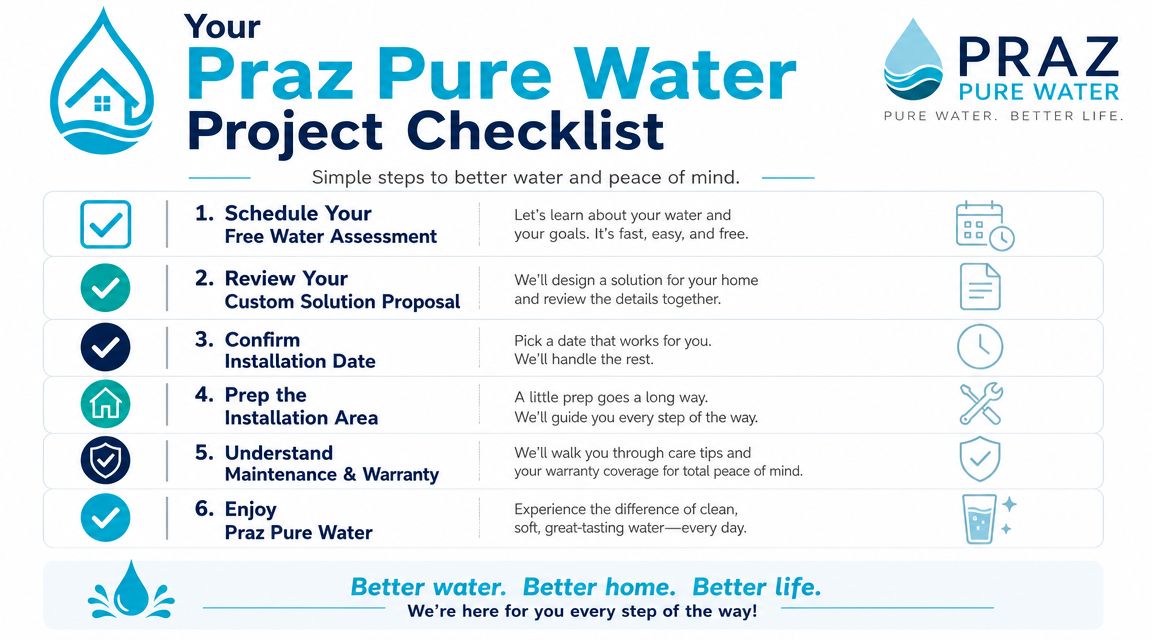
Step through the project in the right order
- Identify the symptoms first: Look for scale on fixtures, cloudy dishware, stiff laundry, soap that seems ineffective, or repeated equipment maintenance tied to mineral buildup.
- Define your goal: Some owners want softer whole-house water. Others also want cleaner-tasting drinking water or better protection for business equipment.
- Check the property constraints: Confirm where the unit could go, whether a drain is nearby, and whether an HOA, landlord, or property manager must approve the work.
- Get the water tested: System sizing should be based on actual water conditions and site realities, not a generic citywide assumption.
- Review the proposal carefully: Make sure the recommended equipment matches the property's usage, access limitations, and maintenance expectations.
Questions worth asking during consultation
Not every owner asks the same questions, and that's fine. The key is to ask the ones that affect long-term fit.
A few good ones:
- Will this system solve only hardness, or also taste and odor concerns?
- How much room will be needed for service and maintenance?
- What happens if the building has limited drain access?
- What does normal upkeep look like for this setup?
- Is buying or renting the better fit for this property and ownership timeline?
If the proposal sounds simple but your building is not simple, keep asking questions.
How to prepare for installation
Once the system is selected, a little preparation makes installation smoother.
| Preparation item | Why it helps |
|---|---|
| Clear the work area | Gives the crew safe and efficient access |
| Confirm access windows | Important for condos, offices, and managed sites |
| Notify building contacts | Helpful if HOA, tenants, or staff need advance notice |
| Ask about shutoff timing | Lets you plan around temporary water interruption |
What support should look like after the install
The project isn't finished just because the water is back on. Owners should know how to use the bypass, what maintenance looks like, and when to call for service.
That's especially important for commercial sites and multifamily properties, where the treatment system becomes part of daily operations rather than a one-time purchase. Clear support, warranty information, and scheduled checkups matter because soft water systems perform best when they're monitored and maintained as part of the building's regular care.
If you're ready to move forward, the cleanest next step is to schedule a site-specific review and get a recommendation based on your water, your building, and your goals.
If you want a customized plan for a home, condo, office, restaurant, or managed property, Praz Pure Water, Inc. can help you assess the site, identify whether softening alone is enough, and map out a practical installation path for Los Angeles conditions.